
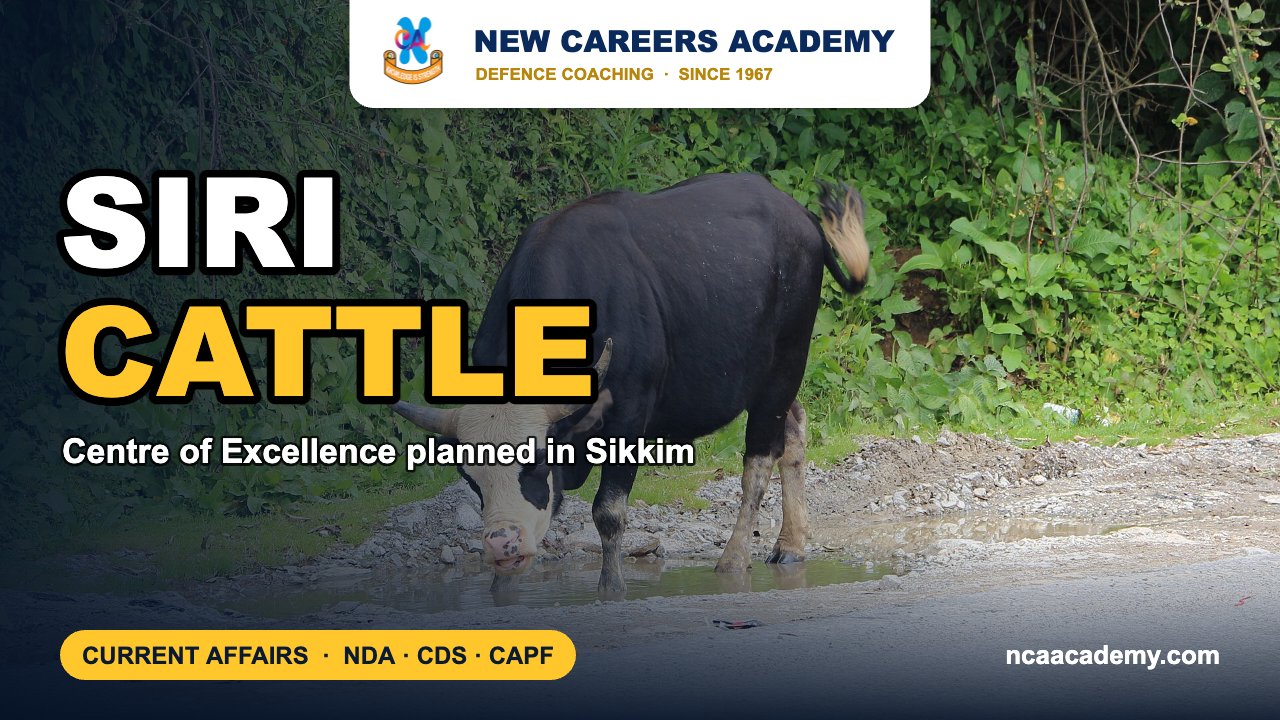
Quick answer: Siri is a small indigenous zebu cattle breed of the Eastern Himalaya, found in Sikkim and the Darjeeling hills, and listed as vulnerable in the 2022 breed watchlist. During a visit to Sikkim on 2-3 November 2026, Union Minister Rajiv Ranjan Singh (Lalan Singh) said the Centre will set up a Centre of Excellence for Siri conservation in the state, as per a PIB release of 2 November 2026.
Why Siri cattle are in the news
The Union Minister of Fisheries, Animal Husbandry and Dairying reviewed the work of the Department of Animal Husbandry and Dairying (DAHD) in Sikkim over two days. According to the Press Information Bureau, three Siri-specific steps came out of the visit:
- He digitally launched a Siri Cattle Conservation Programme to protect the breed’s genetic resources and promote scientific breeding.
- He digitally laid the foundation stone of a Siri Bull Mother Farm at Chuchachen in Pakyong district, meant to multiply quality germplasm of the breed.
- He announced a Centre of Excellence for Siri conservation and development in Sikkim, and asked officials to prepare an Action Plan and a Work Plan for using In Vitro Fertilisation (IVF) to speed up genetic improvement.
The visit also saw the digital launch of the North District Cooperative Milk Producers’ Union at Mangan under White Revolution 2.0, and the release of standard protocols for artificial insemination in pigs. The minister asked the National Dairy Development Board to plan an integrated “Sikkim Milk” brand.
Key facts about Siri cattle
- Type: a small-sized zebu breed of the North Eastern Hill region.
- Home tract: Sikkim and the Darjeeling district of West Bengal; the breed is said to originate in Bhutan, where it is called “Nublang”.
- Unique hump: it is described as the only Indian cattle breed with a cervico-thoracic hump (placed between neck and chest), covered with a tuft of long coarse hair.
- Colour: coat is black or brown, broken by white patches; some animals are solid black or solid brown.
- Status: vulnerable under the 2022 Breed Watchlist of ICAR-National Bureau of Animal Genetic Resources.
- Main threat: numbers are falling because of crossbreeding with Jersey cattle.
Production profile
| Trait | Reported range |
|---|---|
| Daily milk yield | 2 to 6 kg |
| Milk fat | 2.8 to 5.5 per cent |
| Lactation length | about 7 to 9 months |
| Calving interval | 420 to 490 days |
| Herd size | 10-30 in East Sikkim; 1-3 in West Sikkim |
Siri animals graze on steep forest slopes and are housed in small open sheds on hillsides, which suits the terrain of Sikkim.
Conservation work already under way
Sikkim has run Siri conservation under the Rashtriya Gokul Mission, which DAHD launched in December 2014 to develop and conserve indigenous breeds. The Sikkim Livestock Development Board, an autonomous body under the state’s Animal Husbandry and Veterinary Services Department, implements it. Four Intensive Siri Cattle Breeding Areas have been notified at Kabi (Mangan district), Regu (Pakyong), Pokhri (Gyalshing) and Ralong (Namchi). In these areas only Siri frozen semen and Siri bulls are used for breeding.
In April 2026 a Sikkim delegation led by state Animal Husbandry Minister Puran Kumar Gurung met the Union Minister in New Delhi and proposed “Mission Siri”, to be carried out by the Sikkim Livestock Development Board under the Rashtriya Gokul Mission. The November announcements build on that request.
Exam angle: how NDA, CDS and CAPF can ask this
- Indigenous cattle breeds and their home states (Gir, Sahiwal, Red Sindhi, Tharparkar, Siri) are a regular static GK area in CDS and CAPF general studies.
- Schemes such as the Rashtriya Gokul Mission and White Revolution 2.0 can appear in questions on agriculture and rural economy.
- Geography of Sikkim and its districts links with questions on the north-eastern states.
Practice MCQs
Q1. Siri cattle are native mainly to:
(a) Sikkim and Darjeeling hills (b) Kutch (c) Punjab plains (d) Malnad region
Answer: (a) Its home tract is Sikkim and Darjeeling district.
Q2. Which feature makes Siri unusual among Indian cattle?
(a) No hump (b) Cervico-thoracic hump (c) Lyre-shaped horns (d) Red coat
Answer: (b) It is described as the only Indian breed with a cervico-thoracic hump.
Q3. The Siri Bull Mother Farm announced in November 2026 will come up at:
(a) Mangan (b) Chuchachen, Pakyong (c) Ravangla (d) Namchi
Answer: (b) Its foundation stone was laid digitally for Chuchachen.
Q4. Rashtriya Gokul Mission was launched in:
(a) 2010 (b) 2012 (c) 2014 (d) 2019
Answer: (c) DAHD started it in December 2014.
Frequently asked questions
What is Siri cattle?
Siri is a small indigenous zebu breed of the Eastern Himalaya, reared in Sikkim and in Darjeeling district of West Bengal.
What was announced for Siri cattle in November 2026?
A Centre of Excellence for Siri conservation in Sikkim was announced, along with the launch of a Siri Cattle Conservation Programme and a Siri Bull Mother Farm at Chuchachen.
Why does the breed need conservation?
It is listed as vulnerable in the 2022 breed watchlist, and its numbers are falling largely due to crossbreeding with Jersey cattle.
What is Siri called in Bhutan?
In Bhutan, where the breed is said to originate, it is known as “Nublang”.
Which scheme funds Siri conservation in Sikkim?
The Rashtriya Gokul Mission, implemented in the state by the Sikkim Livestock Development Board.
Also read on NCA: National Programme for Dairy Development | National Cooperative Development Corporation | Monthly defence current affairs PDFs | CAPF coaching in Chandigarh
Sources: PIB, Ministry of Fisheries, Animal Husbandry and Dairying, KIRAN portal: Siri cattle profile, PIB feature in Sikkim Express, India Today NE. Facts as reported up to 5 November 2026.
Featured image background (representative): Bernard Gagnon / Wikimedia Commons, CC BY-SA 4.0.