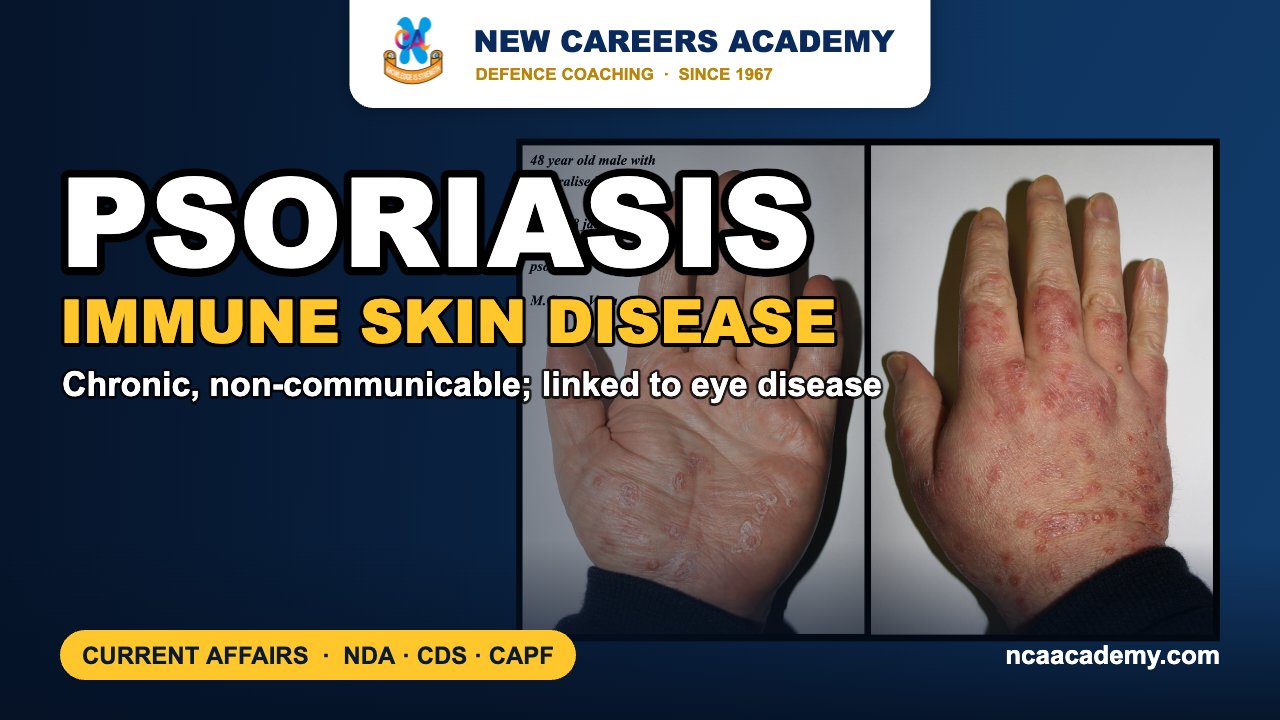
Quick answer: Psoriasis is a long-lasting, immune-mediated disease. An overactive immune system makes skin cells multiply too fast, leaving red, scaly and inflamed patches. It is in the news after World Psoriasis Day on 29 October 2026 and fresh research linking the disease to eye problems such as cataract.
Why psoriasis is in the news
World Psoriasis Day falls on 29 October each year. It is presented by the International Federation of Psoriasis Associations (IFPA), and patient groups hold awareness events in over 50 countries. Around the same time, researchers have been looking at how psoriasis affects organs beyond the skin.
A meta-analysis in the American Journal of Ophthalmology (September 2025), reported by Review of Optometry, pooled 34 studies covering more than one crore subjects. It found people with psoriasis had a higher risk of several eye conditions. For cataract the hazard ratio was 1.78, and the odds of dry eye disease were about five times higher. The authors pointed to three possible causes:
- Body-wide inflammation.
- Oxidative stress on the lens.
- Some treatments, such as steroids.
Key facts about psoriasis
- Nature: a chronic, immune-mediated disease. Immune cells release molecules that speed up the production of skin cells (US National Institute of Arthritis and Musculoskeletal and Skin Diseases, NIAMS).
- WHO view: a painful, disfiguring and disabling non-communicable disease (NCD) with no cure. It can involve the skin, nails and joints.
- Usual sites: scalp, elbows and knees, though any part of the body can be affected.
- Who gets it: anyone, but it is more common in adults than in children, and men and women are affected equally.
- Cause: not fully understood. It involves a mix of genetics and environmental factors, and many patients have a family history.
- Pattern: symptoms come in flares lasting weeks or months, followed by quieter spells or remission.
- Global policy: the 67th World Health Assembly adopted resolution WHA67.9 on psoriasis in 2014. WHO then published its Global report on psoriasis in October 2016.
Types of psoriasis at a glance
| Type | How it looks / where it appears |
|---|---|
| Plaque (most common) | Raised red patches with silvery-white scales, often on the scalp, trunk, elbows and knees, usually in a symmetrical pattern |
| Guttate | Small red dots on the torso or limbs, mostly in children and young adults; often follows a throat infection such as strep throat |
| Pustular | Pus-filled bumps on red skin, usually on the hands and feet |
| Inverse | Smooth red patches in skin folds such as the armpits or groin; rubbing and sweating worsen it |
| Erythrodermic (rare, severe) | Red, scaly skin over most of the body; can follow a bad sunburn or certain medicines |
Symptoms, triggers and linked conditions
Common symptoms include:
- Red, thickened patches covered in silvery scales, with itching or burning.
- Skin that dries, cracks and sometimes bleeds.
- Thick, ridged or pitted nails.
- Poor sleep.
NIAMS lists several outside factors that raise the chance of developing the disease:
- Infections, especially streptococcal infections and HIV.
- Some medicines, including drugs for heart disease, malaria and mental health conditions.
- Smoking.
- Obesity.
Psoriasis rarely stays a skin problem alone. Patients face a higher risk of:
- Psoriatic arthritis, which causes painful, swollen joints and can damage them permanently if untreated.
- Heart attacks and strokes.
- Depression and anxiety.
- Diabetes, obesity and uveitis (inflammation of the middle layer of the eye).
WHO also notes that patients often face stigma and social exclusion.
Treatment depends on severity. Mild cases often respond to creams or ointments. Moderate and severe disease may need tablets, injections or light therapy. There is no permanent cure, so the goal is long-term control.
Exam angle: how NDA, CDS and CAPF can ask this
- General Science papers often ask you to sort diseases as communicable or non-communicable. Psoriasis is an NCD and is not caused by a pathogen, even though infections can trigger it.
- Questions on the immune system can use psoriasis as an example of the body’s defence turning against its own tissue.
- Important days (29 October, World Psoriasis Day) and WHO/World Health Assembly resolutions appear in current-affairs sections.
Practice MCQs
Q1. Psoriasis is best described as:
(a) a bacterial skin infection (b) a fungal disease (c) a chronic immune-mediated disease (d) a vitamin deficiency disorder
Answer: (c) — immune cells push the skin to produce new cells far too quickly.
Q2. Which is the most common type of psoriasis?
(a) Guttate (b) Plaque (c) Pustular (d) Erythrodermic
Answer: (b) — plaque psoriasis, with raised red patches and silvery scales.
Q3. World Psoriasis Day is observed on:
(a) 29 October (b) 3 November (c) 7 April (d) 10 December
Answer: (a) — it is presented by the International Federation of Psoriasis Associations.
Q4. The World Health Assembly resolution on psoriasis (WHA67.9) was adopted in:
(a) 2004 (b) 2010 (c) 2014 (d) 2016
Answer: (c) — WHO’s Global report on psoriasis followed in 2016.
Frequently asked questions
What is psoriasis?
It is a chronic, immune-mediated disease in which skin cells multiply too quickly. This leaves inflamed, scaly patches, most often on the scalp, elbows and knees.
Is psoriasis infectious?
No. WHO classes it as a non-communicable disease, so it does not spread from person to person. Infections such as strep throat can trigger flares in people who already have it.
Can psoriasis be cured?
There is no cure. Creams, tablets, injections and light therapy can keep symptoms under control.
Does psoriasis affect the eyes?
Studies link it with uveitis, dry eye and a higher risk of cataract. A 2025 meta-analysis reported a hazard ratio of 1.78 for cataract.
When is World Psoriasis Day?
It is observed every year on 29 October.
Also read on NCA: Dopamine: the brain’s chemical messenger | Monthly defence current affairs PDFs | NDA coaching in Chandigarh
Sources: NIAMS (US NIH), WHO Global report on psoriasis, IFPA – World Psoriasis Day, Review of Optometry. Facts as reported up to 3 November 2026.
Featured image background: MCvanVeen / Wikimedia Commons, CC BY-SA 4.0.