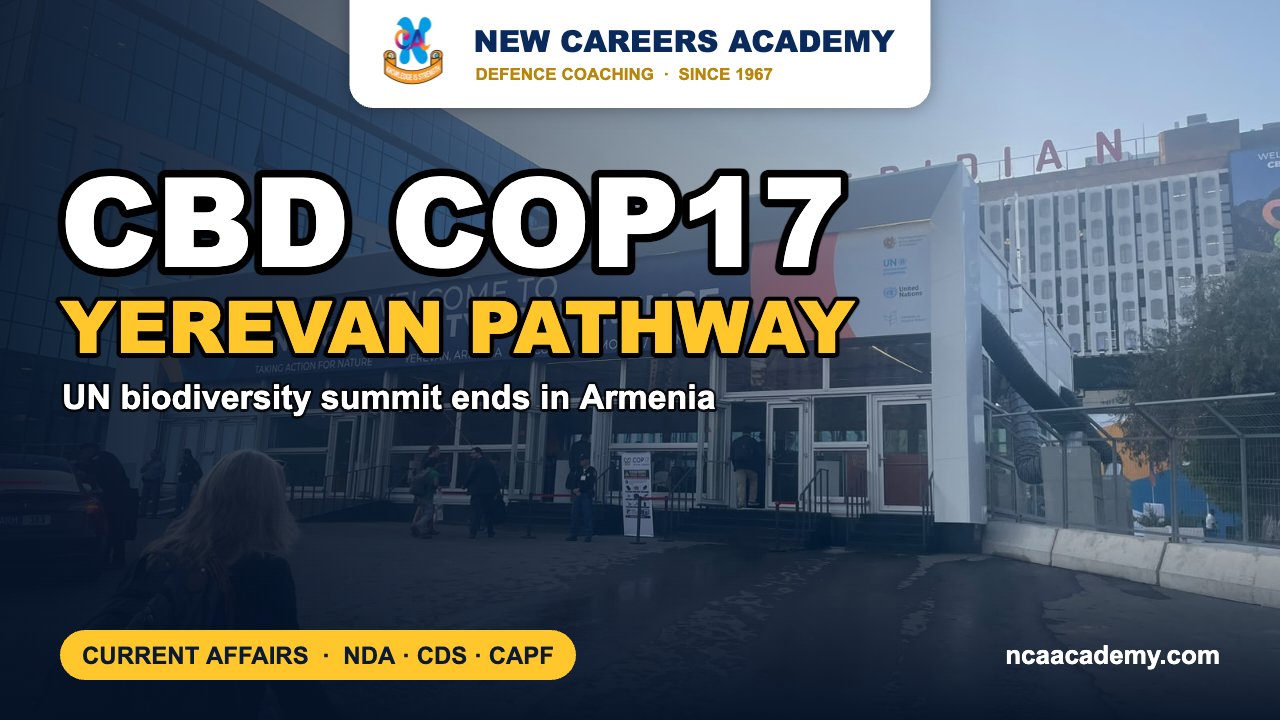
Quick answer: The Yerevan Pathway is the set of priorities agreed at the 17th Conference of the Parties (COP17) to the Convention on Biological Diversity, which ended in Yerevan, Armenia, on 31 October 2026. It responds to the first global review of the Kunming-Montreal Global Biodiversity Framework, which found the world off track to meet its 23 targets by 2030.
Why the Yerevan Pathway is in the news
According to Down To Earth and the CBD Secretariat, the 2026 UN Biodiversity Conference formally opened in Yerevan on 19 October and ended on 31 October. The meetings of Parties to the Cartagena and Nagoya Protocols were held at the same time. Countries adopted nearly 50 decisions. The most important was the Yerevan Pathway, a negotiated plan to speed up action in the four years left before 2030.
COP17 marked the halfway point of the Kunming-Montreal Global Biodiversity Framework (KMGBF). The State of Biodiversity Action report, released on 15 October 2026, found that fewer than half of the assessed targets were on track. Armenia’s Environment Minister, Hambardzum Matevosyan, was the COP17 President.
Key facts about CBD COP17 and the Yerevan Pathway
| Item | Detail |
|---|---|
| Host city | Yerevan, Armenia |
| Dates | Formally opened 19 October 2026; closed 31 October 2026 |
| Main outcome | Yerevan Pathway: priorities for action up to 2030 |
| Decisions adopted | Nearly 50 |
| Indigenous peoples outcome | Sevan Guidelines: operating rules for the new permanent subsidiary body on Article 8(j) |
| New money announced | Nearly US$2 billion |
| Next COP | COP18 in Ecuador, 2028 |
- What the Pathway asks for: action on subsidies that harm nature, more financial, scientific and technical support for developing countries, national budgets aligned with the KMGBF, and stronger monitoring and reporting.
- Funding pledges: these included US$560 million under the GEF-9 replenishment and its Global Biodiversity Framework Fund, US$500 million through the Species Recovery Alliance and over US$330 million through the Value Nature Fund.
- Other initiatives: the Asian Development Bank unveiled a bond and an investment incubator focused on biodiversity.
- Science decisions: these covered protected areas, invasive alien species, marine and coastal biodiversity and synthetic biology, among other topics.
India at COP17 and its national biodiversity plan
DD News reported that Union Environment Minister Bhupender Yadav, in India’s national statement, asked developed countries for adequate and predictable finance, capacity building and technology transfer. He said each country should implement the framework according to its own priorities and laws. India backed benefit-sharing from digital sequence information (DSI) through the multilateral mechanism, including the Cali Fund. It also called for a precautionary, science-based approach to synthetic biology. Yadav said India has 1,134 protected areas, 103 Ramsar Sites, 57 Biodiversity Heritage Sites and 18 Biosphere Reserves, 13 of which are in UNESCO’s Man and the Biosphere network.
India’s updated National Biodiversity Strategy and Action Plan (NBSAP) was presented at COP16 in Cali, Colombia, on 30 October 2024 (Mongabay India). It sets 23 national targets backed by 142 indicators. Implementation is projected to cost about Rs 81,664 crore a year on average from 2024-25 to 2029-30, shared across 23 ministries and departments.
Background: the CBD at a glance
- The CBD Secretariat says the treaty was opened for signature on 5 June 1992 at the Rio Earth Summit and entered into force on 29 December 1993. Its secretariat is in Montreal, Canada.
- The KMGBF was adopted in 2022 and has 23 targets for 2030. Among its commitments is protecting 30% of land, inland waters and seas.
- The Cartagena Protocol deals with biosafety. The Nagoya Protocol deals with access to genetic resources and benefit-sharing.
Exam angle: how NDA, CDS and CAPF can ask this
- Expect match-the-host questions: COP17 with Yerevan (Armenia), COP16 with Cali (Colombia), COP18 with Ecuador.
- Protocols are often tested: Cartagena covers biosafety; Nagoya covers access and benefit-sharing.
- India’s conservation numbers, such as Ramsar Sites and Biosphere Reserves, often appear in CDS and CAPF environment questions.
Practice MCQs
Q1. The 17th Conference of the Parties to the Convention on Biological Diversity (2026) was held in:
(a) Cali (b) Yerevan (c) Baku (d) Montreal
Answer: (b) — COP17 was held in Yerevan, Armenia, and ended on 31 October 2026.
Q2. The “Sevan Guidelines” adopted at CBD COP17 relate to:
(a) Marine protected areas (b) Invasive alien species (c) The permanent subsidiary body on Article 8(j) (d) Living modified organisms
Answer: (c) — they are the operating rules for the Article 8(j) body on indigenous peoples and local communities.
Q3. Which protocol under the CBD deals with biosafety?
(a) Nagoya Protocol (b) Kyoto Protocol (c) Cartagena Protocol (d) Montreal Protocol
Answer: (c) — the Cartagena Protocol covers biosafety.
Q4. According to India’s national statement at COP17, how many Biosphere Reserves does India have?
(a) 13 (b) 15 (c) 18 (d) 21
Answer: (c) — 18, of which 13 are in UNESCO’s Man and the Biosphere network.
Frequently asked questions
What is the Yerevan Pathway?
It is the set of priorities agreed at CBD COP17 in response to the first global review of the Kunming-Montreal framework. It is meant to guide national action on biodiversity up to 2030.
What are the Sevan Guidelines?
They are the rules of operation for the new permanent subsidiary body under Article 8(j) of the CBD. The body is meant to strengthen the role of indigenous peoples and local communities.
What did India ask for at COP17?
India asked developed countries for predictable finance, capacity building and technology transfer. It also supported DSI benefit-sharing through the Cali Fund.
Where will COP18 be held?
COP18 will be held in Ecuador in 2028, according to the CBD Secretariat.
Also read on NCA: International Day for Biosphere Reserves | Monthly defence current affairs PDFs | CDS coaching in Chandigarh
Sources: CBD Secretariat press release (31 Oct 2026), CBD: History of the Convention, DD News, Down To Earth, Mongabay India. Facts as reported up to 5 November 2026.
Featured image background: Mammysou17 / Wikimedia Commons, CC BY-SA 4.0.