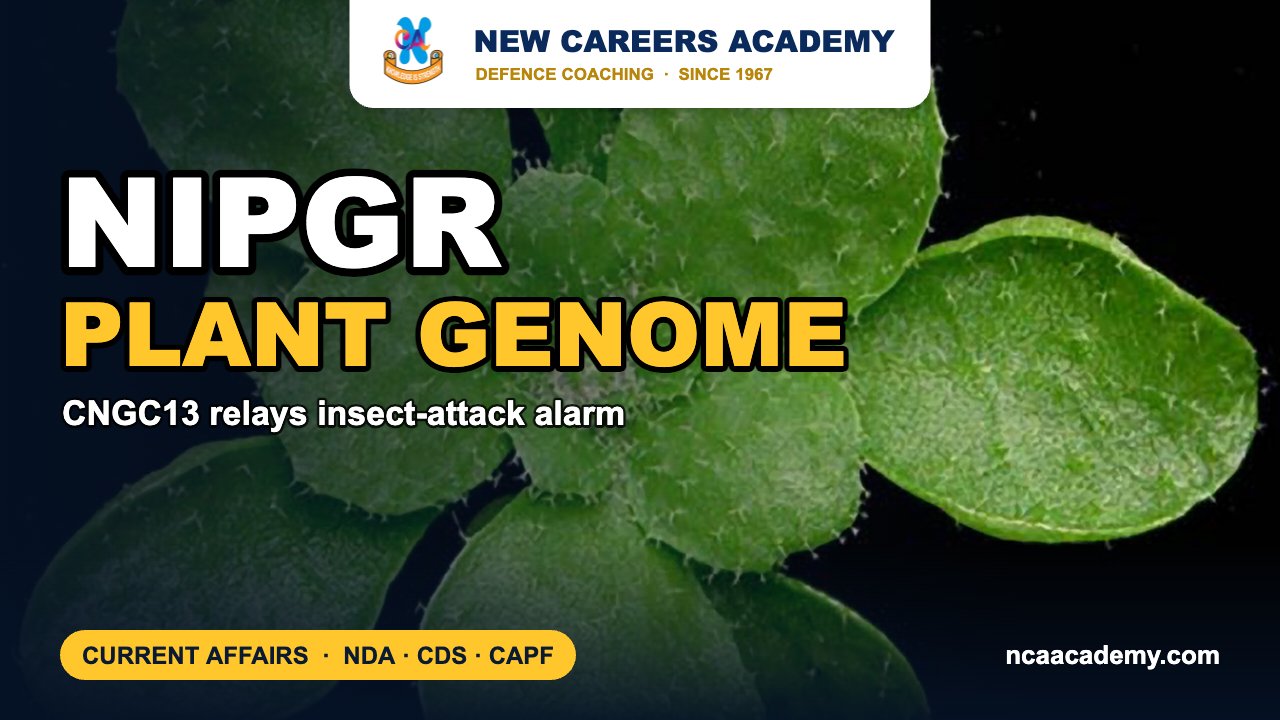
Quick answer: The National Institute of Plant Genome Research (NIPGR), New Delhi, is a plant-science institute of the Department of Biotechnology (DBT) and now runs under DBT’s umbrella body BRIC. It is in the news because its scientists showed, in a 2026 PNAS paper reported in October 2026, that a calcium channel called CNGC13 relays an “insect attack” alarm from a chewed leaf to undamaged leaves.
Why NIPGR is in the news
A team in the laboratory of Dr Jyothilakshmi Vadassery at NIPGR, with Misha Kumari as first author, published the work in the Proceedings of the National Academy of Sciences (PNAS), volume 123, issue 40 (2026). The researchers worked on the model plant Arabidopsis thaliana attacked by caterpillars of Spodoptera litura. CNGC13 (Cyclic Nucleotide Gated Channel 13) sits in the vascular tissue, is strongly switched on by wounding, and helps a calcium signal travel from the damaged leaf to distant leaves, where the defence hormone jasmonic acid and toxic glucosinolates then build up. Plants lacking the gene had a weaker, delayed signal and suffered more feeding. CNGC13 was earlier known only for heavy-metal transport in roots.
Key facts about NIPGR
- Location: New Delhi (Aruna Asaf Ali Marg).
- Began work: 1998, under the earlier name National Centre for Plant Genome Research (NCPGR).
- Parent: an autonomous institute of the Department of Biotechnology, Ministry of Science and Technology; DBT’s annual report now lists it as BRIC-NIPGR.
- Focus: plant genomics for crop improvement, stress tolerance and plant immunity.
- Policy role: two NIPGR scientists sat on DBT’s 2022 committee for genome-editing SOPs.
DBT autonomous institutes under BRIC
DBT merged the governance of its autonomous institutes into one apex society, the Biotechnology Research and Innovation Council (BRIC), which first met in December 2023. Reports give the count as 14 (Cabinet approval) or 13 (DBT annual report 2023-24). Ten listed in that report:
| Institute | City |
|---|---|
| Centre for DNA Fingerprinting and Diagnostics (CDFD) | Hyderabad |
| National Agri-Food Biotechnology Institute (NABI) | Mohali |
| National Brain Research Centre (NBRC) | Manesar |
| National Centre for Cell Science (NCCS) | Pune |
| National Institute of Animal Biotechnology (NIAB) | Hyderabad |
| National Institute of Biomedical Genomics (NIBMG) | Kalyani |
| National Institute of Immunology (NII) | New Delhi |
| National Institute of Plant Genome Research (NIPGR) | New Delhi |
| Rajiv Gandhi Centre for Biotechnology (RGCB) | Thiruvananthapuram |
| Translational Health Science and Technology Institute (THSTI) | Faridabad |
India’s genome-edited rice and the SDN rules
On 4 May 2025, Agriculture Minister Shivraj Singh Chouhan announced India’s first two genome-edited rice varieties, made by ICAR with CRISPR-Cas editing and no foreign DNA, according to the Agriculture Ministry:
- DRR Rice 100 (Kamala), also called DRR Dhan 100: developed by ICAR-IIRR, Hyderabad, from Samba Mahsuri (BPT 5204). It bears more grains per panicle and matures about 20 days earlier (around 130 days).
- Pusa DST Rice 1: developed by ICAR-IARI, New Delhi, from MTU 1010. It gives 9.66% to 30.4% higher yield in saline and alkaline soils.
- The ministry claimed a 19% yield rise and a 20% cut in greenhouse gas emissions.
Regulation depends on the type of edit made by a site-directed nuclease (SDN), an enzyme that cuts DNA at a chosen spot:
| Category | What happens | Foreign DNA in final plant? | Regulatory status in India |
|---|---|---|---|
| SDN-1 | Cell’s own repair (non-homologous end joining), no template; small insertions, deletions or knock-out | No | Exempt from Rules 7-11 of the Rules, 1989 if free of exogenous DNA |
| SDN-2 | Repair guided by a supplied template carrying a few small changes | No (the template must be removed) | Exempt, on the same condition |
| SDN-3 | Larger donor DNA, such as a whole gene, inserted | Yes | Treated as a GMO; needs full approval under the Rules, 1989 |
The exemption came through a MoEFCC Office Memorandum dated 30 March 2022, issued under the Environment (Protection) Act, 1986. DBT followed with safety guidelines (17 May 2022) and SOPs. The institution’s Institutional Biosafety Committee (IBSC) certifies a line as free of foreign DNA and informs DBT’s Review Committee on Genetic Manipulation (RCGM).
Exam angle: how NDA, CDS and CAPF can ask this
- Match-the-following on research institutes and cities (NABI Mohali, NIPGR New Delhi) is common in General Studies.
- Know how GM crops differ from genome-edited crops, and which SDN category counts as GMO.
- Plant hormones (jasmonic acid, auxin, gibberellin) are common biology questions.
Practice MCQs
Q1. The National Institute of Plant Genome Research is located in:
(a) Hyderabad (b) Mohali (c) New Delhi (d) Lucknow
Answer: (c) — it is on Aruna Asaf Ali Marg, New Delhi.
Q2. CNGC13, recently studied at NIPGR, is best described as a:
(a) Sodium pump (b) Calcium channel (c) Chlorophyll protein (d) Nitrogen-fixing enzyme
Answer: (b) — it relays calcium signals.
Q3. Which genome-editing category is regulated as a GMO in India?
(a) SDN-1 (b) SDN-2 (c) SDN-3 (d) None
Answer: (c) — SDN-3 inserts foreign donor DNA.
Q4. DRR Rice 100 (Kamala) was developed from which variety?
(a) MTU 1010 (b) Samba Mahsuri (c) Pusa Basmati 1121 (d) IR64
Answer: (b) — ICAR-IIRR edited Samba Mahsuri (BPT 5204).
Frequently asked questions
What is NIPGR?
A plant genomics institute in New Delhi under the Department of Biotechnology, now part of BRIC.
What did NIPGR scientists discover about CNGC13?
The CNGC13 calcium channel carries an insect-attack signal through vascular tissue to undamaged leaves, which then build up defence chemicals.
Which genome-edited rice varieties did India release?
DRR Rice 100 (Kamala) and Pusa DST Rice 1. Both were announced on 4 May 2025 and developed by ICAR institutes.
Are SDN-1 and SDN-2 plants treated as GM crops?
No. If free of foreign DNA, they are exempt from Rules 7-11 of the Rules, 1989. SDN-3 plants remain regulated as GMOs.
Also read on NCA: National Cooperative Development Corporation | Monthly defence current affairs PDFs | CDS coaching in Chandigarh
Sources: BioPatrika (with PNAS reference), PNAS, PIB (4 May 2025), DBT SOPs, 2022, DBT Annual Report. Facts as reported up to 2 November 2026.
Featured image background (representative): Unknown authorUnknown author / Wikimedia Commons, CC BY 2.5.