
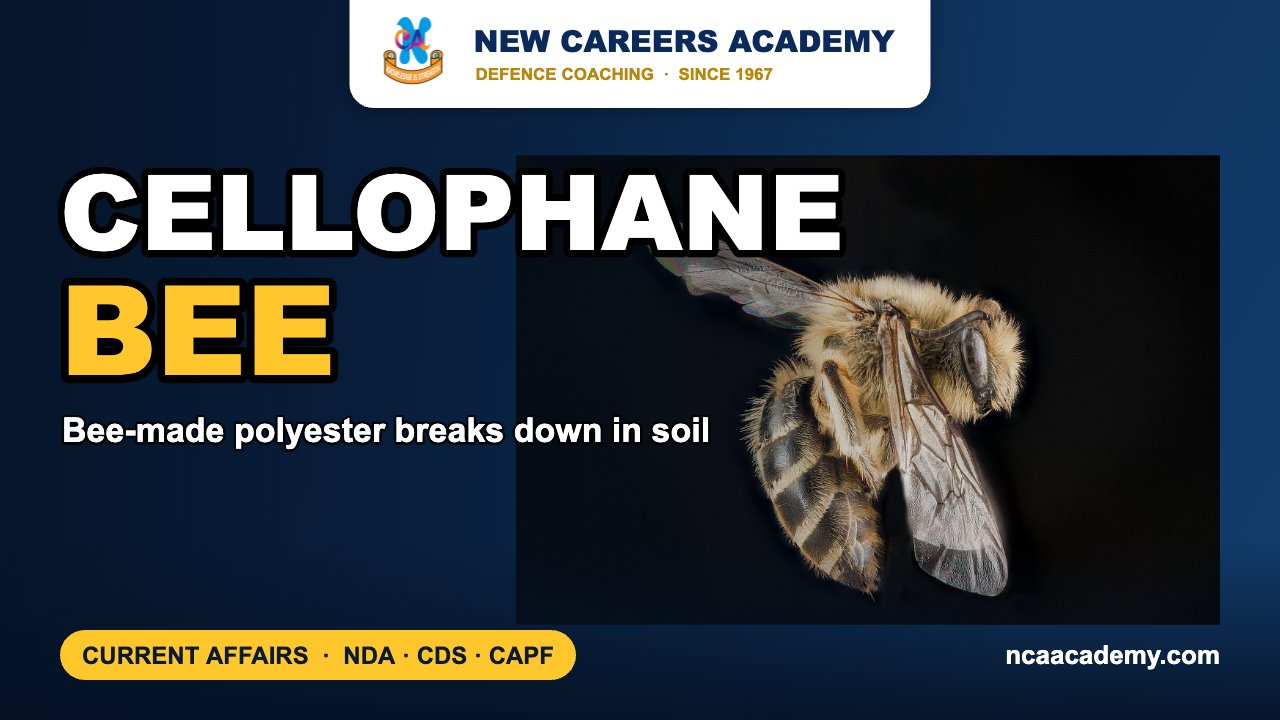
Quick answer: Colletes inaequalis, the unequal cellophane bee, is a ground-dwelling solitary bee, studied here in the United States, that lines its nest cells with a natural polyester film. A study in the Proceedings of the National Academy of Sciences (PNAS), reported in early November 2026, found that this polyethylene-like bee plastic breaks down in soil within months, which could guide the design of plastics that do not persist for centuries.
Why Colletes inaequalis is in the news
Researchers from the University of Minnesota, the University of Tennessee and Virginia Tech dug up cellophane bee nests from a field in Tennessee and tracked how the nest lining changed over about a year. Their paper, titled “Rapid soil degradation of a cross-linked, semicrystalline polyethylene-like polyester produced by Colletes bees”, was covered by Discover magazine on 2 November 2026.
The finding matters because conventional polyethylene barely degrades. Waste that escapes into the environment can last for centuries and break into microplastic fragments. The bee’s material is chemically close to polyethylene, yet it disappears quickly in ordinary soil. If engineers can copy the bee’s chemistry, they may be able to keep the strength of polyethylene-type plastics while making them easier for nature to break down.
Key facts about the cellophane bee
- Family: Colletidae; genus Colletes.
- Name: “inaequalis” is Latin for “unequal”, because the right and left antennae differ slightly in length.
- Lifestyle: solitary: each female digs her own burrow, though thousands may nest close together where soil is suitable.
- Nest: burrows 3 to 15 inches deep with 1 to 7 cells; each cell is stocked with pollen and nectar and gets a single egg.
- The film: a liquid from a gland near the stinger is spread on the cell wall, where it hardens into a thin, see-through lining.
- Pollinator: one of the first bees of spring, visiting red maple, willow, serviceberry, cherries, blueberry and apples.
- Temperament: non-aggressive; stings are very unlikely unless the bee is grabbed or stepped on.
What the study measured
The team collected nests from the same patch in March, July and October 2023 and in February 2024, digging about 7 to 12 inches down to reach the cells.
| Time in soil | What happened to the lining |
|---|---|
| Fresh | About 73% polyester and the rest silk, by weight |
| 4 months | Still mostly intact and flexible, but polyester share had fallen to about 40% |
| 7 months | Cracks visible (the larva had become an adult bee) |
| 11 months | Lining crumbled when handled roughly |
The polyester was breaking down faster than the silk, even though silk is a protein fibre that normally decays quickly. For comparison, the study cites earlier work in which a related laboratory-made plastic lost only 18% of its mass after 280 days of industrial composting, conditions harsher than ordinary soil.
Why does the bee plastic break down so fast?
The authors say they do not yet know, and offer two ideas. One is that the bee’s polymer chains are of mixed lengths and pack together loosely, leaving more weak bonds exposed. The other is that enzymes, from the bee or from microbes in the nest, help cut those bonds; washings from nests showed signs of such enzymes, though each test used only one nest. The researchers admit the data are thin, since a nest holds only a few milligrams of lining and most samples came from a single site. The bee’s plastic itself is not a new discovery: scientists first reported it in Science in 1979.
Exam angle: how NDA, CDS and CAPF can ask this
- Basic polymer chemistry (polyethylene, polyester, natural vs synthetic polymers, biodegradable vs non-biodegradable) is part of NDA and CDS general science.
- Plastic pollution, microplastics and the role of pollinators are common environment topics in CAPF general studies.
- Science-in-news questions often test which journal or country a discovery came from; note PNAS and the US universities involved.
Practice MCQs
Q1. Colletes inaequalis is commonly called the:
(a) Leafcutter bee (b) Cellophane bee (c) Carpenter bee (d) Stingless bee
Answer: (b) It lines its nest cells with a cellophane-like film.
Q2. The bee’s nest-lining polymer is structurally similar to:
(a) Polyvinyl chloride (b) Polystyrene (c) Polyethylene (d) Teflon
Answer: (c) The study describes it as a polyethylene-like polyester.
Q3. In soil, the polyester share of the nest lining fell from about 73% to 40% in roughly:
(a) 2 weeks (b) 4 months (c) 2 years (d) 5 years
Answer: (b) About four months.
Q4. Which statement about Colletes inaequalis is correct?
(a) It lives in large hives with a queen (b) It nests in tree hollows (c) Each female nests alone in a soil burrow (d) It is an aquatic insect
Answer: (c) It is a solitary, ground-nesting species.
Frequently asked questions
What is Colletes inaequalis?
Known as the unequal cellophane bee, it belongs to the family Colletidae; each female nests alone in the ground, and the species pollinates early spring trees and crops.
Why is it called a cellophane bee?
The female coats each nest cell with a thin, transparent film of natural polyester produced in a gland near her stinger.
What did the 2026 PNAS study find?
The polyester share of the nest lining dropped from about 73% to 40% by weight in four months in soil, and the lining crumbled by about 11 months.
Why does this matter for plastic pollution?
The bee polymer resembles polyethylene, which barely degrades. Understanding why the bee version breaks down fast could help design plastics that do not persist in the environment.
Where was the study done?
Nests were collected from a field in Tennessee, USA, by teams from the University of Minnesota, the University of Tennessee and Virginia Tech.
Also read on NCA: BioSentinel mission | Teghaza 001 Mars meteorite | Monthly defence current affairs PDFs | Online NDA coaching
Sources: Discover Magazine, University of Rhode Island Bee Lab fact sheet, PNAS paper (as cited by Discover). Facts as reported up to 5 November 2026.
Featured image background: USGS Native Bee Inventory and Monitoring Laboratory / Wikimedia Commons, Public domain.