Quick answer: BioSentinel is a NASA 6U CubeSat, built at the Ames Research Center, that flew to deep space on Artemis I on 16 November 2022 carrying live yeast to study how radiation damages DNA. It was back in the news in late October 2026, when reports revisited NASA’s finding that the yeast never grew. NASA says the cells most likely died during the long storage before launch. Its radiation detector is still sending data.
Why BioSentinel is in the news
Around 29 October 2026, news reports went back over the yeast experiment, drawing on NASA’s mission page, which NASA last updated in July 2026. According to NASA Ames, the team ran four two-week experiments between December 2022 and April 2023. No yeast grew in any of them. Investigators ruled out deep-space radiation as the cause. Their conclusion is that the cells most likely expired during the spacecraft’s long storage before launch. NASA has extended the mission, and the onboard detector keeps recording radiation. By November 2025 it had logged three years of continuous readings and was more than 48 million miles from Earth.
Key facts about BioSentinel
- Built by: NASA’s Ames Research Center, California, with Johnson Space Center and JPL as partners.
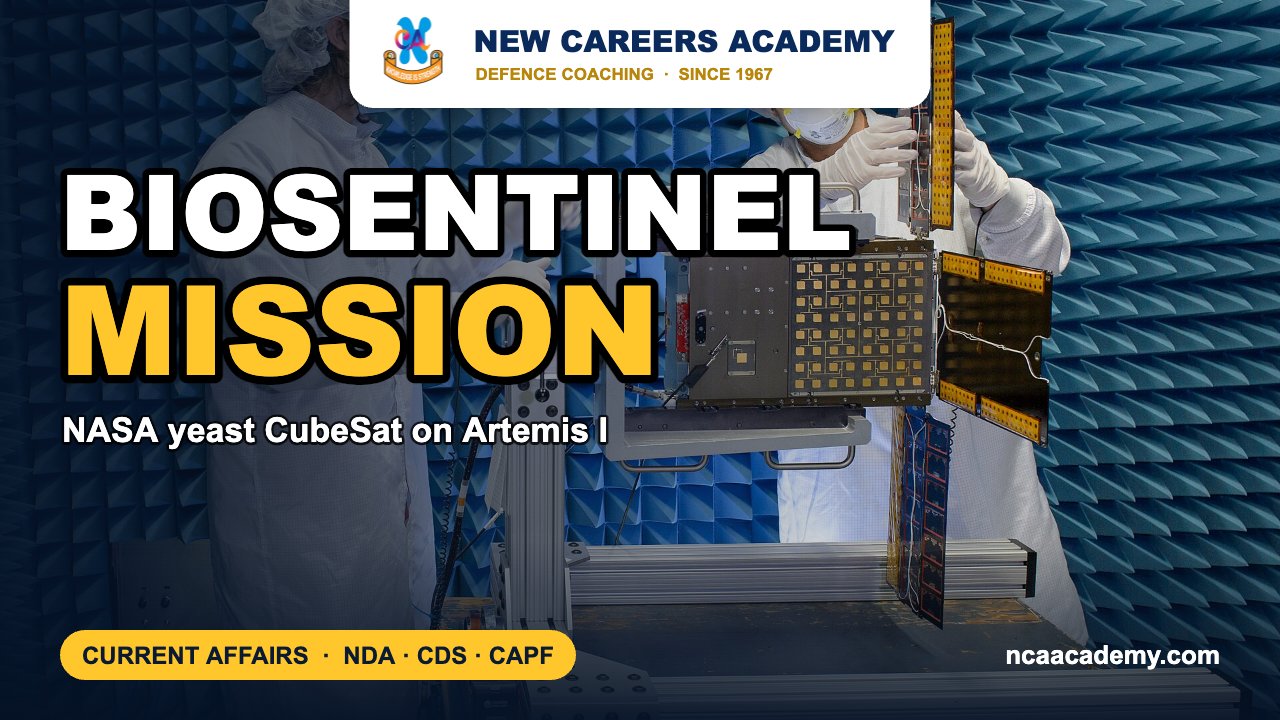
- Size: a six-unit (6U) CubeSat of about 30 pounds (roughly 14 kg). One unit is a cube about four inches on each side.
- Launch: 16 November 2022, on the Space Launch System (SLS) during Artemis I.
- Orbit: after a lunar flyby, it entered a heliocentric orbit, meaning it circles the Sun.
- BioSensor payload: microfluidic cards holding the yeast Saccharomyces cerevisiae. A dye turns from blue to pink when cells are active, and a three-colour LED system reads the change.
- Second payload: a radiation detector that measures the type and dose of radiation. This instrument is still working.
- Controls: identical experiments ran on the International Space Station and on the ground, so scientists could separate the effects of microgravity from those of radiation.
Why yeast was used to study radiation
High-energy radiation can break both strands of the DNA double helix, which is called a double-strand break. Yeast repairs this damage in a way very similar to human cells, and its genetics are well understood, so it serves as a “model organism”. BioSentinel carried two strains: a natural one and one that is poor at repairing DNA. Comparing them would show how much harm radiation does. Reserve cards were kept back to be activated during a solar storm. The ISS version of the experiment did grow yeast. The deep-space result leaves a lesson for future missions: biological samples must stay alive through storage, launch and long flights.
Radiation types in space
| Type | Source | Made of | Why it matters |
|---|---|---|---|
| Galactic cosmic rays (GCR) | Outside the solar system, mostly the Milky Way | Atomic nuclei, from hydrogen to uranium, stripped of electrons and moving near light speed | Pass almost unhindered through spacecraft walls |
| Solar particle events (SPE) | The Sun, during flares and eruptions | Protons and electrons, with X-rays and gamma rays | Sudden intense doses; peak with the 11-year solar cycle |
| Trapped radiation | Earth’s magnetic field (Van Allen belts) | Inner belt: energetic protons; outer belt: protons and electrons | Exposure while crossing the belts |
NASA classes all three as ionising radiation. Earth’s magnetic field and atmosphere block most of it. Beyond low Earth orbit, that protection is gone.
Artemis I and its CubeSats
Artemis I was the uncrewed first flight of NASA’s SLS rocket and Orion capsule. It carried 10 CubeSats as secondary payloads. A NASA paper notes that 13 were planned, but only 10 were ready in time. They were ArgoMoon (Italian Space Agency), EQUULEUS and OMOTENASHI (Japan’s JAXA), Lunar IceCube (Morehead State University), LunaH-Map (Arizona State University), NEA Scout (a solar sail aimed at a near-Earth asteroid), Team Miles (plasma thrusters), CuSP (space weather), LunIR and BioSentinel, the group’s biology experiment.
Exam angle: how NDA, CDS and CAPF can ask this
- Science sections test terms such as CubeSat, heliocentric orbit and low Earth orbit.
- Sources of space radiation and the role of the Van Allen belts link to physics and geography.
- Artemis, NASA’s Moon programme, is often paired with ISRO’s lunar missions in questions.
Practice MCQs
Q1. BioSentinel reached deep space on:
(a) Artemis II (b) Artemis I (c) Gaganyaan G1 (d) Crew-5
Answer: (b) — it launched on SLS on 16 November 2022.
Q2. Which organism did BioSentinel carry?
(a) Tardigrades (b) E. coli (c) Saccharomyces cerevisiae (d) Fruit flies
Answer: (c) — two strains of baker’s yeast.
Q3. Consider: 1. The Van Allen belts are formed by Earth’s magnetic field. 2. The inner belt is mainly energetic protons. Which is/are correct?
(a) 1 only (b) 2 only (c) Both (d) Neither
Answer: (c) — NASA describes both.
Q4. NASA’s most likely explanation for the yeast not growing is:
(a) Deep-space radiation (b) A failed lunar flyby (c) The yeast expiring during pre-launch storage (d) Loss of contact
Answer: (c) — radiation was ruled out.
Frequently asked questions
What is BioSentinel?
BioSentinel is a NASA Ames 6U CubeSat designed to study how deep-space radiation affects living cells, using yeast.
Why did the yeast fail to grow?
NASA concluded that radiation was not to blame. The cells most likely expired during the long storage before launch.
Is BioSentinel still working?
Yes. Its radiation detector still measures radiation from a heliocentric orbit, and NASA has extended the mission.
How many CubeSats flew on Artemis I?
Ten flew as secondary payloads. BioSentinel was one of them.
Also read on NCA: ISRO’s next-decade missions | Aditya-L1 and PROBA-3 | Monthly current affairs PDFs | NDA coaching in Chandigarh
Sources: NASA Ames, NASA: Why Space Radiation Matters, NASA NTRS, NewsBytes. Facts as reported up to 2 November 2026.
Featured image background: NASA Ames Research Center / Dominic Hart / Wikimedia Commons, Public domain.