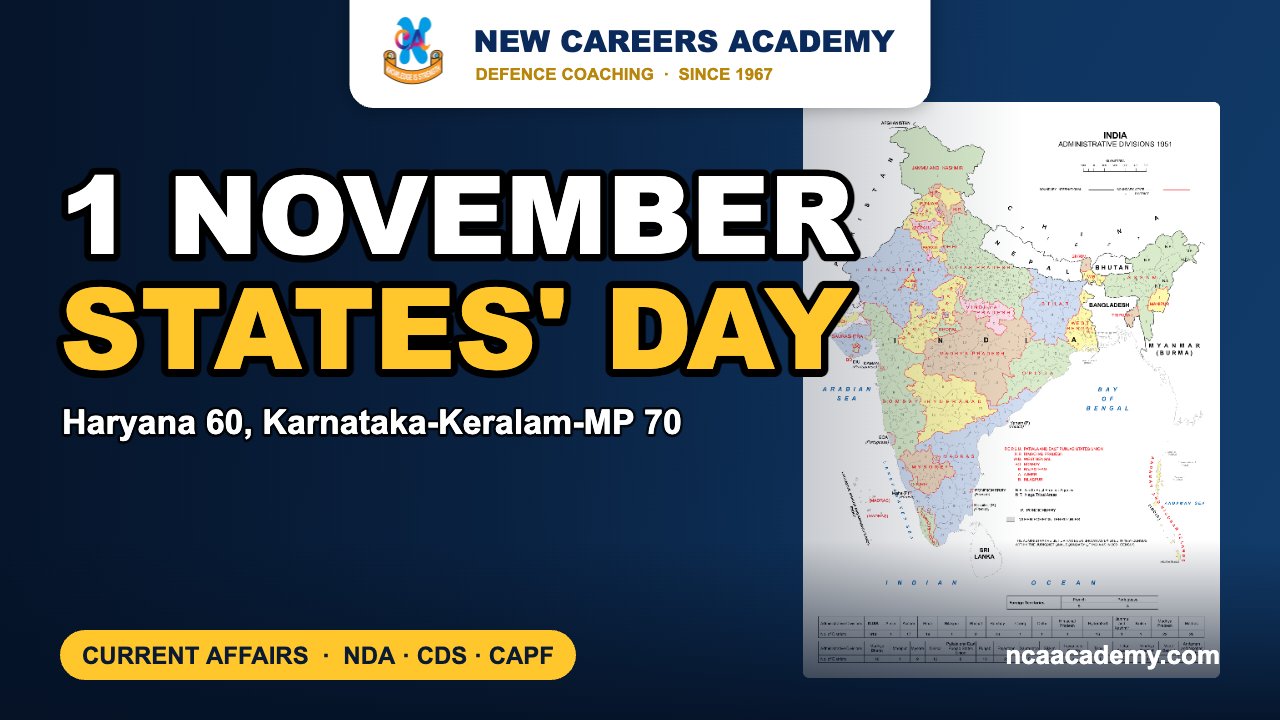
Quick answer: More Indian states and UTs mark their foundation day on 1 November than on any other date, because the States Reorganisation Act, 1956, the Punjab Reorganisation Act, 1966 and the Madhya Pradesh Reorganisation Act, 2000 all took effect that day. On 1 November 2026 the day carried extra weight: Haryana and Punjab completed 60 years, and Karnataka, Keralam and Madhya Pradesh completed 70 years. Keralam also marked its first Piravi under its new name.
Why States’ Formation Day is in the news
On Sunday, 1 November 2026, Prime Minister Narendra Modi greeted the people of Madhya Pradesh, Chhattisgarh, Haryana, Karnataka, Tamil Nadu and Keralam, PTI reported. In Haryana, President Droupadi Murmu was chief guest at the “Hirak Jayanti” (diamond jubilee) event at Kurukshetra University. Chhattisgarh turned 26. Karnataka held its 71st Kannada Rajyotsava, 70 years after 1956 (the first Rajyotsava was in 1956). Keralam’s 70th Keralappiravi was the first since the Kerala (Alteration of Name) Act, 2026 took effect on 25 August 2026. Puducherry marked Liberation Day and Tamil Nadu marked Tamil Nadu Day.
Key facts: who celebrates on 1 November and why
| State / UT | Formed on 1 Nov | Basis of formation |
|---|---|---|
| Karnataka (as Mysore State) | 1956 | States Reorganisation Act, 1956: Mysore enlarged with Kannada areas and Coorg; renamed Karnataka on 1 Nov 1973 |
| Keralam (Kerala) | 1956 | SRA 1956: Travancore-Cochin + Malabar + Kasaragod; renamed Keralam in 2026 |
| Madhya Pradesh | 1956 | SRA 1956: Madhya Bharat, Vindhya Pradesh and Bhopal State merged into it |
| Andhra Pradesh | 1956 | SRA 1956: Andhra State (1953) + Telugu areas of Hyderabad State |
| Tamil Nadu (then Madras State) | 1956 | SRA 1956 boundaries; 18 July also marked, for the 1967 renaming resolution |
| Punjab | 1966 | Punjab Reorganisation Act, 1966 |
| Haryana | 1966 | Punjab Reorganisation Act, 1966 (carved out of Punjab) |
| Chandigarh (UT) | 1966 | Punjab Reorganisation Act, 1966; common capital |
| Chhattisgarh | 2000 | Madhya Pradesh Reorganisation Act, 2000 |
| Andaman and Nicobar Islands (UT) | 1956 | Part D territory made a UT (Seventh Amendment) |
| Lakshadweep (UT) | 1956 | UT of Laccadive, Minicoy and Amindivi Islands (from Malabar district); renamed Lakshadweep on 1 Nov 1973 |
| Delhi (UT) | 1956 | Part C state made a UT (Seventh Amendment) |
| Puducherry (UT) | 1954 | De facto transfer from France to India; observed as Liberation Day |
Three laws behind one date
- States Reorganisation Act, 1956 (Act No. 37 of 1956): enacted on 31 August 1956 and in force from 1 November 1956. It followed the Fazl Ali Commission (with H.N. Kunzru and K.M. Panikkar), appointed in December 1953, which reported on 30 September 1955. The commission suggested 16 states and 3 centrally administered areas; the Act created 14 states and 6 Union Territories. The Seventh Amendment, effective the same day, ended the Part A, B, C, D classification.
- Punjab Reorganisation Act, 1966: it divided the old Punjab, created Haryana and made Chandigarh a UT.
- Madhya Pradesh Reorganisation Act, 2000: it carved out Chhattisgarh. Jharkhand and Uttarakhand followed later that month under separate Acts.
The trigger was Potti Sriramulu‘s death in 1952 after a 56-day hunger strike for a Telugu state, which led to Andhra State on 1 October 1953, the first post-Independence linguistic state.
Two special cases: Andhra Pradesh and Puducherry
Andhra Pradesh: its observance has shifted. After the 2014 split, the TDP government marked 2 June (“Nava Nirmana Deeksha”); the YSRCP government restored 1 November in 2019. Since 2024 it has again been low-key and disputed, with the YSRCP alleging in 2025 that the state did not officially mark it. For exams, Andhra Pradesh was formed on 1 November 1956.
Puducherry: 1 November 1954 marks the de facto transfer of French India’s administration, after the Kizhur referendum of 18 October 1954. The de jure transfer followed on 16 August 1962, when France ratified the 1956 Treaty of Cession; Puducherry became a UT on 1 July 1963. Hence 1 November is “Liberation Day” and 16 August “De Jure Transfer Day”.
Exam angle: how NDA, CDS and CAPF can ask this
- Chronology of state formation (Andhra 1953, SRA 1956, Haryana 1966, three new states in 2000, Telangana 2014) is a common NDA and CDS topic.
- Under Articles 3 and 4, Parliament can rename a state or change its boundaries by simple majority, without an Article 368 amendment, as with Keralam.
- Match-the-pairs on commissions (the Dhar Commission of 1948, which rejected language as the basis, and the Fazl Ali Commission of 1953) are frequent.
Practice MCQs
Q1. The States Reorganisation Act, 1956 created:
(a) 16 states and 3 UTs (b) 14 states and 6 UTs (c) 15 states and 5 UTs (d) 14 states and 3 UTs
Answer: (b).
Q2. Haryana was created under the:
(a) States Reorganisation Act, 1956 (b) Punjab Reorganisation Act, 1966 (c) Seventh Amendment (d) North-Eastern Areas (Reorganisation) Act, 1971
Answer: (b).
Q3. Puducherry’s 1 November commemorates:
(a) De jure transfer (b) De facto transfer (c) UT status (d) Treaty signing
Answer: (b) — de jure came on 16 August 1962.
Q4. Mysore State was renamed Karnataka in:
(a) 1956 (b) 1966 (c) 1973 (d) 1980
Answer: (c).
Frequently asked questions
Why do so many states celebrate their foundation day on 1 November?
Three reorganisation Acts (1956, 1966 and the MP Act of 2000) all came into force on 1 November.
Which states completed 60 years on 1 November 2026?
Haryana and Punjab, both reorganised under the Punjab Reorganisation Act, 1966.
Is Kerala now called Keralam?
Yes. The Kerala (Alteration of Name) Act, 2026 amended the First Schedule; it took effect on 25 August 2026.
What is the difference between Puducherry’s 1 November and 16 August?
1 November 1954 was the de facto handover from France; 16 August 1962 the de jure transfer.
Also read on NCA: Legislative Council (Vidhan Parishad) | Monthly defence current affairs PDFs | CAPF coaching in Chandigarh
Sources: PTI via ThePrint, The Morning Voice, Onmanorama, States Reorganisation Act, 1956, The News Minute, Organiser. Facts as reported up to 2 November 2026.
Featured image background (representative): Andhrapur / Wikimedia Commons, CC0.