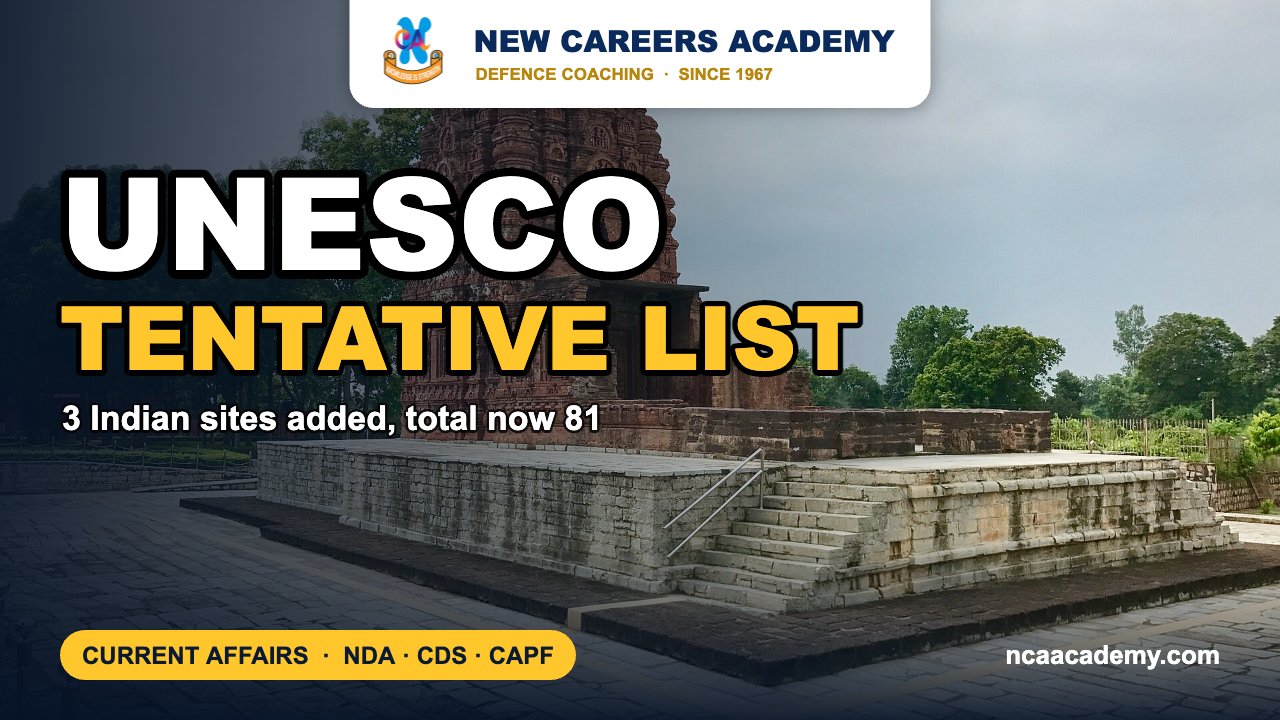
Quick answer: A UNESCO Tentative List is the shortlist of sites a country plans to nominate for World Heritage status. In October 2026, UNESCO’s World Heritage Centre added three Indian entries to it: the Sirpur Cultural and Archaeological Landscape (Chhattisgarh), the Karst-mud-volcano Complex of Baratang and the Andaman Subduction Volcanoes (Barren and Narcondam Islands). Reports put India’s Tentative List at 81 sites after the additions.
Why the UNESCO Tentative List is in the news
The Permanent Delegation of India to UNESCO announced the three additions in a press release around 20–21 October 2026, as reported by ANI and Open magazine. The Delegation noted that a site must be on the Tentative List before it can be nominated for the World Heritage List, and it thanked the Archaeological Survey of India (ASI) for preparing the documentation.
The additions come three months after India gained its 45th World Heritage Site. At the 48th session of the World Heritage Committee in Busan, South Korea, the Ancient Buddhist Site of Sarnath was inscribed on 25 July 2026. Sarnath had been on India’s Tentative List since 1998, so the wait between listing and inscription can be long.
Key facts about the UNESCO Tentative List
- The list is kept under the World Heritage Convention of 1972. According to the World Heritage Centre, India ratified the Convention on 14 November 1977.
- Each country (a “State Party”) keeps its own list of properties it intends to consider for nomination.
- Getting onto the list is not recognition in itself. It is only the first formal step.
- In India, the ASI under the Ministry of Culture prepares the documentation.
- India’s tally now: 81 sites on the Tentative List and 45 inscribed World Heritage Sites.
How a site moves from the Tentative List to the World Heritage List
- Tentative listing by the country.
- Preliminary Assessment: a mandatory early review under UNESCO’s Operational Guidelines.
- Nomination dossier: maps, a management plan and the case for “Outstanding Universal Value”.
- Evaluation: by ICOMOS for cultural sites and by IUCN for natural sites.
- Decision: the World Heritage Committee inscribes, refers, defers or declines the site.
The three new Indian sites at a glance
| Site | Location | Type | What makes it special |
|---|---|---|---|
| Sirpur Cultural and Archaeological Landscape | Mahasamund district, Chhattisgarh, on the eastern bank of the Mahanadi, about 78 km from Raipur | Cultural | An old riverside trading town where Hindu, Buddhist and Jain monuments stand together. It rests on stromatolite-bearing rock of the Proterozoic Chhattisgarh Basin. The Barnawapara Wildlife Sanctuary lies in its buffer zone. |
| Karst-mud-volcano Complex of Baratang | Baratang Island, Andaman and Nicobar Islands | Natural | Limestone caves next to mud volcanoes, which locals call “Jalki”. The volcanoes push out cool mud, water and gases (mainly methane and hydrogen sulphide), not magma. They erupted again in 2025 after about 20 years. |
| Andaman Subduction Volcanoes | Barren and Narcondam Islands, Andaman Sea | Natural | Described in the listing as the only Quaternary subduction volcanoes in the inner arc of the Burma–Andaman–Java chain. Only the land areas of the two islands are proposed. |
Barren and Narcondam: one arc, two stories
Barren Island lies over oceanic crust. It has a caldera about 2 km wide, formed when an older stratovolcano collapsed, and its lavas are mainly basalt and basaltic andesite. The Geological Survey of India declared it a geoheritage site in 2025. Narcondam lies over continental-to-transitional crust nearer the Asian margin. It has no summit crater, and its rocks range from dacite and andesite to rhyolite. It is an Important Bird Area and a Key Biodiversity Area, and the World Heritage Centre’s India page shows it was already a separate Tentative List entry from 2014.
Exam angle: how NDA, CDS and CAPF can ask this
- Volcano questions are common in geography. Barren Island is India’s only confirmed active volcano; Narcondam, further north in the Andaman Sea, is long dormant.
- Expect state–site matching: Sirpur with Chhattisgarh and the Mahanadi, Baratang with Andaman and Nicobar.
- Institutions: ICOMOS and IUCN evaluate nominations, and the World Heritage Committee decides.
- Running count: 45 inscribed sites after Sarnath (2026); Maratha Military Landscapes (2025) was the 44th.
Practice MCQs
Q1. Sirpur, recently added to India’s UNESCO Tentative List, lies on the bank of which river?
(a) Godavari (b) Mahanadi (c) Narmada (d) Son
Answer: (b). It stands on the eastern bank of the Mahanadi in Mahasamund district.
Q2. The “Jalki” of Baratang Island are:
(a) Coral atolls (b) Mud volcanoes (c) Hot springs (d) Sea caves
Answer: (b). They release mud, water and gases, not lava.
Q3. Which body takes the final decision to inscribe a World Heritage Site?
(a) UNESCO General Conference (b) ICOMOS (c) World Heritage Committee (d) IUCN
Answer: (c). ICOMOS and IUCN only evaluate nominations.
Q4. India’s 45th World Heritage Site, inscribed in July 2026, is:
(a) Maratha Military Landscapes (b) Sarnath (c) Majuli (d) Sri Harmandir Sahib
Answer: (b). Sarnath was inscribed at the 48th session in Busan.
Frequently asked questions
What is a UNESCO Tentative List?
It is the list of sites a country intends to nominate for World Heritage status. A site must be on it before it can be nominated.
Which three Indian sites were added in October 2026?
Sirpur Cultural and Archaeological Landscape (Chhattisgarh), the Karst-mud-volcano Complex of Baratang, and the Andaman Subduction Volcanoes (Barren and Narcondam).
Does a Tentative List entry make a site a World Heritage Site?
No. It still needs a Preliminary Assessment, a nomination dossier, evaluation and a Committee decision.
How many World Heritage Sites does India have?
45. The latest is the Ancient Buddhist Site of Sarnath, inscribed in July 2026.
Also read on NCA: Monthly defence current affairs PDFs | CDS coaching in Chandigarh
Sources: UNESCO World Heritage Centre: India, Deccan Chronicle (ANI), Open magazine, Daily Pioneer. Facts as reported up to 31 October 2026.
Featured image background: Ms Sarah Welch / Wikimedia Commons, CC BY-SA 4.0.