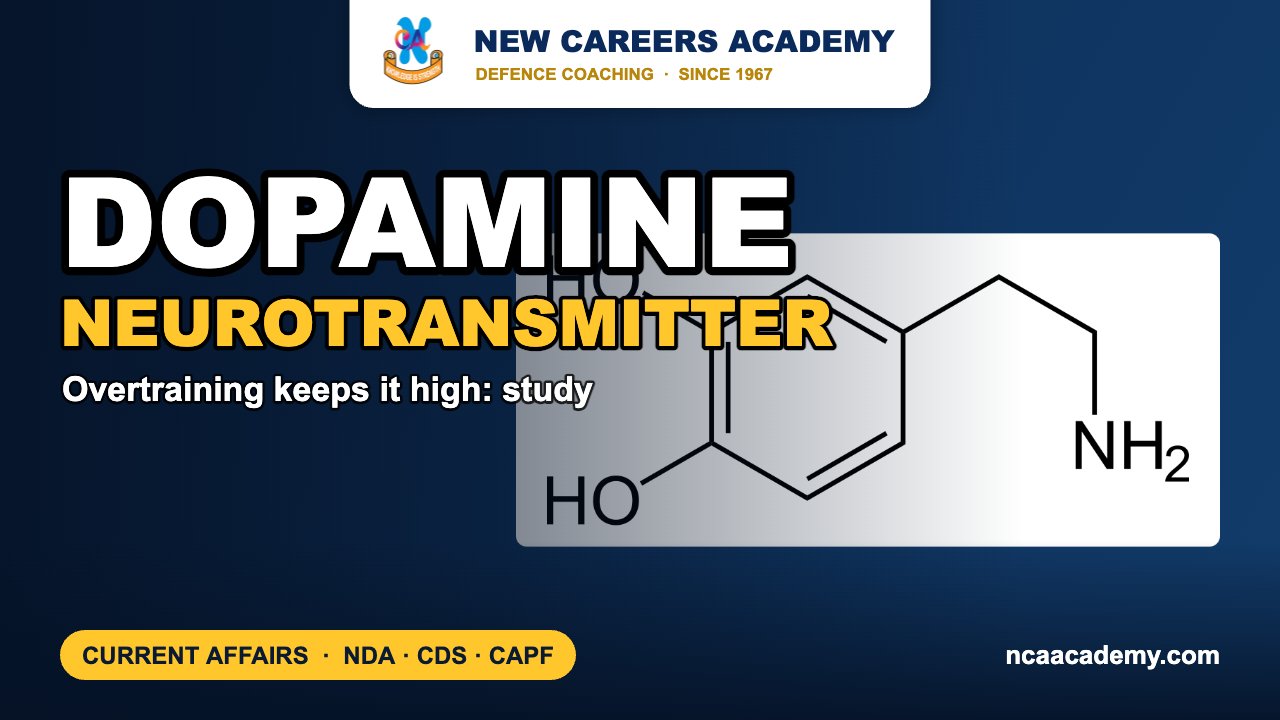
Quick answer: Dopamine is a catecholamine neurotransmitter linked to reward, motivation and movement, and it also acts as a hormone. It was in the news on 30 October 2026, when a Brazilian mouse study reported that overtraining without rest keeps dopamine high in the hippocampus during rest.
Why dopamine is in the news
University of São Paulo researchers published the work in Neuroscience; FAPESP publicised it on 30 October 2026. One group of mice copied athletes with overtraining syndrome: eight weeks of rising loads, ending with two daily sessions four hours apart. In the overtrained mice, dopamine and tyrosine hydroxylase, the enzyme that makes it, stayed raised for 48 hours during the animals’ rest phase. Serotonin levels did not change significantly. The authors note they did not measure sleep or anxiety, so links to athletes’ insomnia need testing in humans.
Key facts about dopamine
- Chemical class: a monoamine and a catecholamine, the same family as adrenaline (epinephrine) and noradrenaline (norepinephrine).
- How it is made: the amino acid L-tyrosine → L-DOPA, through tyrosine hydroxylase, which is the rate-limiting step. L-DOPA then becomes dopamine through aromatic L-amino acid decarboxylase. Dopamine is in turn the precursor of noradrenaline.
- Blood-brain barrier: dopamine itself cannot cross it, but L-DOPA can. That is why the drug levodopa, not dopamine, is given for Parkinson’s disease.
- Brain pathways: the nigrostriatal pathway from the substantia nigra controls movement (lost in Parkinson’s); the tuberoinfundibular pathway regulates prolactin.
- As a hormone: it widens blood vessels at low doses, narrows them at high doses, and increases salt and urine loss.
- Linked conditions: low levels with Parkinson’s, ADHD and restless legs syndrome; schizophrenia involves both excess and shortage.
- Nobel link: Arvid Carlsson showed in the late 1950s that dopamine is a brain transmitter in its own right. He shared the 2000 Nobel Prize in Physiology or Medicine.
Neurotransmitter vs hormone
| Feature | Neurotransmitter | Hormone |
|---|---|---|
| Released by | Nerve cells, at the axon terminal | Endocrine glands (for example the adrenal glands) |
| Travels through | The synaptic cleft, a gap of less than 40 nanometres | The bloodstream |
| Target | The next nerve, muscle or gland cell | Distant organs |
| Examples | Glutamate, GABA, acetylcholine | Insulin, thyroxine |
| Both roles | Dopamine, adrenaline and noradrenaline act as both | |
Main neurotransmitters and their functions
| Neurotransmitter | Type | Main role |
|---|---|---|
| Glutamate | Amino acid, excitatory | The brain’s most abundant transmitter; learning and memory |
| GABA | Amino acid, inhibitory | The main “brake” in the brain; linked to anxiety and seizures |
| Glycine | Amino acid, inhibitory | The main inhibitory transmitter in the spinal cord |
| Acetylcholine | Excitatory | Muscle contraction, memory; shortage is linked to Alzheimer’s |
| Dopamine | Monoamine | Reward, motivation, movement |
| Serotonin | Monoamine | Mood, sleep, appetite; the target of SSRI antidepressants |
| Noradrenaline | Monoamine | Alertness, heart rate, fight-or-flight |
| Endorphins | Peptide | The body’s natural painkillers |
Exam angle: how NDA, CDS and CAPF can ask this
- Biology questions often pair transmitters with diseases: dopamine with Parkinson’s, acetylcholine with Alzheimer’s.
- “Neurotransmitter vs hormone” and “excitatory vs inhibitory” suit statement-based MCQs.
Practice MCQs
Q1. Parkinson’s disease is mainly linked to a loss of dopamine-producing neurons in the:
(a) Cerebellum (b) Substantia nigra (c) Medulla (d) Hippocampus
Answer: (b) — the nigrostriatal pathway begins there.
Q2. Dopamine is synthesised directly from:
(a) Tryptophan (b) L-DOPA (c) Choline (d) Glutamine
Answer: (b) — L-tyrosine becomes L-DOPA, which becomes dopamine.
Q3. Which is the main inhibitory neurotransmitter of the brain?
(a) Glutamate (b) GABA (c) Dopamine (d) Acetylcholine
Answer: (b).
Q4. In the October 2026 mouse study, which brain region showed raised dopamine after overtraining?
(a) Hippocampus (b) Pons (c) Thalamus (d) Spinal cord
Answer: (a) — linked to memory and emotion.
Frequently asked questions
Is dopamine a hormone or a neurotransmitter?
Both. In the brain it signals between nerve cells; in the blood it acts as a hormone on vessels and kidneys.
Why is levodopa used instead of dopamine for Parkinson’s?
Dopamine cannot cross the blood-brain barrier. Levodopa (L-DOPA) can, and the brain then converts it into dopamine.
What did the 2026 overtraining study find?
In overtrained mice, hippocampal dopamine and tyrosine hydroxylase stayed high for 48 hours during rest; serotonin did not change significantly.
Who discovered dopamine’s role as a brain transmitter?
Swedish scientist Arvid Carlsson, in the late 1950s. He shared the 2000 Nobel Prize in Physiology or Medicine.
Also read on NCA: Ayushman Vay Vandana | Monthly defence current affairs PDFs | Online NDA coaching
Sources: News-Medical / FAPESP, NCBI StatPearls: Dopamine, Cleveland Clinic: Dopamine, Cleveland Clinic: Neurotransmitters, NobelPrize.org. Facts as reported up to 2 November 2026.
Featured image background: NEUROtiker / Wikimedia Commons, Public domain.