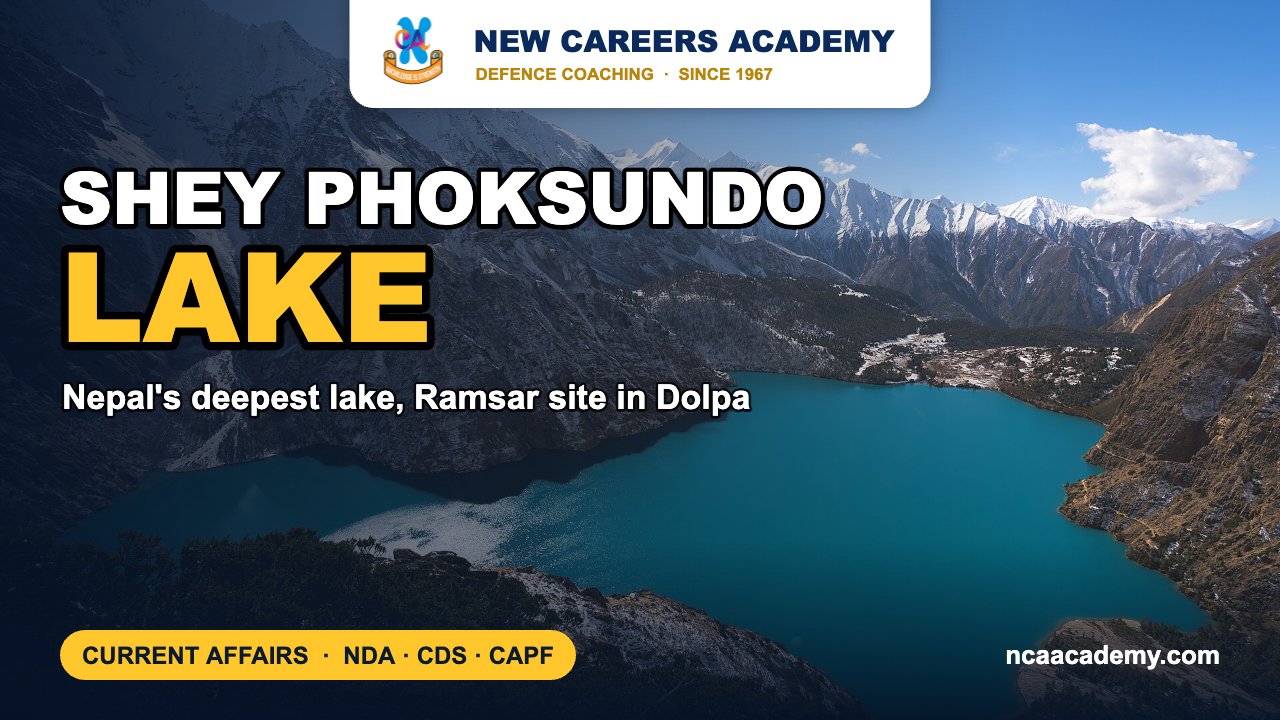
Quick answer: Shey Phoksundo (Phoksundo) Lake is Nepal’s deepest lake, a Ramsar wetland inside Shey Phoksundo National Park in Dolpa district. It made headlines on 1 November 2026 when six Indian trekkers went missing in heavy snow on the mountain passes near the lake.
Why Shey Phoksundo Lake is in the news
On 1 November 2026, officials in Nepal’s Dolpa district confirmed that six Indian tourists, two women and four men, had lost contact while trekking in the Shey-Phoksundo area after a heavy spell of snow. ANI reported that the group was last traced to the Numla Pass and Bagla Pass stretch. Dolpa’s Chief District Officer, Junu Hamal, said the group got stuck on the way back from Dho towards Phoksundo Lake, and that local residents had warned them about the weather before they set out.
The search has been slow. There is no mobile signal on these passes, a Nepal Army team has been sent in, and the police have asked for a helicopter. Local guides told reporters they think the snowfall was linked to Cyclone Arnab, which was forming over the Bay of Bengal at the time. As of 3 November 2026 we have not seen any official word on whether the group has been found.
Key facts about Shey Phoksundo Lake
- Country and district: Dolpa district in Nepal’s Karnali region, close to the village of Ringmo.
- Ramsar status: named a Ramsar site on 23 September 2007 (site no. 1694). The Ramsar listing gives its area as 494 hectares.
- Deepest lake in Nepal: a 2004 survey by Nepal’s Department of Hydrology and Meteorology put the maximum depth at 145 m. A later 2019 survey measured it at 136.2 m.
- Origin: it is a landslide-dammed lake. Ringmo village stands on a natural dam formed by an old landslide, estimated at 30,000 to 40,000 years old.
- Altitude: about 3,600 m. Sources give slightly different figures, from roughly 3,589 m to 3,612 m.
- Waterfall: the water leaving the lake drops over a waterfall about 167 m high, which the Ramsar sheet calls the highest in Nepal.
- Wildlife: the Ramsar sheet lists the snow leopard, musk deer and Tibetan (grey) wolf among the rare species found around the lake.
- Culture: people in Ringmo follow both Buddhism and the older Tibetan Bon tradition.
Shey Phoksundo Lake and National Park at a glance
| Feature | Phoksundo Lake | Shey Phoksundo National Park |
|---|---|---|
| Type | Alpine, oligotrophic freshwater lake | Nepal’s largest national park, and its only trans-Himalayan one |
| Size | 494 ha (Ramsar) | 3,555 sq km |
| Protection | Ramsar site since 2007 | National park since 1984 |
| Districts | Dolpa | Dolpa and Mugu |
| Notable | Turquoise colour, deepest lake in Nepal | 90 snow leopards recorded in a 2019–2022 survey |
Why winter trekking in Dolpa is risky
Upper Dolpa lies on the trans-Himalayan side, towards the edge of the Tibetan Plateau, and the park climbs from about 2,130 m to over 6,800 m at Kanjiroba Himal. Trekkers here have to cross high passes, and communication is poor. The Suligad river, which drains the lake, flows south towards the Thuli Bheri. With few roads, rescuers have to rely on army foot patrols and helicopters.
Visitor numbers are rising: 4,882 tourists reached Phoksundo Lake in the first 11 months of Nepal’s fiscal year 2082/83. The district administration has asked visitors to avoid risky areas and stay in safe places while the passes remain snowbound.
Exam angle: how NDA, CDS and CAPF can ask this
- Lakes of the Himalaya and their origin (glacial, tectonic, landslide-dammed) are standard geography topics. Learn Phoksundo as an example of a landslide-dammed lake.
- Questions on Ramsar sites, both in India and in neighbouring countries, are common. Remember that the Ramsar Convention deals with wetlands of international importance.
- India–Nepal neighbourhood geography (districts, national parks, rivers that become Ganga tributaries) is useful for the CDS and CAPF general studies papers.
Practice MCQs
Q1. Shey Phoksundo Lake is located in which district of Nepal?
(a) Mustang (b) Dolpa (c) Solukhumbu (d) Humla
Answer: (b) — The lake lies inside Shey Phoksundo National Park in Dolpa district.
Q2. Phoksundo Lake was formed mainly by:
(a) Volcanic crater collapse (b) Tectonic rifting (c) A landslide that dammed a valley (d) An oxbow cut-off
Answer: (c) — Ringmo village sits on the ancient landslide dam that holds back the lake.
Q3. In which year was Phoksundo Lake designated a Ramsar site?
(a) 2003 (b) 2007 (c) 2012 (d) 2018
Answer: (b) — It was listed on 23 September 2007 as Ramsar site no. 1694.
Q4. Consider the statements: 1. Shey Phoksundo is the largest national park of Nepal. 2. It is Nepal’s only trans-Himalayan national park. Which is/are correct?
(a) 1 only (b) 2 only (c) Both 1 and 2 (d) Neither
Answer: (c) — The park, set up in 1984, covers 3,555 sq km and lies north of the main Himalayan range.
Frequently asked questions
Where is Shey Phoksundo Lake?
It is in Dolpa district in Nepal’s Karnali region, inside Shey Phoksundo National Park, near the village of Ringmo.
Why is Shey Phoksundo Lake in the news in November 2026?
Six Indian tourists lost contact near the Numla and Bagla passes after heavy snowfall on 1 November 2026. The Nepal Army and local police began a search.
How deep is Phoksundo Lake?
A 2004 government survey measured it at 145 m, and a 2019 survey gave 136.2 m. Either way, it is the deepest lake in Nepal.
Is Phoksundo Lake a Ramsar site?
Yes. It was designated on 23 September 2007 as Ramsar site no. 1694, covering 494 hectares.
Also read on NCA: NDMA and the Disaster Management Act | UNESCO tentative list of India | Monthly defence current affairs | CDS coaching in Chandigarh
Sources: ANI, Business Today, Ramsar Sites Information Service, Wikipedia: Phoksundo Lake, Wikipedia: Shey Phoksundo National Park. Facts as reported up to 3 November 2026.
Featured image background: Sunuwargr / Wikimedia Commons, CC BY-SA 4.0.