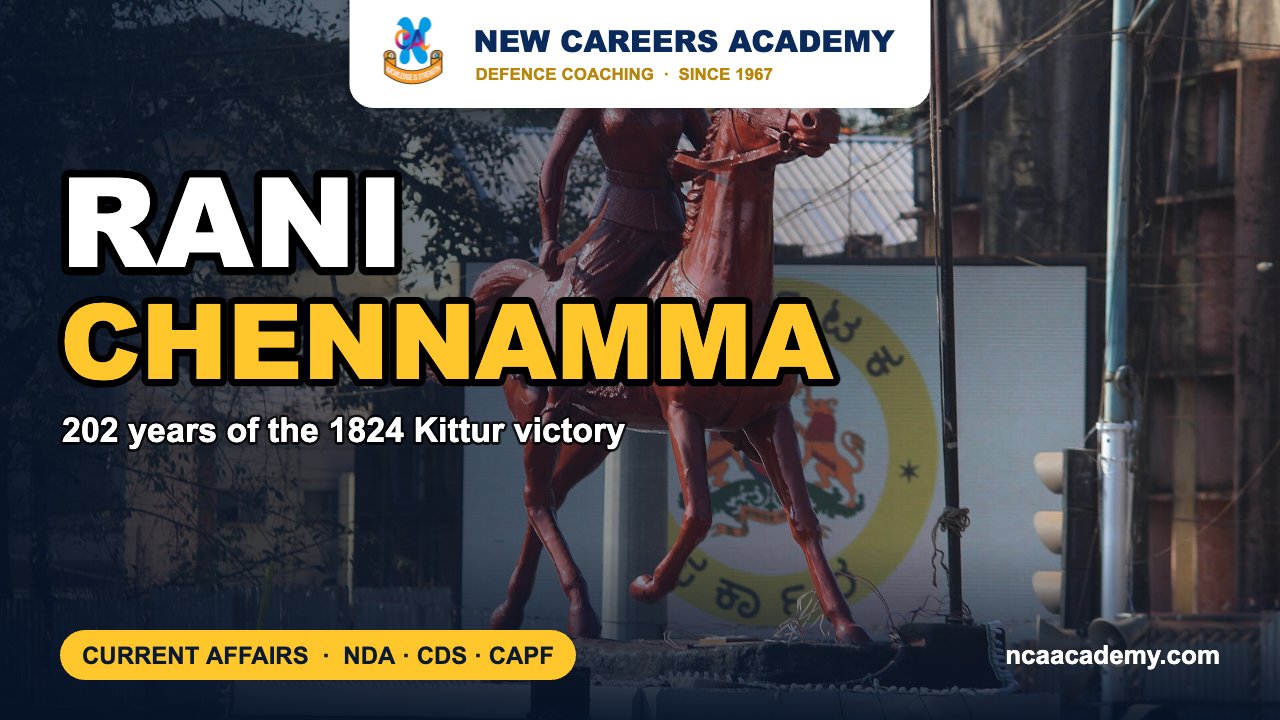
Quick answer: Rani Chennamma was the queen of Kittur (in present-day Belagavi district, Karnataka). In October 1824 she defeated a British East India Company force, one of the earliest armed challenges to Company rule. The 202nd anniversary of that victory was marked at Prerana Sthal in the Parliament complex on 23 October 2026, and Karnataka’s Kittur Utsav 2026 ended at Kittur on 25 October.
Why Rani Chennamma is in the news
According to a Press Information Bureau release from the Ministry of Railways, Rani Chennamma’s birth anniversary and the 202nd Victory Celebration were held on 23 October 2026 at Prerana Sthal, in the Parliament premises in New Delhi. The programme was led by V. Somanna, Union Minister of State for Railways and Jal Shakti and MP from Tumakuru. Lok Sabha Speaker Om Birla attended.
In Karnataka, Chief Minister D.K. Shivakumar spoke at the closing ceremony of Chennammana Kittur Utsav-2026 on Sunday, 25 October, Deccan Chronicle reported. He announced a Chennamma Freedom Park at Kittur, with ₹40 crore to be set aside in the next state Budget. He also said the NWKRTC bus corporation would be renamed the Kittur Rani Chennamma Road Transport Corporation.
Key facts about Rani Chennamma
| Point | Detail |
|---|---|
| Birth | 1778, at Kakati village in present-day Belagavi district, Karnataka |
| Kingdom | Kittur; she married Raja Mallasarja of the Desai family |
| Cause of conflict | The Company would not accept her adopted son Shivalingappa as heir |
| Victory | First battle at Kittur, October 1824; British collector and political agent St. John Thackeray was killed |
| Key lieutenants | Amatur Balappa, Sangolli Rayanna, Gurusiddappa |
| Death | As a prisoner at Bailhongal Fort, 21 February 1829 |
| Annual commemoration | Kittur Utsava, traditionally held around 22–24 October |
The Kittur revolt of 1824: how it unfolded
A PIB feature in its “Heroes of Freedom Struggle” series (2016) sets out the background. Chennamma’s husband had died, and when their son also died in 1824 she adopted Shivalingappa and named him heir. The East India Company refused to recognise the adoption and ordered the boy sent away. Kittur then came under the Dharwad collectorate. The PIB feature says the takeover was probably the first use of the logic behind the Doctrine of Lapse, which Lord Dalhousie made formal policy only during 1848–56.
Chennamma appealed to Mountstuart Elphinstone of the Bombay Presidency, but her plea was rejected. The Company then moved against Kittur with roughly 20,000 men and 400 guns, according to PIB. In the first clash in October 1824, the British suffered heavy losses. Collector St. John Thackeray was killed, and the PIB feature credits his death to her lieutenant Amatur Balappa. Two British officers were taken hostage.
Chennamma freed them on the understanding that hostilities would stop. Instead, the Company sent a larger force under Chaplin, and Munro, the sub-collector of Solapur, was killed in the second assault. Kittur was outnumbered. Chennamma was captured and imprisoned at Bailhongal Fort, where she died in 1829. Sangolli Rayanna kept up a guerrilla fight until he was captured and hanged.
How Rani Chennamma is remembered
- Parliament statue: President Pratibha Patil, India’s first woman President, unveiled her statue in the Parliament complex on 11 September 2007. The sculptor was Vijay Gaur.
- Postage stamp: The Government of India issued a commemorative stamp on 23 October 1977.
- Coast Guard ship: A Coast Guard vessel named Kittur Chennamma was commissioned in 1983 and decommissioned in 2011.
- Institutions: Rani Channamma University in Belagavi and the Rani Chennamma Express (Bengaluru–Sangli) are named after her.
Exam angle: how NDA, CDS and CAPF can ask this
- Pre-1857 resistance to the Company is a common theme in NDA and CDS history questions. Kittur (1824) belongs with other early revolts such as those of the Poligars and Pazhassi Raja.
- The Doctrine of Lapse is usually linked with Lord Dalhousie. Kittur shows the same idea of refusing an adopted heir being applied decades before Dalhousie.
- Questions on women in the freedom struggle often compare Rani Chennamma (1824) with Rani Lakshmibai of Jhansi (1857).
Practice MCQs
Q1. Rani Chennamma ruled which kingdom?
(a) Jhansi (b) Kittur (c) Keladi (d) Sivaganga
Answer: (b) — Kittur, in present-day Belagavi district of Karnataka.
Q2. Which British officer was killed in the first battle at Kittur in 1824?
(a) Thomas Munro (b) Mountstuart Elphinstone (c) St. John Thackeray (d) Walter Elliot
Answer: (c) — Thackeray, the collector and political agent, was killed in October 1824.
Q3. Which lieutenant of Rani Chennamma continued guerrilla resistance after her capture?
(a) Sangolli Rayanna (b) Tantia Tope (c) Veerapandiya Kattabomman (d) Kunwar Singh
Answer: (a) — Sangolli Rayanna fought on until he was caught and hanged.
Q4. Where did Rani Chennamma die in captivity?
(a) Vellore Fort (b) Bailhongal Fort (c) Chitradurga Fort (d) Dharwad Fort
Answer: (b) — she died at Bailhongal Fort on 21 February 1829.
Frequently asked questions
Why was the 202nd anniversary of Kittur’s victory celebrated in 2026?
Rani Chennamma’s forces defeated the British at Kittur in October 1824, so October 2026 marks 202 years. The anniversary was commemorated at Prerana Sthal, Parliament, on 23 October 2026.
Who was Rani Chennamma?
She was the queen of Kittur in present-day Karnataka. In 1824 she led armed resistance against the British East India Company after it refused to accept her adopted heir.
What is Kittur Utsav?
It is an annual festival at Kittur that celebrates Rani Chennamma’s 1824 victory, traditionally held around 22–24 October. The 2026 edition ended on 25 October.
How is Rani Chennamma linked to the Doctrine of Lapse?
The Company refused to recognise her adopted son and took over Kittur. A PIB feature calls this probably the earliest application of the idea that Lord Dalhousie later made formal policy.
Also read on NCA: Sinhagad Fort | Monthly defence current affairs PDFs | CDS coaching in Chandigarh
Sources: PIB, Ministry of Railways (23 Oct 2026), PIB feature: Rani Chennamma of Kitturu, Deccan Chronicle, Kittur Chennamma (Wikipedia). Facts as reported up to 5 November 2026.
Featured image background: Djsourabh.bwd / Wikimedia Commons, CC BY-SA 4.0.