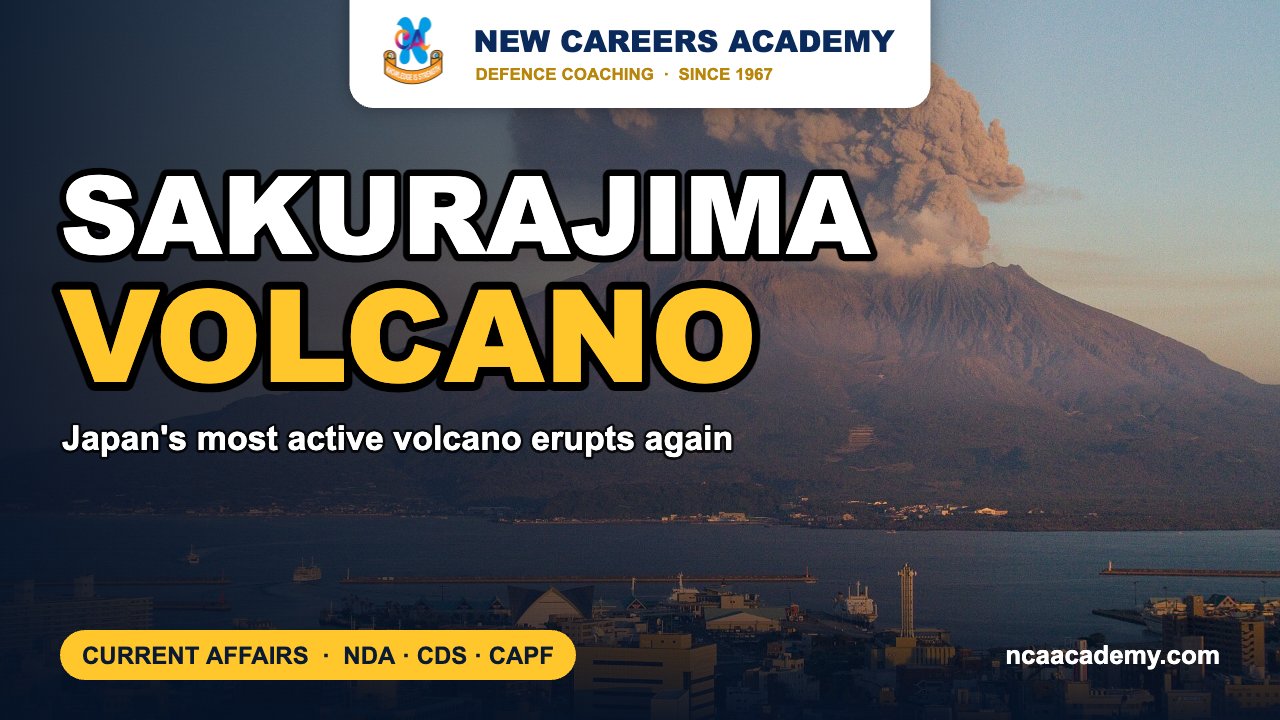
Quick answer: Sakurajima is an active stratovolcano on Kagoshima Bay in southern Kyushu, Japan, and one of the most active volcanoes in the country. It is in the news because on 28 October 2026 it threw up a huge ash column, about 2,200 m above its crater. Japan kept the volcano at alert Level 3 and issued ashfall warnings for parts of Kagoshima Prefecture.
Why Sakurajima is in the news
On Wednesday, 28 October 2026, at 11:58 a.m. local time, the Minamidake summit crater erupted. The ash column rose roughly 2,200 m above the crater and drifted south-east. A Reuters video report carried footage of the plume shot by a resident filming from Kagoshima. Forecasters expected moderately heavy ashfall on Sakurajima itself and lighter ash in nearby towns.
The volcano had been busy for weeks. The Japan Meteorological Agency (JMA), cited in the Smithsonian–USGS weekly summary, logged 25 eruptive events and 8 explosions at Minamidake between 19 and 26 October, with ash up to 1.8 km and blocks thrown 500 m. The alert stayed at Level 3 of JMA’s 5-level scale, which restricts access within about 1 km of the craters.
Key facts about Sakurajima
- Location: In Kagoshima Bay, southern Kyushu, only about 8 km from Kagoshima city across the water.
- Height: About 1,117 m.
- Type: A stratovolcano (composite cone) built of alternating layers of lava and ash.
- Parent caldera: It is a post-caldera volcano of the Aira caldera. The caldera covers the northern half of Kagoshima Bay and formed about 22,000 years ago in a huge eruption.
- Age: It began building about 13,000 years ago on the caldera’s southern rim.
- From island to peninsula: It was an island until the 1914 eruption, when lava joined it to the Osumi Peninsula.
- Active vent: The northern cone, Kitadake, stopped erupting about 4,850 years ago. Activity since then has come from Minamidake, the southern peak.
- Largest recorded eruption: 1471–76.
Sakurajima and the Pacific Ring of Fire
The Pacific Ring of Fire is the horseshoe-shaped belt of volcanoes and earthquake zones around the edges of the Pacific Ocean. Along most of it, one tectonic plate is being pushed down (subducted) beneath another. The sinking plate releases water into the hot mantle above it. That lowers the melting point of the rock and produces sticky, gas-rich magma. This is why Ring of Fire volcanoes such as Sakurajima, Mount Fuji and Mount St. Helens tend to erupt explosively and build steep stratovolcanoes.
Types of volcanoes: a quick comparison
The US Geological Survey groups volcanoes into four main kinds:
| Type | How it forms | Shape | Examples |
|---|---|---|---|
| Shield volcano | Thousands of very fluid basalt lava flows | Broad, gentle slopes, like a warrior’s shield | Mauna Loa and Kilauea (Hawaii) |
| Composite (stratovolcano) | Alternating layers of lava, ash, cinders and blocks around a central vent | Steep, tall, symmetrical cone | Mount Fuji (Japan), Cotopaxi (Ecuador), Mount St. Helens (USA), Sakurajima |
| Cinder cone | Gas-charged lava blown into the air, falling back as cinders around a single vent | Small cone with a bowl-shaped crater, rarely more than about 300 m high | Parícutin (Mexico), which grew on a farm in 1943 |
| Lava dome | Lava too viscous to flow far, piling up over the vent | Small, bulbous mound | Mont Pelée (Martinique), Lassen Peak (USA) |
India’s link: Barren Island
India’s only confirmed active volcano is on Barren Island in the Andaman Sea, about 138 km north-east of Port Blair. Like Sakurajima, it is a product of subduction. Here the Indian Plate is sinking beneath the Burma Plate. Its first recorded eruption was in 1787. After almost 150 years of quiet it erupted again in 1991. It has been active often since then, including ash plumes in 2025. Its eruptions are mostly mild Strombolian bursts. The uninhabited island is a wildlife sanctuary.
Exam angle: how NDA, CDS and CAPF can ask this
- Volcano types and their examples (shield–Mauna Loa, composite–Fuji, cinder cone–Parícutin) are classic NDA and CDS geography questions.
- Expect plate-boundary questions: subduction at convergent margins explains both Sakurajima and Barren Island.
- “India’s only active volcano” (Barren Island) and its location relative to Port Blair is a common one-liner.
- Volcanic ash endangers aviation, linking the topic to disaster management for CAPF and AFCAT.
Practice MCQs
Q1. Sakurajima volcano is located on which Japanese island?
(a) Honshu (b) Hokkaido (c) Kyushu (d) Shikoku
Answer: (c). It sits in Kagoshima Bay, southern Kyushu.
Q2. Which of the following is a shield volcano?
(a) Mount Fuji (b) Mauna Loa (c) Parícutin (d) Mount St. Helens
Answer: (b). Shield volcanoes are built of fluid basalt flows. Fuji and St. Helens are composite, and Parícutin is a cinder cone.
Q3. Sakurajima was joined to the Osumi Peninsula by lava from an eruption in:
(a) 1883 (b) 1914 (c) 1955 (d) 1991
Answer: (b). The 1914 eruption turned the island into a peninsula.
Q4. Barren Island volcano is formed by the subduction of the Indian Plate beneath which plate?
(a) Eurasian Plate (b) Burma Plate (c) Sunda Plate (d) Philippine Sea Plate
Answer: (b). It lies on the Andaman arc above the Burma Plate.
Frequently asked questions
Where is Sakurajima volcano?
It is in Kagoshima Bay on Kyushu island in southern Japan, about 8 km across the water from Kagoshima city.
What type of volcano is Sakurajima?
It is a stratovolcano (composite volcano) that grew on the southern rim of the Aira caldera.
What happened at Sakurajima in October 2026?
On 28 October 2026 the Minamidake crater sent ash about 2,200 m above the summit, which led to ashfall warnings. The JMA kept the alert at Level 3 of 5.
Why does Japan have so many volcanoes?
Japan lies on the Pacific Ring of Fire, where oceanic plates sink beneath neighbouring plates. The magma this produces feeds explosive volcanoes.
Which is India’s only active volcano?
Barren Island in the Andaman Sea, part of the Andaman and Nicobar Islands, about 138 km north-east of Port Blair.
Also read on NCA: NDMA and the Disaster Management (Amendment) Act 2024 | Monthly defence current affairs PDFs | Online NDA coaching
Sources: Reuters, Wake Up Singapore, Smithsonian/USGS weekly report via The Watchers, USGS: Principal Types of Volcanoes, Barren Island (reference). Facts as reported up to 31 October 2026.
Featured image background: Kimon Berlin / Wikimedia Commons, CC BY-SA 2.0.