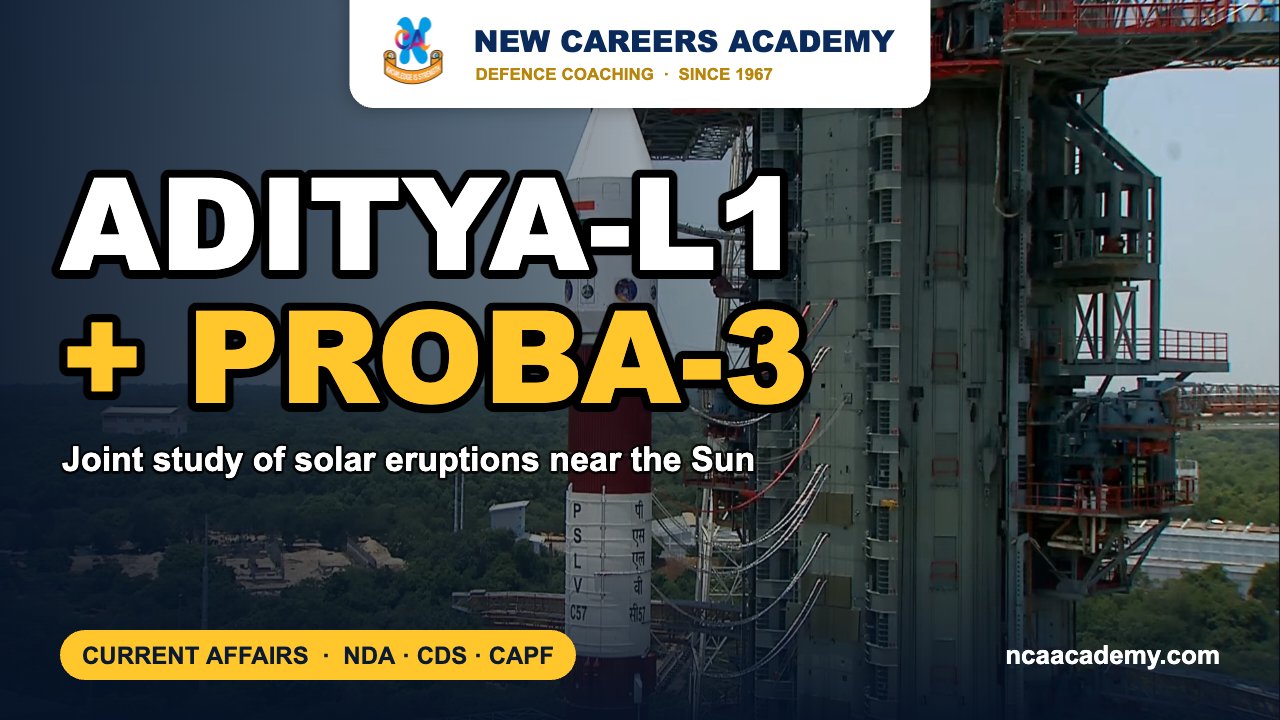
Quick answer: Scientists at the Indian Institute of Astrophysics (IIA), Bengaluru, have combined data from India’s Aditya-L1 (its VELC coronagraph) and the European Space Agency’s Proba-3 (its ASPIICS coronagraph) to study two solar eruptions close to the Sun. These eruptions are coronal mass ejections (CMEs), and this is the first published joint analysis by the two missions. ISRO announced the result on 15 October 2026.
Why Aditya-L1 and Proba-3 are in the news
ISRO says the study appeared in the journal Astronomy & Astrophysics (Agarwal, Mishra, Ramesh and colleagues, 2026). The team searched data from July to December 2025 and found only two CMEs recorded by both instruments at the same time: on 14 and 16 September 2025. In both cases, VELC on Aditya-L1 picked up the eruption at a very early stage. This matters because older coronagraphs could follow faint CMEs only partly in this region.
Key findings of the joint study
- Two CMEs, two speeds: the 14 September CME moved fast, at about 645 km/s. The 16 September CME was slow, at about 145 km/s, but expanded more strongly early on.
- Cross-check passed: mass and thermal-energy estimates from the two instruments agreed well, even though one takes images and the other measures spectra.
- Energy split: in the fast CME, thermal energy was only about 1 per cent of the total. In the slow CME, thermal energy rose until it equalled kinetic energy. Magnetic energy was comparable to or greater than kinetic energy in both.
- Complementary tools: VELC records spectra from 1.05 to 1.5 solar radii in the 5303 Å green coronal line, emitted by gas at about 2 million degrees. ASPIICS takes images from about 1.1 to 3 solar radii.
The two missions at a glance
Aditya-L1 is India’s first dedicated solar observatory. PSLV-C57 launched it on 2 September 2023, and it entered a halo orbit around the Sun–Earth L1 point on 6 January 2024, about 1.5 million km from Earth. Proba-3 is an ESA mission and the world’s first precision formation-flying mission. PSLV-C59 launched it from Sriharikota on 5 December 2024 as a commercial mission of NewSpace India Limited. It consists of two spacecraft, the Coronagraph Spacecraft and the Occulter Spacecraft, which fly about 150 m apart. The occulter casts a shadow on the coronagraph and so creates an artificial solar eclipse.
Aditya-L1’s seven payloads
| Type | Payload | What it studies |
|---|---|---|
| Remote sensing (4) | Visible Emission Line Coronagraph (VELC) | Corona: imaging and spectroscopy |
| Solar Ultraviolet Imaging Telescope (SUIT) | Photosphere and chromosphere in UV | |
| Solar Low Energy X-ray Spectrometer (SoLEXS) | Soft X-rays (Sun as a star) | |
| High Energy L1 Orbiting X-ray Spectrometer (HEL1OS) | Hard X-rays (Sun as a star) | |
| In-situ (3) | Aditya Solar wind Particle Experiment (ASPEX) | Solar wind protons and heavier ions |
| Plasma Analyser Package for Aditya (PAPA) | Solar wind electrons and heavier ions | |
| Advanced Tri-axial High Resolution Digital Magnetometers | Magnetic field at L1 |
Lagrange points in one line each
- L1: between the Sun and Earth. It gives an uninterrupted view of the Sun (Aditya-L1, SOHO).
- L2: beyond Earth, on the side away from the Sun. It suits deep-space astronomy (James Webb Space Telescope).
- L3: on the far side of the Sun, always hidden from Earth.
- L4 and L5: the stable points, 60° ahead of and behind Earth in its orbit. Trojan asteroids gather at these points.
- L1, L2 and L3 are unstable, so spacecraft parked there need regular course corrections.
What CMEs do to Earth and its technology
A CME throws billions of tonnes of magnetised plasma into space. According to ISRO, a CME that reaches Earth interacts with its magnetic field. The resulting disturbances can upset satellite communications, GPS signals and power grids. The armed forces rely on satellite navigation and communication links, so space-weather warnings matter to them. Near-Sun measurements like these help predict how a CME will evolve.
Exam angle: how NDA, CDS and CAPF can ask this
- Questions on Lagrange points come up often: which points are stable, and why L1 suits solar study.
- Mission-launcher matching is likely: Aditya-L1 with PSLV-C57, Proba-3 with PSLV-C59.
- Questions on the layers of the Sun (photosphere, chromosphere, corona) and what a coronagraph does fall under General Science.
Practice MCQs
Q1. ESA’s Proba-3 mission was launched by:
(a) GSLV-F15 (b) PSLV-C59 (c) LVM3-M5 (d) PSLV-C57
Answer: (b) — on 5 December 2024 from Sriharikota. PSLV-C57 carried Aditya-L1.
Q2. Which Sun–Earth Lagrange points are stable?
(a) L1 and L2 (b) L2 and L3 (c) L4 and L5 (d) L1 and L3
Answer: (c) — L4 and L5 are stable; L1 to L3 are unstable.
Q3. Aditya-L1’s VELC observes the corona in the green emission line at:
(a) 6563 Å (b) 5303 Å (c) 3934 Å (d) 1216 Å
Answer: (b) — the 5303 Å line, emitted by highly ionised iron.
Q4. How many scientific payloads does Aditya-L1 carry?
(a) Five (b) Six (c) Seven (d) Nine
Answer: (c) — four remote-sensing and three in-situ payloads.
Frequently asked questions
What did the Aditya-L1 and Proba-3 joint study find?
It measured the mass, density and energy of two CMEs (14 and 16 September 2025) close to the Sun. The CMEs had very different speeds and energy splits, and the two instruments’ estimates agreed.
What is VELC?
VELC is the Visible Emission Line Coronagraph on Aditya-L1. IIA Bengaluru built it with ISRO, and it records spectra of the inner corona in the 5303 Å green line.
What is ASPIICS on Proba-3?
ASPIICS is the coronagraph carried by Proba-3’s Coronagraph Spacecraft. It images the corona from about 1.1 to 3 solar radii, using the shadow cast by the Occulter Spacecraft flying about 150 m away.
Why is Aditya-L1 placed at L1?
From a halo orbit around L1, the Sun is never blocked by Earth or the Moon. This allows continuous observation of the Sun.
Also read on NCA: ISRO’s next-decade missions and challenges | Monthly defence current affairs PDFs | NDA coaching in Chandigarh
Sources: ISRO (15 Oct 2026), ISRO: Aditya-L1, ISRO: PSLV-C59/Proba-3, ISRO: VELC CME observations, NASA: Lagrange points. Facts as reported up to 31 October 2026.
Featured image background: Indian Space Research Organization (ISRO) / Wikimedia Commons, CC BY 3.0.