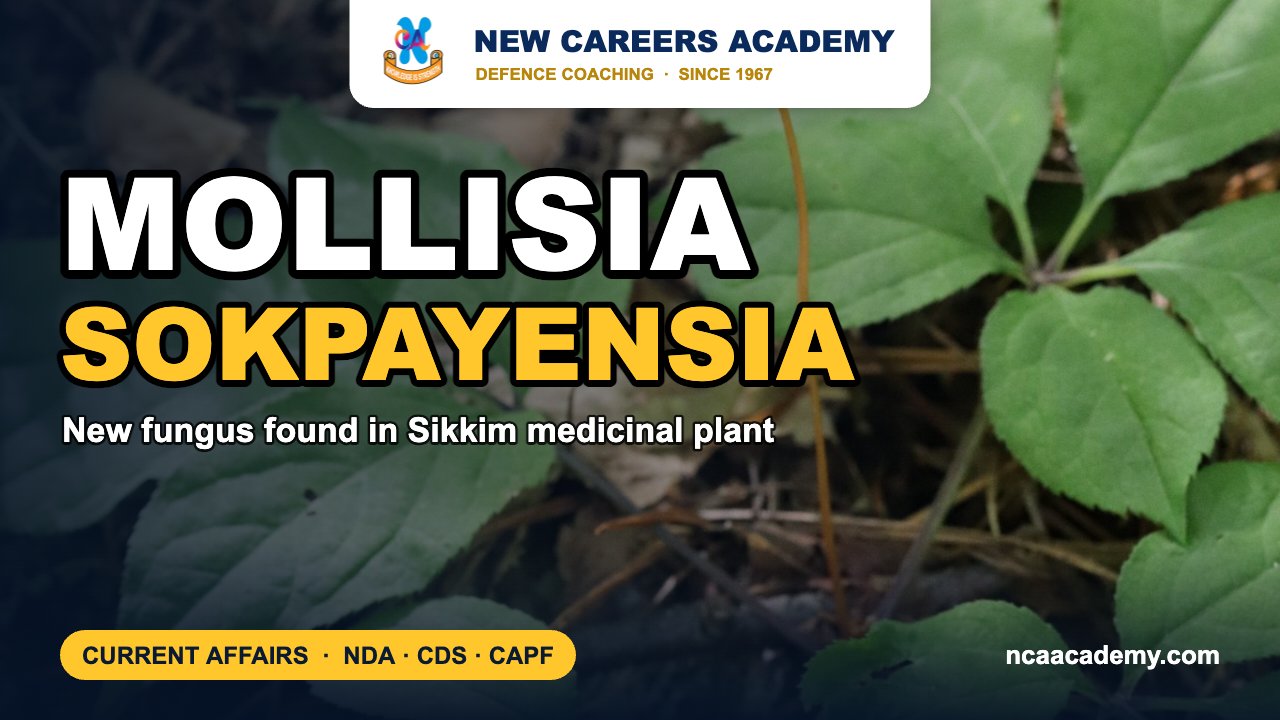
Quick answer: Mollisia sokpayensia is a newly described endophytic fungus, meaning a fungus that lives inside a healthy plant. It was isolated from the rhizome of Panax sokpayensis, a rare ginseng species of the Sikkim Himalaya. A team led by Manipur microbiologist Dr Laishram Shantikumar Singh announced the discovery in late October 2026.
Why Mollisia sokpayensia is in the news
India Today NE reported on 29 October 2026 that the new species appears in the journal Fungal Diversity (2026, Volume 136), in its series of notes on new fungal species and records from around the world. The team members are Subecha Rai, Gajanan V. Mane, Dr Rohit Sharma and Dr Thounaojam Salvia. Dr Singh and Dr Salvia both come from Khangabok village in Thoubal district, Manipur. The Department of Biotechnology (DBT) funded the project.
Key facts about Mollisia sokpayensia
- Host: the rhizome (underground stem) of Panax sokpayensis. The fungus is named after this host plant.
- Collection site: Jorbotay in Uttarey, West Sikkim, at about 1,800–2,300 m above sea level.
- Lifestyle: an endophyte. It lives inside healthy plant tissue without causing visible disease.
- Lab behaviour: it was grown on Potato Dextrose Agar and grows slowly. At 28°C the colonies start out cottony and brown and darken to blackish-brown. They reach about 8 cm across in two weeks.
- Classification: the genus Mollisia belongs to the family Mollisiaceae, order Helotiales, phylum Ascomycota (the sac fungi).
- Use: any medicinal or biotech value is still untested. The researchers say further work is needed.
Endophyte, epiphyte or parasite: know the difference
| Type | Where it lives | Effect on host | Example |
|---|---|---|---|
| Endophyte | Inside living plant tissue (roots, stems, leaves) | No visible disease; often neutral or helpful | Mollisia sokpayensia in a Panax rhizome |
| Epiphyte | On the surface of another plant, for support only | Does not draw food from the host | Many orchids, mosses and lichens on tree bark |
| Parasite | On or inside the host | Takes nutrients and harms the host | Cuscuta (dodder); rust and smut fungi |
Why Panax and the Sikkim Himalaya matter
Panax is the ginseng genus, and ginseng sells at high prices worldwide. Panax sokpayensis was described as a new species from Sikkim in 2009. Its rhizome has long been used in traditional medicine. Collecting such rare plants from the wild puts pressure on their populations. Scientists therefore look at endophytes as a possible alternative: a fungus grown in a lab might one day yield useful compounds without the plant being dug up again and again. The news report points out that this idea still has to be proven.
Sikkim lies in the Eastern Himalaya, and its steep altitude gradient packs many habitats into a small area. The report notes that the microbes of the Indian Himalaya are far less studied than those on the Chinese side. Every new species described adds to India’s biodiversity records and supports its commitments under the Convention on Biological Diversity.
Exam angle: how NDA, CDS and CAPF can ask this
- Biology questions on terms such as endophyte, epiphyte, parasite, saprophyte and symbiosis are standard in the General Science section.
- Questions on India’s biodiversity hotspots (Himalaya, Indo-Burma, Western Ghats–Sri Lanka, Sundaland) can be linked to North-East discoveries.
- Expect state-based GK: a species is discovered in Sikkim, so which hotspot or region does it fall in?
Practice MCQs
Q1. Mollisia sokpayensia was isolated from:
(a) Leaves of rhododendron (b) The rhizome of Panax sokpayensis (c) Bark of the Himalayan yew (d) Roots of rice
Answer: (b) — it was found in the rhizome of a Sikkim ginseng species.
Q2. An endophytic fungus is one that:
(a) Grows only on dead wood (b) Lives inside healthy plant tissue without causing visible disease (c) Grows on leaf surfaces for support (d) Always kills its host
Answer: (b) — that is the definition of an endophyte.
Q3. Plants of the genus Panax are commonly known as:
(a) Ginseng (b) Cardamom (c) Yew (d) Orchids
Answer: (a) — Panax is the ginseng genus.
Q4. The genus Mollisia belongs to which fungal phylum?
(a) Basidiomycota (b) Ascomycota (c) Zygomycota (d) Chytridiomycota
Answer: (b) — it is a sac fungus in the order Helotiales.
Frequently asked questions
What is Mollisia sokpayensia?
It is a new species of endophytic fungus, described in 2026, that was isolated from the rhizome of the rare Sikkim ginseng Panax sokpayensis.
Who discovered Mollisia sokpayensia?
A team of microbiologists led by Dr Laishram Shantikumar Singh of Manipur, with DBT funding.
Where was the host plant collected?
At Jorbotay in Uttarey, West Sikkim, at roughly 1,800–2,300 m above sea level.
Does the fungus have medicinal uses?
Not yet known. Its biological properties still have to be studied, though endophytes of medicinal plants are often screened for useful compounds.
Also read on NCA: Monthly defence current affairs PDFs | Online NDA coaching
Sources: India Today NE (29 Oct 2026), Mollisia (taxonomy), Systematic Botany (2009), Panax sokpayensis. Facts as reported up to 31 October 2026.
Featured image background: iNaturalist.org (Nina Filippova) (Nina%20Filippova) / Wikimedia Commons, CC BY 4.0.