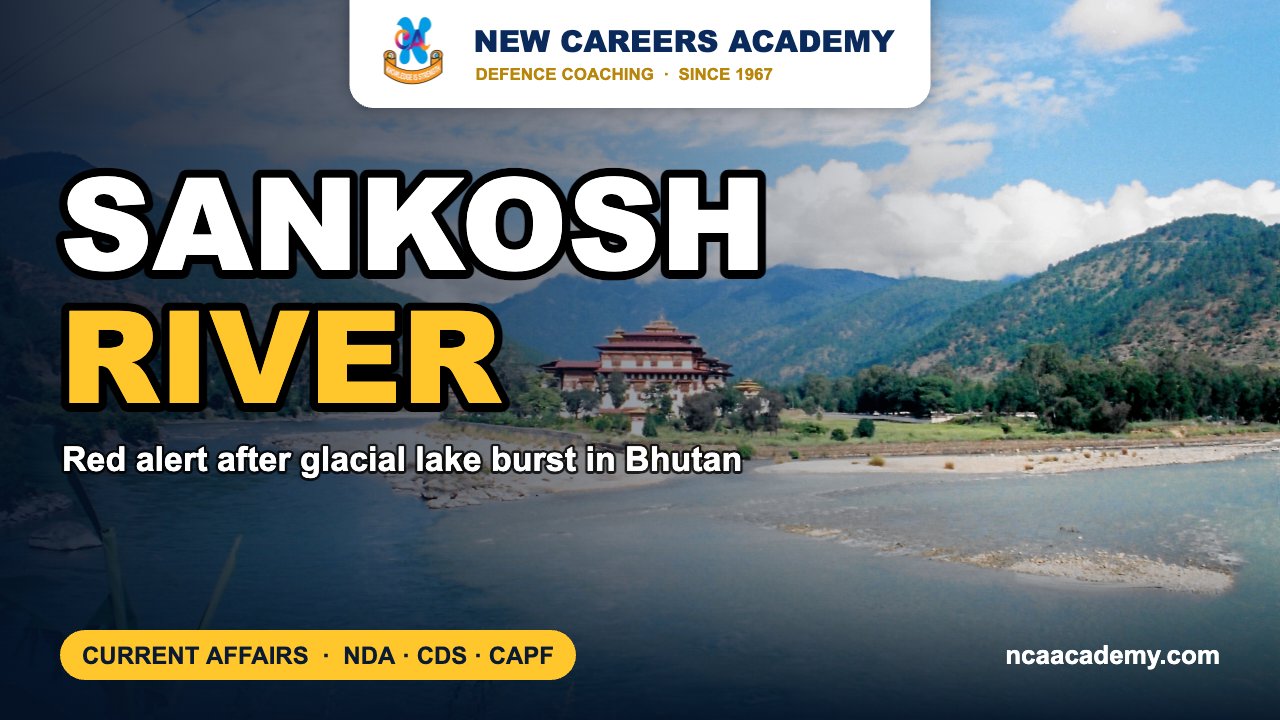
Quick answer: The Sankosh is a Himalayan river that rises in northern Bhutan, where it is called the Puna Tsang Chu, and joins the Brahmaputra in Assam. It is in the news because a glacial lake burst in Bhutan’s Gasa district on 29 October 2026. The Sankosh system was put on red alert, and more than 10,000 people in West Bengal’s Alipurduar district were moved to safety.
Why the Sankosh River is in the news
On the evening of 29 October 2026, Shintaphu Lake (also spelt Sintaphu), below Wakila mountain in Bhutan’s Gasa district, suddenly released its water into the upper Mo Chhu. The flood damaged the Gasa Tshachu hot springs and parts of the Punakha–Gasa highway. No deaths or injuries were reported.
Because the Mo Chhu feeds the Punatsangchhu, which enters India as the Sankosh, the Union water ministry warned of a sudden rise in Alipurduar (West Bengal) and Dhubri (Assam). Officials said the surge could reach the border within six to eight hours.
Alipurduar Superintendent of Police Amit Kumar Shaw said 4,000 to 5,000 people were placed in temporary shelters, mostly schools, and over 6,000 more moved to safer ground. Alerts also covered Jalpaiguri, Cooch Behar and Darjeeling, and NDRF and SDRF teams were put on standby. The flow later eased slightly, but the red alert stayed.
Key facts about the Sankosh River
- Source and outfall: It rises in northern Bhutan and joins the Brahmaputra in Assam.
- Bhutanese name: Below the confluences near Wangdue Phodrang it is called the Puna Tsang Chu (often written Punatsangchhu).
- Headstreams: Its two largest tributaries, the Mo Chhu and Pho Chhu, meet at Punakha, just below the famous Punakha Dzong.
- Interstate boundary: After entering India, its lower course runs along the Assam–West Bengal border.
- Bank: It is a north-bank (right-bank) tributary of the Brahmaputra.
- Bhutan’s four major rivers: Sankosh, Manas (Drangme Chhu), Torsa (Amo Chu) and Raidak (Wang Chu).
What is a glacial lake outburst flood (GLOF)?
As Himalayan glaciers retreat, meltwater collects in lakes held back by loose moraine (rock and sediment dumped by the glacier) or by ice. A GLOF happens when that natural dam fails or is overtopped, and the stored water rushes out all at once. Triggers include avalanches, landslides, very heavy rain and earthquakes.
A GLOF is worse than an ordinary flood because it is fast (hours, not days), it carries debris such as boulders and timber, and it can cross borders. Here a lake in northern Bhutan put two Indian states on alert.
Shintaphu is one of the 17 glacial lakes Bhutan classifies as potentially dangerous. Sirens were sounded along the Mo Chhu, and India’s Central Water Commission tracked the surge at stations including Barobisha and Golakganj.
Brahmaputra’s right-bank rivers at a glance
| River | Rises in | Exam-worthy point |
|---|---|---|
| Subansiri | Tibet (Chayul Chu) | About 518 km. Cited as the Brahmaputra’s largest tributary. Lower Subansiri hydro project. |
| Kameng (Jia Bharali) | Tawang district, Arunachal Pradesh | Joins near Tezpur. Pakke Tiger Reserve on its east bank. |
| Manas | Headwaters in Tibet and Tawang (Drangme Chhu in Bhutan) | Bhutan’s largest river system. Joins near Jogighopa. Flows through Manas National Park (UNESCO site). |
| Sankosh | Northern Bhutan (Puna Tsang Chu) | Mo Chhu + Pho Chhu at Punakha. Lower course on the Assam–West Bengal border. |
| Teesta | Sikkim Himalaya | Joins the Brahmaputra (Jamuna) inside Bangladesh. |
Do not confuse these with south-bank (left-bank) tributaries such as the Dhansiri, Kopili, Burhi Dihing and Disang. Paper-setters often mix the two banks in one option list.
Exam angle: how NDA, CDS and CAPF can ask this
- Questions on the tributaries of the Brahmaputra, and which bank each joins from, are common in NDA and CDS geography.
- River names in Bhutan and Tibet (Puna Tsang Chu, Drangme Chhu, Wang Chu, Amo Chu, Chayul Chu) work well as match-the-following options.
- GLOFs fit the disaster management part of the CAPF syllabus, and they also link to climate change and glacier retreat in the Himalaya.
Practice MCQs
Q1. Inside Bhutan, the Sankosh is called:
(a) Wang Chu (b) Amo Chu (c) Puna Tsang Chu (d) Drangme Chhu
Answer: (c). Wang Chu is the Raidak, Amo Chu is the Torsa and Drangme Chhu is the Manas.
Q2. Which two rivers meet at Punakha to form the main stream of the Sankosh?
(a) Mo Chhu and Pho Chhu (b) Paro Chhu and Thimphu Chhu (c) Kuri Chhu and Mangde Chhu (d) Tang Chhu and Daga Chhu
Answer: (a). The two rivers meet just below Punakha Dzong.
Q3. Which of the following is NOT a north-bank tributary of the Brahmaputra?
(a) Subansiri (b) Manas (c) Kopili (d) Kameng
Answer: (c). The Kopili joins from the south (left) bank.
Q4. The October 2026 glacial lake outburst that put the Sankosh on red alert happened in which district of Bhutan?
(a) Paro (b) Gasa (c) Trashigang (d) Samtse
Answer: (b). Shintaphu Lake is in Gasa district, at the head of the Mo Chhu.
Frequently asked questions
Where does the Sankosh River originate?
It rises in northern Bhutan. Its main headstreams, the Mo Chhu and Pho Chhu, meet at Punakha, and the river then flows south into India and joins the Brahmaputra in Assam.
Why was the Sankosh put on red alert in October 2026?
Shintaphu Lake in Bhutan’s Gasa district burst on 29 October 2026 and sent floodwater down the Mo Chhu–Punatsangchhu system. Downstream, that water flows into the Sankosh.
How many people were evacuated in Alipurduar?
More than 10,000. Police said 4,000 to 5,000 were placed in relief shelters and over 6,000 moved to safer places.
What is a GLOF?
A glacial lake outburst flood is the sudden release of water from a lake held back by glacial moraine or ice. It happens when that natural dam is breached or overtopped.
Is the Sankosh a left-bank or right-bank tributary of the Brahmaputra?
It joins from the north, so it is a right-bank (north-bank) tributary, like the Manas, Kameng and Subansiri.
Also read on NCA: NDMA and the Disaster Management (Amendment) Act 2024 | Monthly defence current affairs PDFs | NDA coaching in Chandigarh
Sources: The Statesman, The Star (via The Statesman/ANN), RNA, Times Kuwait, Sankosh River (reference). Facts as reported up to 31 October 2026.
Featured image background: Taxidesign / Wikimedia Commons, CC BY 2.0.