Quick answer: Punah Bharan is a mobile app and web portal that helps users find suitable spots for artificial groundwater recharge within up to 3 km of their location. It was launched by the Union Jal Shakti Minister, as announced on 28 October 2026, and was developed by BISAG-N with the National Water Mission.
Why the Punah Bharan app is in the news
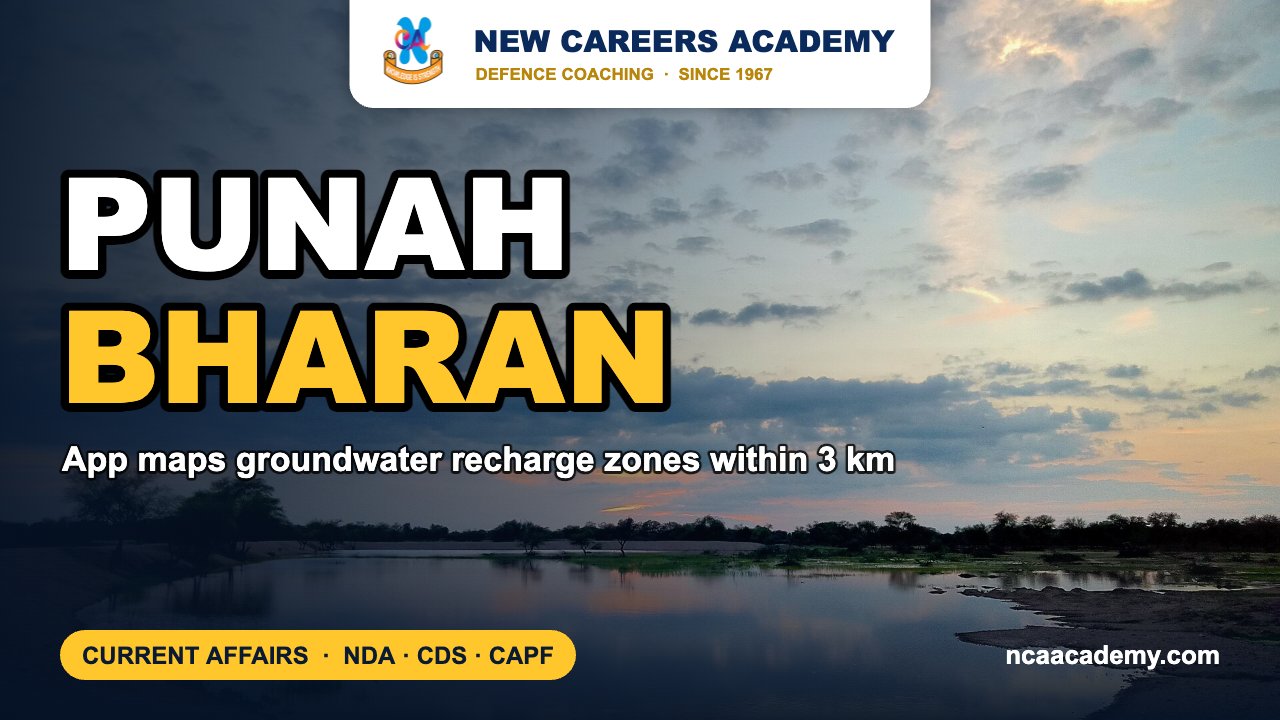
According to a Ministry of Jal Shakti release issued through PIB on 28 October 2026, the Union Minister of Jal Shakti launched the Punah Bharan Mobile Application to support scientific planning of groundwater recharge. “Punah bharan” means “refilling” or “recharge”. The tool was built by the Bhaskaracharya National Institute for Space Applications and Geo-informatics (BISAG-N), working jointly with the National Water Mission (NWM) of the Department of Water Resources, River Development and Ganga Rejuvenation.
Key facts about Punah Bharan
- Main feature: identifies potential artificial recharge zones within a radius of up to 3 km of the user and suggests suitable recharge structures for local conditions.
- Web portal: offers map layers and GIS tools, including village-wise maps of where Artificial Recharge Structures (ARS) suit best.
- Data used: geospatial layers on rainfall, slope, drainage, water-table depth and aquifer yield.
- Developer: BISAG-N, Gandhinagar, an autonomous scientific society under the Ministry of Electronics and Information Technology (MeitY), which was raised to national status in 2020.
- Partner: the National Water Mission, one of the eight missions under the National Action Plan on Climate Change (2008).
Typical artificial recharge structures include check dams, percolation tanks, recharge shafts and recharge wells. They hold rainwater long enough for it to seep down into aquifers. The app aims to place them where soil, slope and water level suit recharge, instead of building them by guesswork. NCA readers may compare this with the traditional surangam tunnel wells of Kerala, a traditional way of tapping groundwater.
How stressed is India’s groundwater? CGWB categories
The Central Ground Water Board (CGWB) and States jointly carry out the annual Dynamic Ground Water Resources assessment. The stage of groundwater extraction is annual extraction as a percentage of the annual extractable resource. Each block, taluk or mandal is graded as below (figures for 2025, as given in a Rajya Sabha reply in July 2026).
| Category | Stage of extraction | Units in 2025 | Share |
|---|---|---|---|
| Safe | Up to 70% | 4,946 | 73.14% |
| Semi-critical | 70% to 90% | 758 | 11.21% |
| Critical | 90% to 100% | 201 | 2.97% |
| Over-exploited | Above 100% | 730 | 10.8% |
| Saline | Groundwater too salty for use | 127 | 1.88% |
- Total assessment units: 6,762.
- National stage of extraction: 60.63 per cent in 2025, slightly up from 60.48 per cent in 2024 but down from 63.33 per cent in 2017.
- Highest stage: Punjab (156.36%), then Rajasthan (147.11%) and Haryana (136.75%).
India’s main groundwater and water schemes
| Scheme | Ministry / nodal body | Key points |
|---|---|---|
| Atal Bhujal Yojana | Jal Shakti (DoWR, RD&GR) | Community-led groundwater management in 8,203 water-stressed gram panchayats of 80 districts in seven states: Gujarat, Haryana, Karnataka, Madhya Pradesh, Maharashtra, Rajasthan, Uttar Pradesh |
| Jal Shakti Abhiyan: Catch the Rain | Jal Shakti | Campaign for rainwater harvesting and recharge; “Catch the Rain” theme taken up from 2021; over 2 crore conservation and recharge works reported |
| Mission Amrit Sarovar | Rural Development | Launched in 2022 to build or revive ponds; nearly 69,000 Amrit Sarovars completed |
| Jal Sanchay Jan Bhagidari | Jal Shakti | Launched in 2024; over 1.55 crore recharge and storage structures created |
| National Water Mission | Jal Shakti | One of eight NAPCC missions; promotes water conservation and better water-use efficiency |
Water is a State subject (Entry 17 of the State List), so the Centre mainly provides technical and financial support.
Exam angle: how NDA, CDS and CAPF can ask this
- Expect a direct question on which body developed the app (BISAG-N) or the 3 km radius in CDS and CAPF current affairs.
- CGWB categories and the state with the highest extraction (Punjab) are good one-line geography questions.
- Questions on the eight missions of the NAPCC appear in environment sections of NDA and CDS papers.
Practice MCQs
Q1. The Punah Bharan app was developed by:
(a) ISRO (b) CGWB (c) BISAG-N with the National Water Mission (d) NRSC
Answer: (c) — as per the Jal Shakti Ministry release.
Q2. Punah Bharan identifies recharge zones within a radius of up to:
(a) 1 km (b) 3 km (c) 5 km (d) 10 km
Answer: (b) — up to 3 km.
Q3. A groundwater assessment unit with a stage of extraction of 95 per cent is classified as:
(a) Safe (b) Semi-critical (c) Critical (d) Over-exploited
Answer: (c) — 90 to 100 per cent is critical.
Q4. Which state had the highest stage of groundwater extraction in 2025?
(a) Rajasthan (b) Haryana (c) Punjab (d) Delhi
Answer: (c) — Punjab, at 156.36 per cent.
Frequently asked questions
What is the Punah Bharan app?
It is a mobile app and web portal of the Ministry of Jal Shakti that helps users find suitable sites and structures for artificial groundwater recharge within up to 3 km of their location.
Who developed Punah Bharan?
It was developed by BISAG-N, Gandhinagar, together with the National Water Mission of the Department of Water Resources, RD and GR.
What data does Punah Bharan use?
It uses geospatial data on rainfall, slope, drainage, water-table depth and aquifer yield to map recharge potential.
What does “over-exploited” mean for groundwater?
An assessment unit is over-exploited when annual groundwater extraction is more than the annual extractable recharge, that is, the stage of extraction is above 100 per cent.
Which states are covered under Atal Bhujal Yojana?
Gujarat, Haryana, Karnataka, Madhya Pradesh, Maharashtra, Rajasthan and Uttar Pradesh.
Also read on NCA: Surangam tunnel wells of Kerala | Monthly defence current affairs PDFs | Online NDA coaching
Sources: PIB, Ministry of Jal Shakti, PTI via ETV Bharat (Rajya Sabha reply), Digital India: BISAG-N. Facts as reported up to 1 November 2026.
Featured image background: Amar singh kangarot / Wikimedia Commons, CC BY-SA 4.0.