Quick answer: India’s ties with the five Central Asian republics are back in the news. On 23 October 2026, External Affairs Minister S. Jaishankar met Uzbek Foreign Minister Bakhtiyor Saidov in Baku, Azerbaijan, and the two pressed for quick delivery of the deals signed in August 2026, when India and Uzbekistan raised their ties to a Comprehensive Strategic Partnership.
Why India–Central Asia relations are in the news
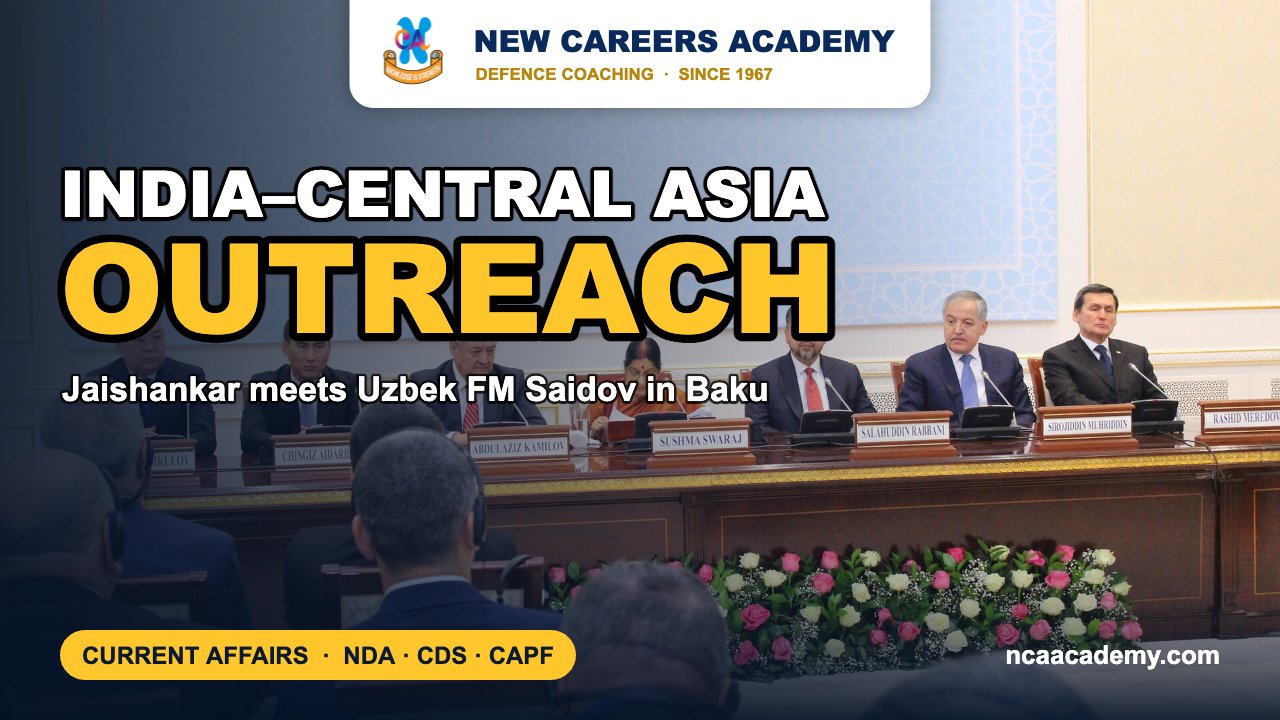
Jaishankar spent the day in Baku on Friday, 23 October 2026. PTI reported that he called on President Ilham Aliyev and held talks with Foreign Minister Jeyhun Bayramov on trade, investment, energy, tourism and connectivity. In the same city he met Saidov, who had come from Georgia after the first joint meeting of the foreign ministers of Georgia and the five Central Asian states. Uzbekistan’s Dunyo agency reported that they stressed timely implementation of agreements reached “at the highest level”.
Those agreements date from PM Narendra Modi’s visit to Tashkent on 29–30 August 2026, the 15th anniversary year of the India–Uzbekistan Strategic Partnership. During the visit the two sides:
- raised ties to a Comprehensive Strategic Partnership;
- agreed on a long-term arrangement for uranium supply from Uzbekistan;
- set a target of US$5 billion in trade by 2030 (trade had just crossed US$1 billion);
- signed 11 agreements, including in mining and tourism.
Modi also received Uzbekistan’s Oliy Darajali Do’stlik (Order of the Highest Friendship) before leaving for the SCO summit in Bishkek.
Key facts about India–Central Asia relations
| Country | Capital | Area (sq km) | Point to remember |
|---|---|---|---|
| Kazakhstan | Astana | 2,724,900 | World’s largest landlocked country; Strategic Partner of India since 2009 |
| Kyrgyzstan | Bishkek | 199,950 | Farthest landlocked country from any ocean |
| Tajikistan | Dushanbe | 142,550 | India upgraded the Ayni airfield near Dushanbe |
| Turkmenistan | Ashgabat | 488,100 | India supports its entry into the INSTC |
| Uzbekistan | Tashkent | 448,978 | Doubly landlocked; Comprehensive Strategic Partner of India |
- In July 2015, Modi became the first Indian PM to visit all five republics.
- India announced a US$1 billion Line of Credit for infrastructure in the region in 2020.
How India’s Central Asia policy was built
| When | Milestone |
|---|---|
| June 2012 | MoS for External Affairs E. Ahamed announced the Connect Central Asia policy at a Track-II dialogue in Bishkek, seeking political, economic and people-to-people links with each country and the region as a whole. |
| Jan 2019 | First foreign-minister-level India–Central Asia Dialogue, held in Uzbekistan. |
| 27 Jan 2022 | First India–Central Asia Summit, held online. Leaders agreed to meet every two years and set up working groups, including one on Chabahar port. |
| 6 June 2025 | Fourth Dialogue in New Delhi; an India–Central Asia Digital Partnership Forum was agreed, with Uzbekistan to host its first meeting. |
The second summit is still pending. The 2025 joint statement aimed for that year, but an MP-IDSA brief of 27 August 2026 noted that no date had been fixed.
Connectivity: why Chabahar and the INSTC matter
All five republics are landlocked, and MP-IDSA described poor connectivity as a “major impediment” to India’s trade with them back in 2012. India is working on two routes:
- International North-South Transport Corridor (INSTC): a multi-modal freight network of about 7,200 km linking India with Iran, the Caspian region, Russia, Central Asia and Europe. Azerbaijan is also invested in it, which explains why connectivity was discussed in Baku. Kazakhstan is developing an eastern branch of the corridor.
- Chabahar port, Iran: Central Asian states have shown interest in the Shahid Beheshti Terminal, and both sides want simpler transit rules, including wider use of TIR Carnets.
Defence ties exist too: India trained Tajik personnel and upgraded Ayni. NCA has covered India’s later exit from that base (link below).
Exam angle: how NDA, CDS and CAPF can ask this
- Expect map-based questions that pair each republic with its capital, or ask which countries are landlocked or doubly landlocked.
- INSTC and Chabahar are standard questions on connectivity; learn the route India–Iran–Caspian–Russia.
- Dates such as Connect Central Asia (2012) and the first summit (January 2022) suit one-liner questions.
Practice MCQs
Q1. Which of these is a doubly landlocked country?
(a) Kazakhstan (b) Turkmenistan (c) Uzbekistan (d) Kyrgyzstan
Answer: (c) — all of Uzbekistan’s neighbours are themselves landlocked.
Q2. India’s “Connect Central Asia” policy was announced in:
(a) Tashkent (b) Bishkek (c) Astana (d) Dushanbe
Answer: (b) — at a Track-II dialogue in Bishkek in June 2012.
Q3. The first India–Central Asia Summit was held in:
(a) January 2022, online (b) June 2025, New Delhi (c) July 2015, Astana (d) August 2026, Tashkent
Answer: (a) — it took place virtually on 27 January 2022.
Q4. Which pairs are correct? 1. Turkmenistan – Ashgabat 2. Tajikistan – Bishkek 3. Kazakhstan – Astana
(a) 1 and 2 only (b) 1 and 3 only (c) 2 and 3 only (d) 1, 2 and 3
Answer: (b) — Tajikistan’s capital is Dushanbe; Bishkek is in Kyrgyzstan.
Frequently asked questions
Which are the five Central Asian republics?
Kazakhstan, Kyrgyzstan, Tajikistan, Turkmenistan and Uzbekistan, with capitals at Astana, Bishkek, Dushanbe, Ashgabat and Tashkent.
Why did Jaishankar meet the Uzbek foreign minister in Baku?
Both were in Azerbaijan on 23 October 2026. They reviewed ties and called for timely implementation of the agreements from PM Modi’s August 2026 visit to Tashkent.
What did India and Uzbekistan agree in August 2026?
They formed a Comprehensive Strategic Partnership, agreed on long-term uranium supply, set a US$5 billion trade target for 2030 and signed 11 agreements.
How often is the India–Central Asia Summit meant to meet?
Every two years, as agreed at the first summit on 27 January 2022. The second summit has not yet been held.
Also read on NCA: India withdraws from Ayni airbase | Monthly defence current affairs PDFs | CDS coaching in Chandigarh
Sources: PTI via DT Next, Dunyo, ThePrint, Embassy of India, Astana, MP-IDSA (2026), MP-IDSA (2012), The Tribune, Wikipedia. Facts as reported up to 5 November 2026.
Featured image background (representative): Ministry of External Affairs / Wikimedia Commons, GODL-India.