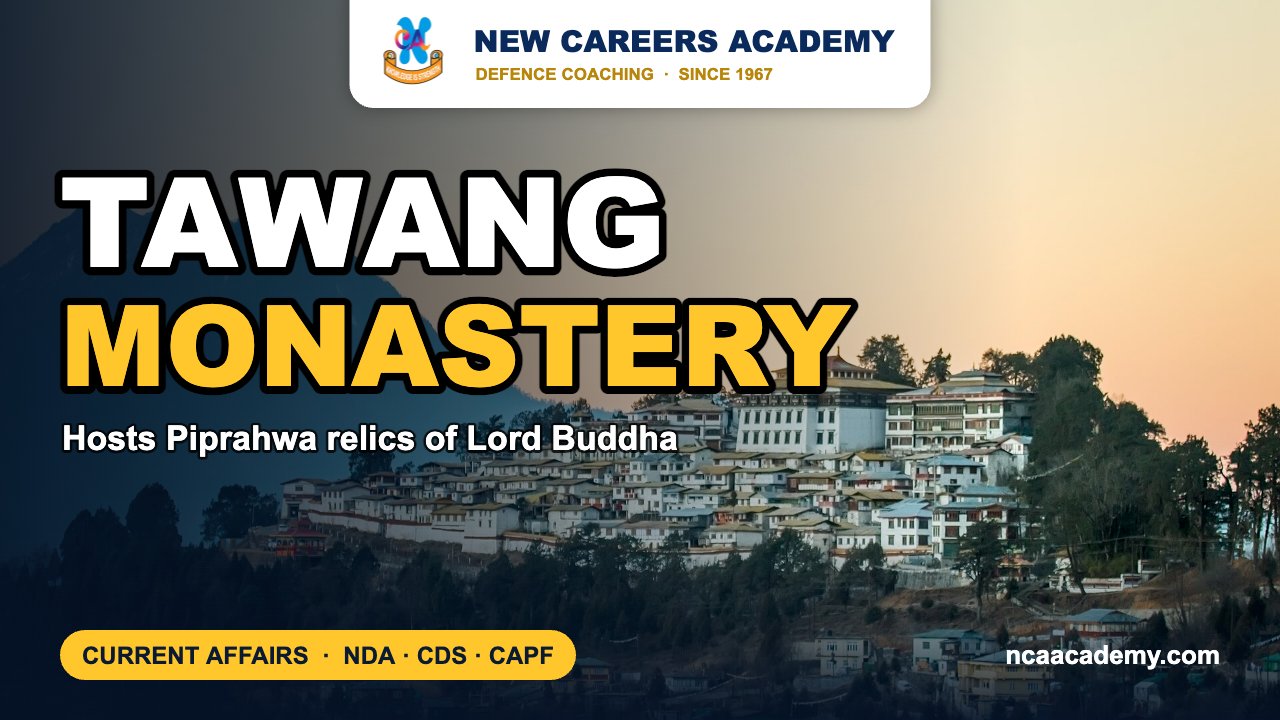
Quick answer: Tawang Monastery (Gaden Namgyal Lhatse) in Arunachal Pradesh is India’s largest Buddhist monastery. On 31 October 2026 it became the first stop of a Ministry of Culture exposition of the Piprahwa relics of Lord Buddha. The relics are open for public darshan at Tawang from 1 to 7 November 2026.
Why Tawang Monastery is in the news
The Ministry of Culture is organising an exposition of the holy relics of Shakyamuni Buddha across Arunachal Pradesh from 31 October to 21 November 2026. It is doing so together with the state government, the International Buddhist Confederation (IBC) and the National Museum, New Delhi, according to PIB and All India Radio. Union Culture and Tourism Minister Gajendra Singh Shekhawat was named as the chief guest for the inaugural ceremony at Tawang Monastery on 31 October. The relics were flown in from the National Museum using special Indian Air Force aircraft and helicopters, because the terrain is difficult.
The exposition coincides with Lhabab Düchen, a Tibetan Buddhist festival that marks the Buddha’s descent from the heavenly realm. On 2 November, Chief Minister Pema Khandu attended the opening of an international conference at Tawang’s Kala Wangpo Convention Centre, held alongside the exposition. Its theme was “Buddhism: Dissemination in the Himalayan Region and Beyond”, and it brought together delegates from India, Nepal, Sri Lanka, Myanmar, Malaysia, Indonesia and Germany.
Exposition schedule
| Dates (2026) | Venue | Buddhist tradition of the area |
|---|---|---|
| 31 Oct (inauguration), 1–7 Nov | Tawang Monastery (Gaden Namgyal Lhatse), Tawang | Mahayana/Vajrayana |
| 8–13 Nov | TGL Monastery (Lower Gompa), Bomdila | Mahayana/Vajrayana |
| 14–20 Nov | Golden Pagoda, Namsai | Theravada |
| 21 Nov | Relics return to National Museum, New Delhi | — |
Key facts about the Piprahwa relics
- Site: Piprahwa in Siddharthnagar district of Uttar Pradesh, which is linked to ancient Kapilavastu and the Shakya clan of the Buddha.
- First discovery: in 1898, British engineer William Claxton Peppé dug into a stupa there and found reliquaries holding bone fragments and precious objects.
- Later excavation: the Archaeological Survey of India found more relics during digs between 1971 and 1977.
- Where kept: of the 22 bone fragments from the later digs, 20 are in the National Museum, New Delhi and 2 in the Indian Museum, Kolkata.
- Exhibition: the IBC is also showing “Unearthing the Sacred Piprahwa”, which traces the discovery and the effort to bring this heritage back to India.
Key facts about Tawang Monastery
- Name: Gaden Namgyal Lhatse, usually translated as “divine paradise of complete victory”.
- Founded: 1680–81 by Merak Lama Lodre Gyatso, at the wish of the 5th Dalai Lama, Ngawang Lobsang Gyatso.
- School: the Gelug school of Tibetan Buddhism.
- Size: it is the largest Buddhist monastery in India. It is three storeys high, has a 282 m (925 ft) outer wall and 65 residential buildings.
- Location: on a ridge at about 3,000 m (10,000 ft) above the Tawang Chu valley, close to the borders with China and Bhutan.
- Treasures: its library holds the Kangyur (the Buddha’s teachings) and Tengyur (commentaries). The main hall (Dukhang), built in 1860–61, houses a gilded Buddha image about 5.5 m (18 ft) tall.
- Festival: Torgya, an annual Monpa festival with masked dances, is held only at this monastery.
Tawang in India’s strategic history
Tawang came under British India through the Simla Agreement of 1913–14. Chinese forces occupied the area, including the monastery, for about six months during the 1962 war. In 1959, the 14th Dalai Lama sheltered at the monastery for a few days after escaping from Tibet. He visited again in 2009 and 2017.
Exam angle: how NDA, CDS and CAPF can ask this
- Monasteries of the North-East (Tawang, the Bomdila Lower Gompa, the Golden Pagoda at Namsai) and their sects are common in art and culture questions.
- Buddhist archaeological sites are asked in history papers. Link Piprahwa with Kapilavastu and the Shakya clan.
- The Simla Agreement and the 1962 war in the Tawang sector are core topics for CDS and CAPF history and current affairs.
Practice MCQs
Q1. Tawang Monastery belongs to which school of Tibetan Buddhism?
(a) Nyingma (b) Kagyu (c) Sakya (d) Gelug
Answer: (d) — It was founded in 1680–81 at the wish of the 5th Dalai Lama and follows the Gelug school.
Q2. The Piprahwa relics, displayed at Tawang in November 2026, were excavated in which present-day state?
(a) Bihar (b) Uttar Pradesh (c) Madhya Pradesh (d) Odisha
Answer: (b) — Piprahwa is in Siddharthnagar district, linked to ancient Kapilavastu.
Q3. Who first excavated the Piprahwa stupa in 1898?
(a) Alexander Cunningham (b) John Marshall (c) William Claxton Peppé (d) R.D. Banerji
Answer: (c) — A British engineer, Peppé found reliquaries with bone fragments in the stupa.
Q4. During the 2026 exposition, which Arunachal venue represents the Theravada tradition?
(a) Tawang Monastery (b) Bomdila Lower Gompa (c) Golden Pagoda, Namsai (d) Urgelling Gompa
Answer: (c) — Theravada Buddhism is followed in Namsai and adjoining areas.
Frequently asked questions
Why are Buddha’s relics in Tawang in November 2026?
The Ministry of Culture is holding an exposition of the Piprahwa relics in Arunachal Pradesh. Tawang Monastery hosts them for public viewing from 1 to 7 November 2026.
Where will the relics go after Tawang?
They go to the Lower Gompa at Bomdila (8–13 November) and the Golden Pagoda at Namsai (14–20 November). They return to New Delhi on 21 November.
Who founded Tawang Monastery?
Merak Lama Lodre Gyatso founded it in 1680–81 at the wish of the 5th Dalai Lama.
Where are the Piprahwa relics normally kept?
Twenty of the 22 bone fragments are in the National Museum, New Delhi, and two are in the Indian Museum, Kolkata.
Also read on NCA: Sankosh River | UNESCO tentative list of India | Monthly defence current affairs | CAPF coaching in Chandigarh
Sources: DD News (PIB), All India Radio, ANI, Wikipedia: Tawang Monastery. Facts as reported up to 3 November 2026.
Featured image background: Vikramjit Kakati / Wikimedia Commons, CC BY-SA 4.0.