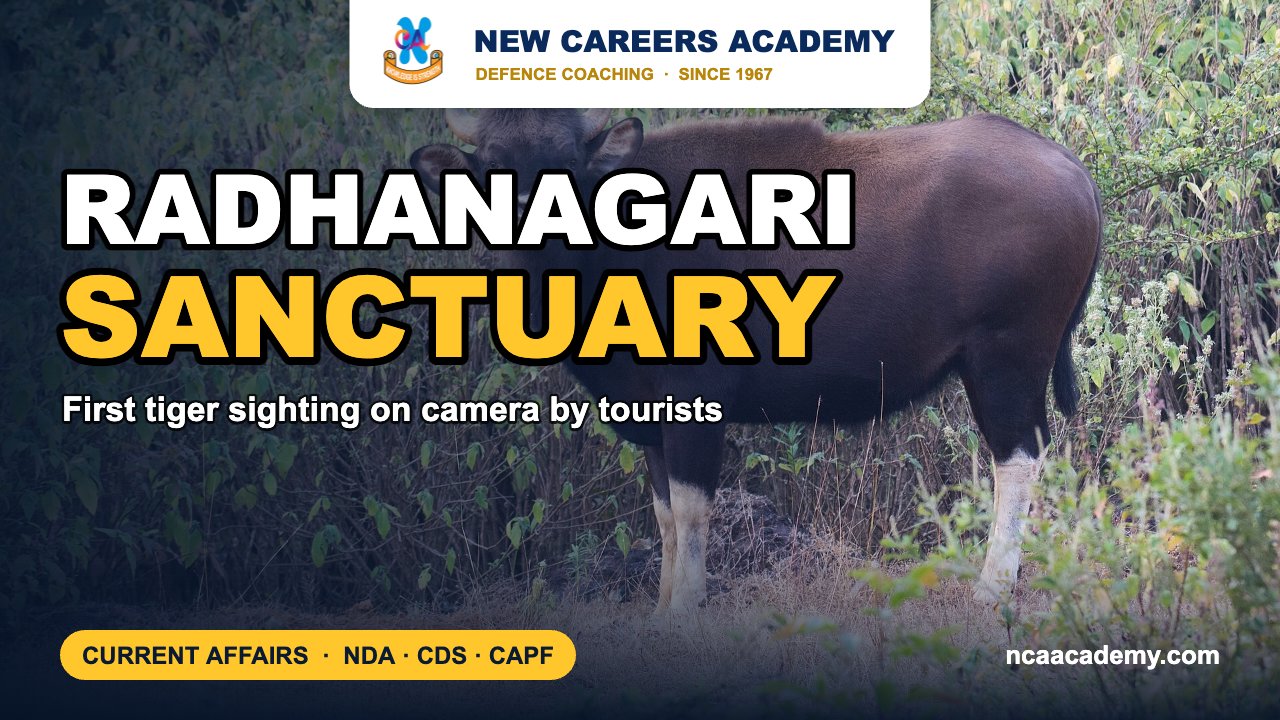
Quick answer: Radhanagari (Dajipur) Wildlife Sanctuary in Kolhapur district is Maharashtra’s first wildlife sanctuary and is best known for the Indian gaur. On Monday, 2 November 2026, tourists on a safari photographed and filmed a male tiger, STR-T10 “Ranoji”, inside it. Forest officials say this is the sanctuary’s first officially recorded tiger sighting on camera by tourists.
Why Radhanagari Wildlife Sanctuary is in the news
According to forest department officials quoted by The Times of India, tourists on a jungle safari in the sanctuary’s core zone saw a male Bengal tiger resting under trees. The animal was identified as STR-T10, nicknamed “Ranoji”. The sighting came a day after safaris reopened for the new tourist season on 1 November. Photographs and video verified it, which officials say makes it the first tiger sighting in Dajipur officially recorded on camera by tourists.
Officials credited the sighting to steps that reduce disturbance. These include a cap on the number of safari vehicles, safari timings limited to 6 a.m. to 2 p.m., a registered guide in every vehicle, and 20 artificial water bodies dug inside the sanctuary.
Who is Ranoji, and why it matters for the Sahyadri tigers
- Ranoji (STR-10) was earlier confirmed by the forest department through camera traps and pugmark tracking. Its addition took the count of tigers identified in the Sahyadri Tiger Reserve landscape to 10 (seven males and three females), as the Free Press Journal reported.
- The ten tigers named are Senapati, Subhedar, Baji, Chanda, Tara, Hirkani, Raiba, Sardar, Shiledar and Ranoji.
- Two other adult males, Raiba (STR-07) and Sardar (STR-08), had earlier been recorded in the Radhanagari area.
- The Sawantwadi–Dodamarg–Radhanagari corridor lets tigers move freely into the Sahyadri landscape, so the numbers are growing through natural migration as well as relocation.
- Because the reserve has more males than females, female tigers have been relocated from Tadoba-Andhari and Pench tiger reserves under a phased plan approved by the Centre.
Key facts about Radhanagari Wildlife Sanctuary
| Feature | Detail |
|---|---|
| Location | Kolhapur district, Maharashtra, in the southern Sahyadri ranges of the Western Ghats |
| Status | First declared wildlife sanctuary of Maharashtra; notified in 1958 as Dajipur Wildlife Sanctuary and renotified as Radhanagari in 1985 |
| Popular name | “Bison Sanctuary“; the Indian gaur is its flagship species |
| Area | About 341 sq km (TOI) |
| History | Once a royal hunting reserve of the Kolhapur rulers |
| Rivers | Bhogavati, Dudhganga, Tulshi, Kallamma and Dirba, all tributaries of the Krishna |
| Forest type | Tropical evergreen forests of the northern Western Ghats |
| Global tags | Part of the Western Ghats UNESCO World Heritage Site (Sahyadri sub-cluster, 2012); an Important Bird Area of BirdLife International |
| Eco-sensitive zone | Area around the sanctuary notified as ESZ on 15 October 2020 |
Wildlife of Radhanagari
- Mammals: Gaur, leopard, sloth bear, sambar, barking deer, mouse deer, wild boar, Indian giant squirrel and dhole (wild dog). The sanctuary has recorded 47 mammal, 264 bird and 59 reptile species.
- Birds: It shelters the threatened Nilgiri wood-pigeon. Other notable birds are the Malabar whistling thrush, Malabar grey hornbill, great pied hornbill and Ceylon frogmouth.
- Plants: Common trees include jambul, hirda, awala, ain, kinjal and umbar. Karvi shrubs cover large stretches, and local communities protect sacred groves (devrai).
Exam angle: how NDA, CDS and CAPF can ask this
- “Match the sanctuary with its state” questions are common. Link Radhanagari to Maharashtra and to the Krishna basin.
- The Western Ghats World Heritage Site (2012) is made up of sub-clusters across Kerala, Tamil Nadu, Karnataka and Maharashtra. Know which protected areas are part of it.
- Tiger corridors, relocation of tigers and Project Tiger reserves in Maharashtra (Tadoba-Andhari, Pench, Sahyadri) are frequent topics in current affairs.
- Flagship species are a favourite theme: gaur at Radhanagari, and the tiger at the tiger reserves.
Practice MCQs
Q1. Radhanagari Wildlife Sanctuary is located in which district?
(a) Satara (b) Sindhudurg (c) Kolhapur (d) Ratnagiri
Answer: (c) — it lies in Kolhapur district of Maharashtra.
Q2. Radhanagari is popularly called the “Bison Sanctuary”. Its flagship species is the:
(a) Tiger (b) Indian gaur (c) Sambar (d) Elephant
Answer: (b) — the sanctuary was set up mainly to protect the gaur.
Q3. The rivers flowing through Radhanagari sanctuary belong to which river system?
(a) Godavari (b) Krishna (c) Kaveri (d) Mahanadi
Answer: (b) — the Bhogavati, Dudhganga and others are Krishna tributaries.
Q4. The tiger “Ranoji” sighted by tourists in November 2026 belongs to which tiger reserve’s landscape?
(a) Tadoba-Andhari (b) Melghat (c) Sahyadri (d) Pench
Answer: (c) — it is catalogued as STR-10 of the Sahyadri Tiger Reserve.
Frequently asked questions
Where is Radhanagari Wildlife Sanctuary?
It lies in Maharashtra’s Kolhapur district, in the southern Sahyadri ranges of the Western Ghats.
Why is Radhanagari called the Bison Sanctuary?
It was set up mainly to protect the Indian gaur, often called the Indian bison. The gaur remains its flagship species.
Which tiger was sighted at Radhanagari in November 2026?
A male Bengal tiger, STR-T10 “Ranoji”, was photographed and filmed by tourists on 2 November 2026 during a safari in the core zone.
Is Radhanagari a UNESCO World Heritage Site?
Yes. It is part of the Sahyadri sub-cluster of the Western Ghats natural World Heritage Site, inscribed in 2012.
Which was Maharashtra’s first wildlife sanctuary?
Radhanagari, first notified as Dajipur Wildlife Sanctuary in 1958.
Also read on NCA: Pench Tiger Reserve | Talacauvery Wildlife Sanctuary | Monthly defence current affairs PDFs | NDA coaching in Chandigarh
Sources: The Times of India, Free Press Journal, Free Press Journal (Raiba, Sardar), Incredible India, Wikipedia. Facts as reported up to 4 November 2026.
Featured image background: Prasad2092 / Wikimedia Commons, CC0.