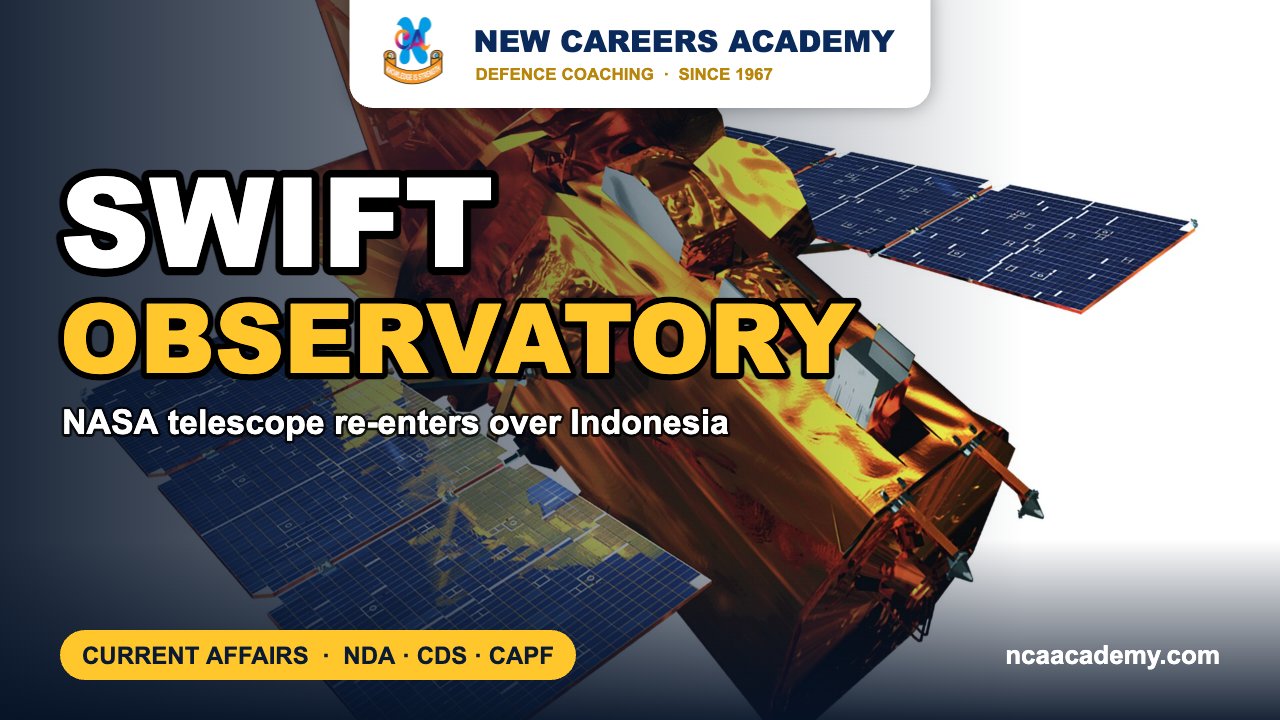
Quick answer: The Neil Gehrels Swift Observatory was a NASA space telescope that studied gamma-ray bursts, the most powerful explosions in the universe. On 4 November 2026 it re-entered Earth’s atmosphere over North Sumatra, Indonesia, almost 22 years after its 2004 launch. A commercial attempt to boost it to a higher orbit had failed earlier.
Why the Swift Observatory is in the news
NASA said the US Space Force confirmed Swift’s re-entry at 7:39 a.m. EST (12:39 GMT, about 6:09 p.m. IST) on Wednesday, 4 November 2026. The spacecraft came down over the North Sumatra region of Indonesia, at about 3.4 degrees north latitude and 98.6 degrees east longitude. NASA expected most of it to burn up in the atmosphere, but said some parts may have survived. Xinhua and CBS News reported the same time and location.
The end had been coming for some weeks. NASA said on 23 October that Swift’s science operations were over. On 20 October the satellite had dropped to about 275 km (171 miles). It could no longer cope with the extra drag at that height and went into safe mode. The operations team at Penn State then sent a command that ended its operations and prepared it for re-entry.
Key facts about the Neil Gehrels Swift Observatory
| Parameter | Detail |
|---|---|
| Agency | NASA (mission run with Pennsylvania State University; partners in the US, UK and Italy) |
| Launch | 20 November 2004, on a Delta II rocket from Cape Canaveral |
| Programme | NASA MIDEX (Medium-class Explorer) mission |
| Orbit | Low Earth orbit, about 585–604 km high at launch, inclined at 20.6 degrees |
| Launch mass | About 1,470 kg |
| Planned life | 2 years; it worked for about 22 |
| Original name | Swift Gamma-Ray Burst Explorer; renamed in January 2018 after principal investigator Neil Gehrels, who died in 2017 |
| Re-entry | 4 November 2026, over North Sumatra, Indonesia |
How Swift worked: three telescopes
Swift observed in several wavebands. It carried three instruments that worked as a team:
- Burst Alert Telescope (BAT): a wide-field gamma-ray instrument (15–150 keV) that spotted a new burst and found its position in the sky. It picked up about 100 bursts a year.
- X-ray Telescope (XRT): once the spacecraft had turned towards the burst, this instrument fixed its position more precisely and followed the X-ray afterglow (0.2–10 keV).
- Ultraviolet/Optical Telescope (UVOT): followed the afterglow in ultraviolet and visible light, pinning down its position to better than one arcsecond.
The name “Swift” refers to how quickly it could turn towards a short-lived outburst. It also sent alerts to other observatories, including Hubble and Webb, so that they could make follow-up observations. CBS News reported that Swift observed more than 2,000 gamma-ray bursts and about 1,400 exploding stars. NASA says its work also covered black holes in active galaxies, X-ray flares from stars, and comets and asteroids in our own solar system.
Why Swift fell: drag, the Sun and a failed rescue
Every satellite in low Earth orbit feels a little drag from the thin upper atmosphere. When solar activity is high, the upper atmosphere expands, so the drag grows. This made Swift’s orbit decay faster. In September 2025 NASA said the observatory would need a boost and gave a contract of about $30 million to Katalyst Space Technologies, a company in Arizona. Katalyst’s robotic servicer LINK was launched on 3 July 2026. It developed attitude-control problems, and on 19 August 2026 Katalyst announced that LINK could not rendezvous with Swift. NASA then let the observatory re-enter the atmosphere.
Exam angle: how NDA, CDS and CAPF can ask this
- NDA GAT physics and general science can ask about the parts of the electromagnetic spectrum. Gamma rays have the shortest wavelength and the highest energy, then come X-rays and ultraviolet.
- Questions on satellite orbits (LEO, MEO, GEO) and atmospheric drag are common in science and current affairs. Swift shows how solar activity shortens the life of a satellite in low orbit.
- Space servicing and orbit-boosting missions are a growing field and are linked to space debris and sustainability. India’s own plans are covered in our ISRO post.
Practice MCQs
Q1. The Neil Gehrels Swift Observatory was mainly designed to study:
(a) Exoplanet atmospheres (b) Gamma-ray bursts (c) Solar wind (d) Earth’s ozone layer
Answer: (b) — Swift was built to detect and study gamma-ray bursts.
Q2. Over which country did Swift re-enter Earth’s atmosphere on 4 November 2026?
(a) Philippines (b) Australia (c) Indonesia (d) Sri Lanka
Answer: (c) — The re-entry was over North Sumatra, Indonesia.
Q3. Which instrument was NOT on board Swift?
(a) Burst Alert Telescope (b) X-ray Telescope (c) Ultraviolet/Optical Telescope (d) Near-Infrared Spectrograph
Answer: (d) — Swift carried BAT, XRT and UVOT.
Q4. The main reason for the fast decay of Swift’s orbit was:
(a) A collision with debris (b) Higher atmospheric drag caused by increased solar activity (c) A thruster explosion (d) The Moon’s gravity
Answer: (b) — Solar activity expands the upper atmosphere and increases drag.
Frequently asked questions
When and where did the Swift Observatory re-enter?
It re-entered on 4 November 2026 at 7:39 a.m. EST, over the North Sumatra region of Indonesia. The US Space Force confirmed the re-entry, according to NASA.
Who was Neil Gehrels?
Neil Gehrels was the principal investigator of the Swift mission. He died in 2017, and in January 2018 NASA renamed the spacecraft the Neil Gehrels Swift Observatory in his honour.
How long did Swift work?
Swift was launched on 20 November 2004 for a two-year prime mission. It kept working for about 22 years, and its operations ended in October 2026.
Why could Swift not be saved?
Katalyst Space Technologies’ LINK spacecraft, launched in July 2026 to boost Swift’s orbit, ran into attitude-control problems. In August 2026 the company said LINK could not reach Swift.
What are gamma-ray bursts?
Gamma-ray bursts are short, extremely powerful flashes of gamma radiation from distant parts of the universe. NASA calls them the most powerful explosions in the cosmos.
Also read on NCA: ISRO’s next-decade missions | BioSentinel mission | Monthly defence current affairs PDFs | NDA coaching in Chandigarh
Sources: NASA Science (re-entry), NASA Science (mission end), Xinhua, CBS News, Wikipedia. Facts as reported up to 6 November 2026.
Featured image background: NASA E/PO, Sonoma State University/Aurore Simonnet / Wikimedia Commons, Public domain.