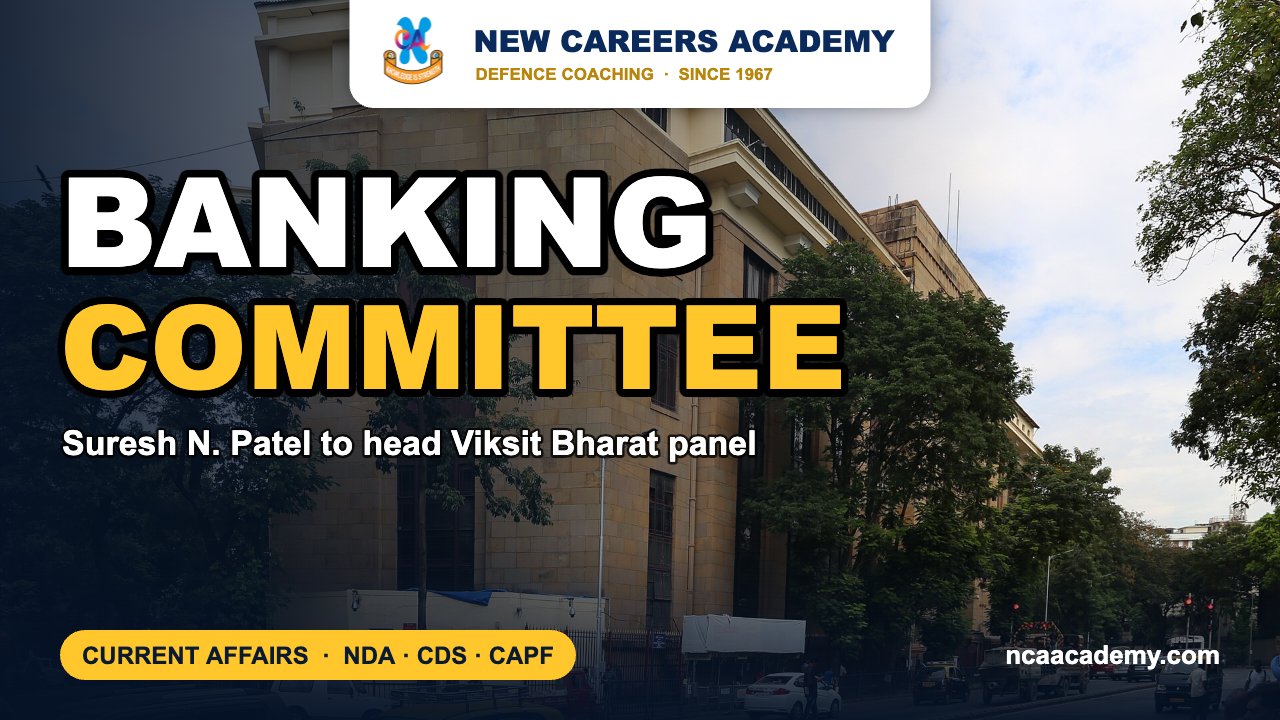
Quick answer: The High Level Committee on Banking for Viksit Bharat is a five-member panel set up by the Government of India on 30 October 2026 to review the banking sector and suggest reforms for the Viksit Bharat 2047 goal. It is chaired by former Central Vigilance Commissioner Suresh N. Patel and has six months to finish its work.
Why the High Level Committee on Banking is in the news
The Ministry of Finance announced the committee through a Press Information Bureau release dated 30 October 2026. Union Finance Minister Nirmala Sitharaman had promised such a review in her Budget speech for 2026-27. According to the release, the panel will recommend structural, institutional, regulatory and legislative changes so that Indian banking becomes globally competitive, financially inclusive and resilient. News On AIR reported the same details.
Key facts: who is on the committee
| Role | Name | Background |
|---|---|---|
| Chairman | Suresh N. Patel | Former Central Vigilance Commissioner |
| Member | Shirish Chandra Murmu | Deputy Governor, Reserve Bank of India |
| Member | Padmaja Chunduru | Former MD and CEO, Indian Bank |
| Member | N. S. Vishwanathan | Former Deputy Governor, RBI |
| Member Secretary | Joint Secretary (Banking) | Department of Financial Services, Ministry of Finance |
- Set up by: Government of India, Ministry of Finance (Department of Financial Services provides the Member Secretary).
- Announced in: Union Budget 2026-27.
- Constituted on: PIB release dated 30 October 2026.
- Tenure: six months.
- Long-term goal: a banking system suited to Viksit Bharat 2047.
Terms of reference of the committee
The PIB release lists seven tasks. In simple terms, the committee will:
- Benchmark against the world: assess current banking practices and prudential norms, identify global best practices, adapt them for India and give a roadmap for globally competitive banks.
- Review laws and regulation: examine the regulatory and legal framework for banks, including Regional Rural Banks and Cooperative Banks, and suggest reforms for efficiency and “ease of doing banking”.
- Work out capital needs: estimate the long-term capital requirements of banks, Development Financial Institutions and Non-Banking Financial Companies, along with funding sources to support credit growth.
- Study the cost of capital: look at differences in the cost of capital for business and suggest ways to boost private investment.
- Plan for technology and talent: prepare a roadmap for AI and digital innovation with safeguards against cyber risks, and a strategy for recruiting and training a future-ready banking workforce.
- Re-examine inclusion tools: review the Priority Sector Lending framework and the Lead Bank Scheme for relevance, effectiveness and data-driven credit delivery.
- Any other matter referred to it by the Government.
Background: earlier banking reform committees
Large-scale reviews of Indian banking are not new. Two committees headed by former RBI Governor M. Narasimham shaped the reforms after 1991. The first, the Committee on the Financial System, was set up in August 1991 and submitted its report in November 1991. The second, the Committee on Banking Sector Reforms, was set up in December 1997 and reported in April 1998. Among other things, the second committee recommended higher capital adequacy norms and the creation of asset reconstruction companies to handle bad loans; this line of reform led to the SARFAESI Act, 2002.
The new committee differs in scope. Apart from banks, its terms of reference also cover DFIs and NBFCs, and it has been asked to look at newer issues such as artificial intelligence, cyber security and the relevance of priority sector targets in a changing economy.
Exam angle: how NDA, CDS and CAPF can ask this
- “Who heads the committee” questions are common in current affairs sections; remember Suresh N. Patel and the six-month tenure.
- Banking static GK links: Regional Rural Banks, Cooperative Banks, NBFCs, DFIs, Priority Sector Lending and the Lead Bank Scheme.
- Past reform panels such as the Narasimham Committees (1991 and 1998) are often paired with new committees in matching questions.
- The Viksit Bharat 2047 vision is a recurring theme across schemes and Budget announcements.
Practice MCQs
Q1. Who chairs the High Level Committee on Banking for Viksit Bharat constituted in October 2026?
(a) Shirish Chandra Murmu (b) N. S. Vishwanathan (c) Suresh N. Patel (d) Padmaja Chunduru
Answer: (c) — he is a former Central Vigilance Commissioner.
Q2. What is the tenure of the committee?
(a) Three months (b) Six months (c) One year (d) Two years
Answer: (b) — as stated in the PIB release of 30 October 2026.
Q3. Which of the following is NOT part of the committee’s terms of reference?
(a) Review of the Priority Sector Lending framework (b) Roadmap for AI in banking (c) Capital needs of NBFCs and DFIs (d) Fixing the repo rate
Answer: (d) — the committee advises on structural reform; it does not set monetary policy.
Q4. The Committee on Banking Sector Reforms that reported in April 1998 was headed by:
(a) M. Narasimham (b) Bimal Jalan (c) Raghuram Rajan (d) Y. V. Reddy
Answer: (a) — it is known as Narasimham Committee-II.
Frequently asked questions
Who heads the High Level Committee on Banking for Viksit Bharat?
Suresh N. Patel, former Central Vigilance Commissioner, is the Chairman. The other members are Shirish Chandra Murmu, Padmaja Chunduru and N. S. Vishwanathan.
When was the committee constituted?
The Ministry of Finance announced it on 30 October 2026, following an announcement in the Union Budget 2026-27.
How long will the committee work?
Its tenure is six months.
What will the committee review?
It will review prudential norms, laws for banks including RRBs and cooperative banks, capital needs of banks, DFIs and NBFCs, cost of capital, AI and cyber safeguards, and the Priority Sector Lending framework and Lead Bank Scheme.
Who is the Member Secretary of the committee?
The Joint Secretary (Banking) in the Department of Financial Services, Ministry of Finance.
Also read on NCA: Liberalised Remittance Scheme | National Cooperative Development Corporation | Monthly defence current affairs PDFs | Online NDA coaching
Sources: PIB, Ministry of Finance, News On AIR, Narasimham Committee. Facts as reported up to 6 November 2026.
Featured image background (representative): Sailko / Wikimedia Commons, CC BY 3.0.