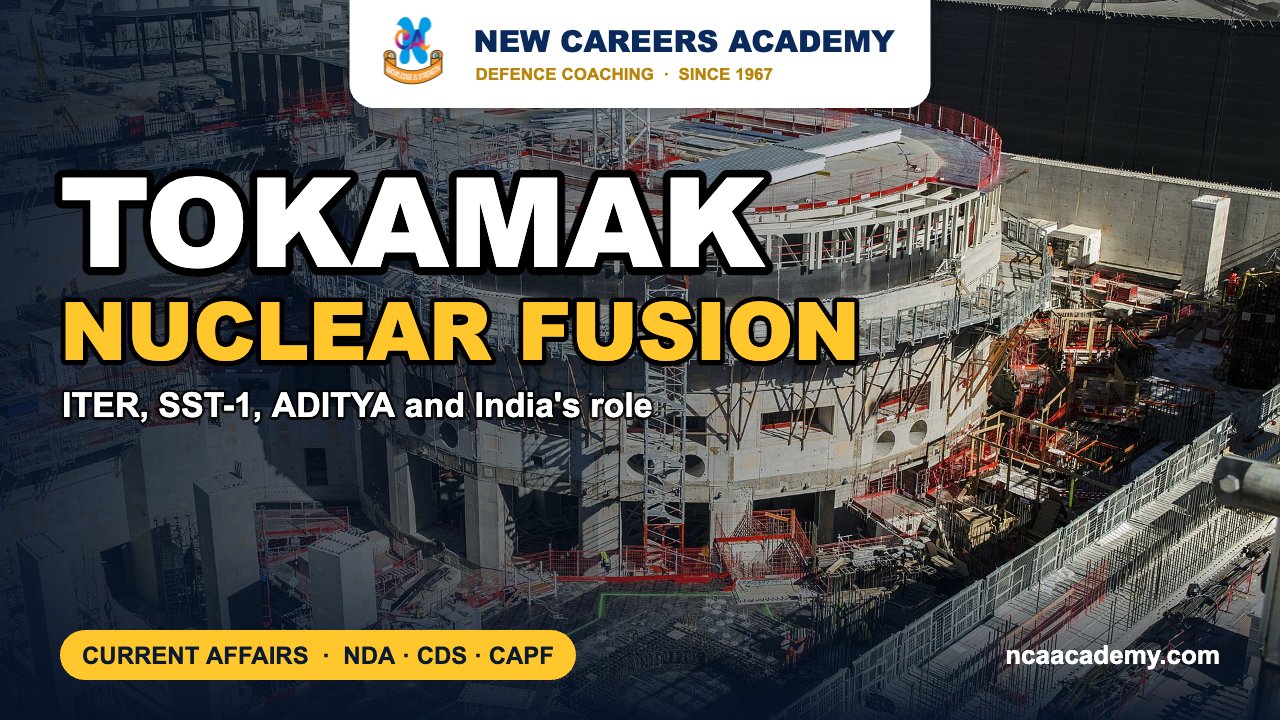
Quick answer: A tokamak is a doughnut-shaped machine that uses strong magnetic fields to hold fuel plasma hot enough for nuclear fusion. It was back in the news in the first week of November 2026 through newspaper explainers on how tokamaks work, as records from China’s EAST and India’s first private tokamak, PRAGYA, keep the fusion race in focus while no tokamak yet produces electricity.
Why the tokamak is in the news
Explainers carried in the national press on 7 November 2026 revisited a basic question: how far are tokamaks from giving us power? Even ITER, the giant international machine being assembled in southern France, will test reactor-scale technology but is not designed to produce electricity. In India, Bengaluru-based Pranos Fusion has unveiled PRAGYA, described by Business Today as the country’s first privately developed compact tokamak.
Key facts about the tokamak
- Name: “Tokamak” comes from a Russian acronym meaning “toroidal chamber with magnetic coils”. ITER says the design was first developed by Soviet research in the late 1960s and is now the most widely adopted magnetic fusion configuration.
- Fuel: The most efficient laboratory reaction fuses two hydrogen isotopes, deuterium and tritium, producing helium and one neutron.
- Temperature: D-T fusion needs about 150 million °C, roughly ten times hotter than the Sun’s core (about 15 million °C).
- Breeding fuel: Because world tritium supply is limited, ITER will test producing tritium from lithium-6 inside the vessel.
How a tokamak works
Air and impurities are first pumped out of the doughnut-shaped vacuum chamber. Magnets are then energised and hydrogen gas is let in. A powerful electric current through the gas strips electrons from the nuclei, turning it into plasma. Magnetic coils shape this charged plasma and keep it off the walls, while extra heating pushes the plasma to fusion temperatures, where nuclei collide hard enough to overcome their mutual repulsion and fuse.
The key measure is the gain factor, Q, the ratio of fusion power to heating power. Europe’s JET holds the magnetic-fusion power record set in 1997: 16 MW from 24 MW of heating (Q = 0.67). ITER is designed for Q = 10: 500 MW of fusion power from 50 MW of heating.
Major tokamaks: a comparison
| Tokamak | Location | Exam-worthy fact |
|---|---|---|
| ITER | Cadarache, southern France | World’s largest; twice the size of Japan’s JT-60SA with six times its plasma chamber volume |
| EAST | Hefei, China | Held a high-confinement plasma for 1,066 seconds (announced January 2025), beating its 2023 record of 403 seconds |
| WEST | Cadarache, France | Reported 1,336 seconds of steady high-confinement plasma in February 2025 |
| ADITYA / ADITYA-U | IPR, Gandhinagar | India’s first tokamak, commissioned in 1989; upgraded version operating since January 2017 |
| SST-1 | IPR, Gandhinagar | Steady State Superconducting Tokamak; uses superconducting magnets and a divertor from the start |
| PRAGYA | Bengaluru (Pranos Fusion) | India’s first privately developed compact tokamak; a test-bed, not a power reactor |
India’s role in ITER and at home
- Full member since December 2005: India became the seventh full member of ITER alongside China, the European Union, Japan, Korea, Russia and the United States.
- Cost share: Europe bears 45.6 per cent of construction cost; the other six members, including India, bear 9.1 per cent each. About nine-tenths of contributions are given as finished components rather than cash.
- Indian hardware: ITER-India, run as a project of the Institute for Plasma Research (IPR), supplied through Larsen & Toubro the ITER cryostat, the world’s largest vacuum stainless-steel vessel (about 3,850 tonnes, 30 m tall and 30 m wide), installed in 2020.
- Home programme: IPR, an aided institute of the Department of Atomic Energy, runs ADITYA-U and SST-1. SST-1 has achieved long discharges of around 650 milliseconds. A larger machine, SST-2, has been planned as the next step towards an Indian demonstration reactor.
- Private entry: Pranos says it built PRAGYA in about eight months and plans roughly 3,000 experimental shots a year.
Exam angle: how NDA, CDS and CAPF can ask this
- Fission versus fusion is a regular NDA physics topic: fission splits heavy nuclei, fusion joins light ones such as deuterium and tritium.
- Watch the name trap: ADITYA is IPR’s tokamak, while Aditya-L1 is ISRO’s solar observatory. Statement-based questions often mix such pairs.
Practice MCQs
Q1. The word “tokamak” originated in which language?
(a) German (b) Japanese (c) Russian (d) French
Answer: (c) — it is a Russian acronym for “toroidal chamber with magnetic coils”.
Q2. India’s first tokamak, commissioned in 1989, is:
(a) SST-1 (b) ADITYA (c) PRAGYA (d) EAST
Answer: (b) — ADITYA was commissioned at IPR, Gandhinagar, in 1989.
Q3. ITER is designed to produce 500 MW of fusion power from 50 MW of heating. Its gain factor Q is:
(a) 0.67 (b) 1 (c) 5 (d) 10
Answer: (d) — 500 divided by 50 gives Q = 10.
Q4. Which Indian company supplied the ITER cryostat?
(a) BHEL (b) Larsen & Toubro (c) HAL (d) Godrej Aerospace
Answer: (b) — L&T supplied the 3,850-tonne cryostat, installed in 2020.
Frequently asked questions
What is a tokamak?
It is an experimental fusion machine with a doughnut-shaped vacuum chamber in which strong magnetic fields confine very hot hydrogen plasma so that nuclei can fuse and release energy.
Does any tokamak produce electricity today?
No. Even ITER is not designed to generate electricity; it will test long-pulse operation and reactor-scale technology for future power plants.
What is India’s share in ITER?
India is one of seven members and bears 9.1 per cent of construction cost, mostly through components such as the cryostat supplied by L&T.
Which tokamaks does India operate?
The Institute for Plasma Research, Gandhinagar, operates ADITYA-U and SST-1. Bengaluru’s Pranos Fusion has built PRAGYA, a private compact tokamak.
Also read on NCA: Aditya-L1 and Proba-3 | ISRO’s next-decade missions | Monthly defence current affairs PDFs | NDA coaching in Chandigarh
Sources: ITER: What is a tokamak?, ITER Goals, ITER Members, Nuclear Engineering International, Physics World, Business Today. Facts as reported up to 8 November 2026.
Featured image background: Oak Ridge National Laboratory / Wikimedia Commons, CC BY 2.0.