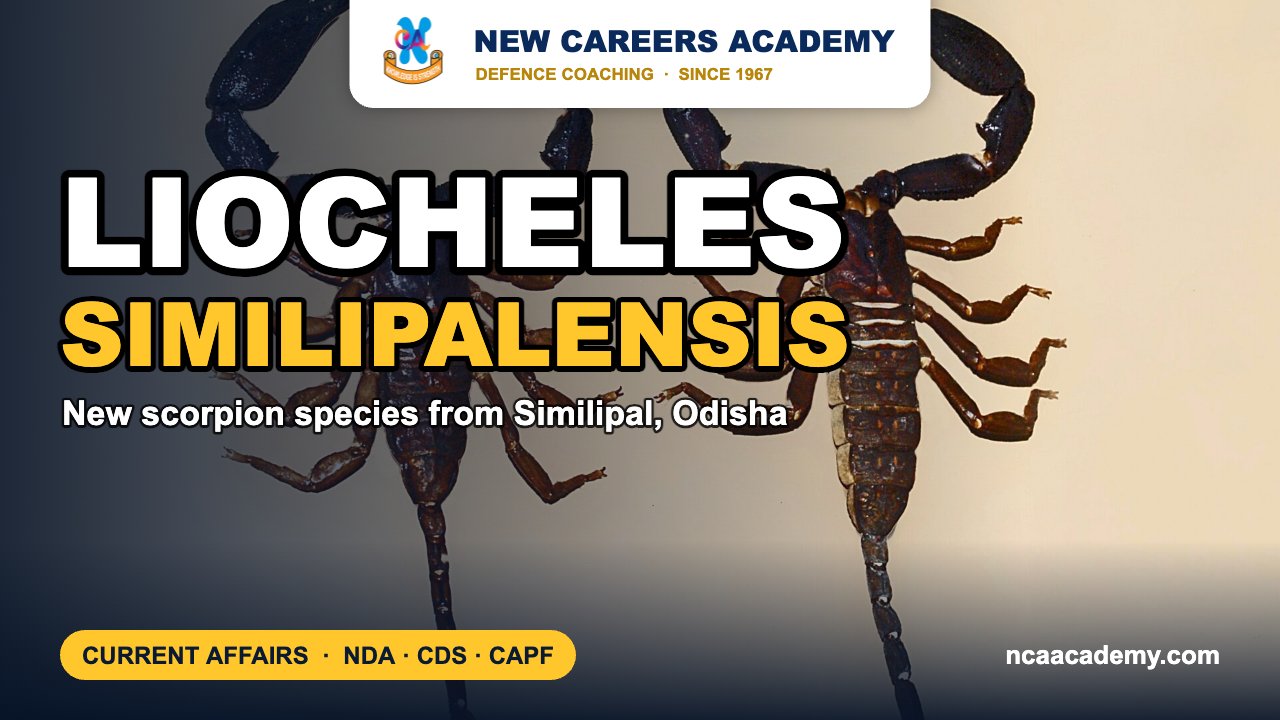
Quick answer: Liocheles similipalensis is a newly described, glossy bluish-black scorpion found only in Similipal Tiger Reserve in Odisha’s Mayurbhanj district. Its formal description appeared in the scorpion journal Euscorpius in early November 2026. It is the first record of the genus Liocheles in Odisha.
Why Liocheles similipalensis is in the news
The species was described in a paper by Saurabh Kininge, Tejas Thackeray, Prakash C. Gogineni and Akshay Khandekar, published in Euscorpius (Volume 2026, Issue 443). A taxonomy blog posted the abstract on 4 November 2026, and ThePrint and OrissaPOST reported the find on 5 November 2026. Kininge, Thackeray and Khandekar are researchers with the Thackeray Wildlife Foundation (TWF), an Indian wildlife research organisation founded in June 2019. Gogineni is the Field Director of Similipal Tiger Reserve.
According to ThePrint, reserve staff first collected the specimens and sent them to TWF scientist Akshay Khandekar for study. The paper is based on both male and female specimens.
Key facts about the new scorpion
| Feature | Details |
|---|---|
| Scientific name | Liocheles similipalensis (named after Similipal) |
| Family | Hormuridae |
| Genus | Liocheles Sundevall, 1833 |
| Size | 44 to 53 mm long |
| Colour | Dark black body with a bluish sheen |
| Habitat | Rocky spots inside tropical moist deciduous forest, at about 1,000 m above sea level |
| Known range | Only Similipal Tiger Reserve, Mayurbhanj district, Odisha |
| Journal | Euscorpius, Issue 443 (2026) |
- Seventh in its genus: The discovery takes the number of known Liocheles species from six to seven.
- Fourth from India: The paper’s abstract says it is the fourth Liocheles species described from India.
- A state first: It is the first confirmed record of the genus Liocheles in Odisha.
- How it was identified: Tiny hair-like structures called setae beneath a leg segment (tarsomere II) placed it in Liocheles. Differences in the ridges (carinae) and granules on its pincers and tail segments, and in the size ratio of its median eyes, separate it from the other six species.
- Wider message: The authors say older Indian records of L. nigripes and L. australasiae may hide species complexes, and call for more surveys and DNA studies.
Similipal: the landscape behind the find
Similipal is one of eastern India’s richest forest landscapes. The Odisha government notified it as a national park on 24 April 2025, making it the 107th national park in India, according to ETV Bharat. The notified park covers 845.70 sq km, mostly in the Similipal South division. Until then, Bhitarkanika, declared a national park in 1998, was Odisha’s only national park.
The notification recognised Similipal’s several protective layers. It is a wildlife sanctuary, a Project Tiger reserve, a UNESCO Biosphere Reserve and an Elephant Reserve. The reserve records 55 mammal species, 361 bird species, 62 reptile species and 21 amphibian species. It is also home to indigenous communities such as the Birhor, Hill Khadia, Mankidia, Ho and Santhal.
The scorpion shows that even a well-known reserve can still hold small animals that science has not yet described.
Exam angle: how NDA, CDS and CAPF can ask this
- Protected-area questions are common in the geography section: link Similipal to Mayurbhanj, Odisha, and remember its national park, tiger reserve and biosphere reserve tags.
- Know the difference between a national park and a wildlife sanctuary under the Wildlife (Protection) Act, 1972; Similipal now holds both labels in different parts.
- Questions may test classification: scorpions belong to the order Scorpiones, among the arachnids.
Practice MCQs
Q1. Liocheles similipalensis, described in 2026, is a new species of:
(a) frog (b) scorpion (c) orchid (d) spider
Answer: (b) – It is a scorpion of the family Hormuridae.
Q2. Similipal Tiger Reserve lies in which district of Odisha?
(a) Koraput (b) Kendrapara (c) Mayurbhanj (d) Ganjam
Answer: (c) – The paper places the type locality in Mayurbhanj district.
Q3. With this discovery, the genus Liocheles has how many known species?
(a) Four (b) Five (c) Six (d) Seven
Answer: (d) – Six species were known earlier; this is the seventh.
Q4. Before Similipal, which was Odisha’s only national park?
(a) Bhitarkanika (b) Satkosia (c) Chilika (d) Debrigarh
Answer: (a) – Bhitarkanika became a national park in 1998.
Frequently asked questions
Where was Liocheles similipalensis found?
In Similipal Tiger Reserve, Mayurbhanj district, Odisha. So far it is known from nowhere else.
Who described the new scorpion?
Saurabh Kininge, Tejas Thackeray and Akshay Khandekar of the Thackeray Wildlife Foundation, with Similipal Field Director Prakash C. Gogineni.
How big is the scorpion?
It measures 44 to 53 mm and has a dark black body with a bluish sheen.
Why is the find significant?
It is the first record of the genus Liocheles in Odisha and the fourth Liocheles species described from India.
When did Similipal become a national park?
The Odisha government notified it on 24 April 2025, making it India’s 107th national park.
Also read on NCA: Bhimbandh Wildlife Sanctuary | Pench Tiger Reserve | Monthly defence current affairs PDFs | CAPF coaching in Chandigarh
Sources: Euscorpius, Issue 443, Paper abstract (Aracnido Taxonomy), ThePrint, OrissaPOST, ETV Bharat. Facts as reported up to 7 November 2026.
Featured image background (representative): Hectonichus / Wikimedia Commons, CC BY-SA 3.0.