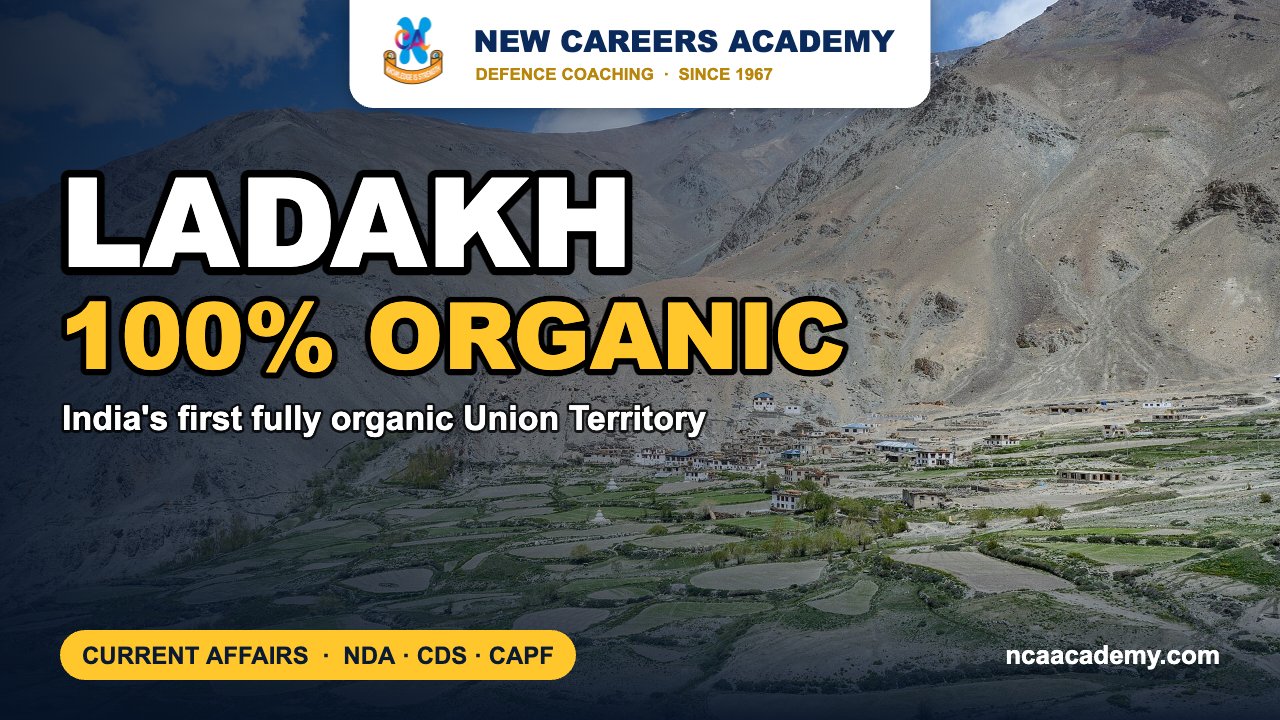
Quick answer: Ladakh has been declared India’s first 100% organic Union Territory. Lieutenant Governor Vinai Kumar Saxena made the announcement on Sunday, 25 October 2026, after a July 2026 ban on chemical fertilisers, making Ladakh the Union Territory counterpart of Sikkim, which became India’s first fully organic state in 2016.
Why Ladakh is in the news
According to an official spokesperson in Leh quoted by the Deccan Chronicle, Lt Governor Vinai Kumar Saxena formally declared the whole Union Territory organic on 25 October 2026. He called it a commitment to protect the fragile Himalayan ecosystem and said the status must translate into better prices and market access for farmers. The announcement followed two policy steps. In March 2026, the administration sent consignments of organic fertiliser to villages ahead of the sowing season. In July 2026, it ordered a complete ban on the procurement, distribution, sale, marketing and use of chemical and synthetic fertilisers for farming anywhere in Ladakh.
Certification had been building up for some time. On 27 July 2026, PTI reported that Saxena handed organic certificates to 102 villages in the Kargil, Dras, Zanskar and Sham areas, taking the number of certified villages to 207. Swarajya, reporting the October declaration, put that figure at 207 of Ladakh’s 666 villages under the territory’s Mission Organic Development Initiative (MODI), which it says was launched in 2020 with an outlay of Rs 500 crore.
Key facts about Ladakh’s organic status
- First Union Territory in India to be declared fully organic; Sikkim remains the first state (2016).
- The declaration covers both districts, Leh and Kargil.
- A July 2026 order banned chemical and synthetic fertilisers across the UT.
- Certified villages are promoted under the Paramparagat Krishi Vikas Yojana (PKVY) using PGS-India certification.
- Under the Large Area Certification (LAC) route, a proposal for 5,000 hectares of Ladakh land was supported with Rs 11.475 lakh, as per a PIB backgrounder.
- Main crops expected to gain: apricot, sea buckthorn, buckwheat and barley, plus vegetables.
- Raktsey Karpo apricot and Ladakh sea buckthorn already carry GI tags, the Ladakh administration has noted.
How organic certification works in India
India runs two certification systems, and PKVY uses both.
| System | Run by | Who it suits |
|---|---|---|
| NPOP (National Programme for Organic Production) | Ministry of Commerce and Industry, through accredited certification agencies | Third-party certification to international standards; covers the full chain up to exports |
| PGS-India (Participatory Guarantee System) | Ministry of Agriculture and Farmers Welfare | Group-based peer inspection; low-cost, aimed at the domestic market and small farmers |
| Large Area Certification (LAC) | Launched 2020-21 under PKVY | Areas where chemicals were never used, such as hills, islands and tribal belts; cuts the usual 2 to 3 year conversion period to a few months |
PKVY itself began in 2015 as part of the National Mission for Sustainable Agriculture. Farmers form clusters of 20 hectares and receive Rs 31,500 per hectare over three years, of which Rs 15,000 goes directly to them for organic inputs. Other LAC examples listed by PIB include 14,491 hectares in Car Nicobar and Nancowry islands and the entire 2,700 hectares of cultivable land in Lakshadweep.
Ladakh and Sikkim compared
| Point | Sikkim | Ladakh |
|---|---|---|
| Type | State | Union Territory |
| Declared | Formally announced by PM Narendra Modi in Gangtok, January 2016 | Declared by LG Vinai Kumar Saxena, 25 October 2026 |
| Starting point | 2003 declaration in the state assembly | Mission Organic Development Initiative; July 2026 fertiliser ban |
| Area | About 75,000 ha converted under NPOP guidelines | 5,000 ha proposal supported under LAC (PIB) |
| Key crops | Large cardamom, ginger, turmeric, buckwheat | Apricot, sea buckthorn, barley, buckwheat |
Exam angle: how NDA, CDS and CAPF can ask this
- “First” questions are popular in GK sections: first organic state (Sikkim) and first organic UT (Ladakh).
- Questions on government schemes such as PKVY, the National Mission for Sustainable Agriculture and certification systems appear in CDS and CAPF general studies.
- Ladakh’s geography, including its two districts, cold-desert climate and GI-tagged produce, is useful static GK for NDA and CDS.
Practice MCQs
Q1. Which is India’s first Union Territory to be declared 100% organic?
(a) Lakshadweep (b) Ladakh (c) Puducherry (d) Andaman and Nicobar Islands
Answer: (b) — Ladakh was declared fully organic on 25 October 2026.
Q2. The Participatory Guarantee System for India (PGS-India) is operated by the:
(a) Ministry of Commerce and Industry (b) Ministry of Agriculture and Farmers Welfare (c) NITI Aayog (d) APEDA alone
Answer: (b) — NPOP sits with the Commerce Ministry; PGS-India with the Agriculture Ministry.
Q3. Paramparagat Krishi Vikas Yojana was launched in:
(a) 2010 (b) 2013 (c) 2015 (d) 2019
Answer: (c) — it began in 2015 under the National Mission for Sustainable Agriculture.
Q4. Raktsey Karpo, a GI-tagged product of Ladakh, is a variety of:
(a) Barley (b) Apricot (c) Sea buckthorn (d) Pashmina wool
Answer: (b) — Raktsey Karpo is a Ladakhi apricot.
Frequently asked questions
When was Ladakh declared India’s first organic Union Territory?
Lt Governor Vinai Kumar Saxena declared Ladakh fully organic on Sunday, 25 October 2026.
Which was India’s first fully organic state?
Sikkim. Its status was formally announced by Prime Minister Narendra Modi in Gangtok in January 2016, after about 75,000 hectares were converted to certified organic land.
What is Large Area Certification?
It is a programme launched in 2020-21 under PKVY to certify areas where chemicals were never used. It reduces the conversion period from two or three years to a few months.
What is the difference between NPOP and PGS-India?
NPOP is a third-party system under the Commerce Ministry meant mainly for exports. PGS-India is a peer-review system under the Agriculture Ministry for the domestic market.
Did Ladakh ban chemical fertilisers?
Yes. In July 2026, the administration banned the procurement, sale, distribution, marketing and use of chemical and synthetic fertilisers for farming across Ladakh.
Also read on NCA: Rezang La, Ladakh: bravery revisited | Monthly defence current affairs PDFs | NDA coaching in Chandigarh
Sources: Deccan Chronicle, Swarajya, The Tribune (PTI), PIB: PKVY backgrounder, Ladakh Information Department, Business Standard (PTI, Sikkim). Facts as reported up to 7 November 2026.
Featured image background (representative): This Photo was taken by Timothy A. Gonsalves. Feel free to / Wikimedia Commons, CC BY-SA 4.0.