
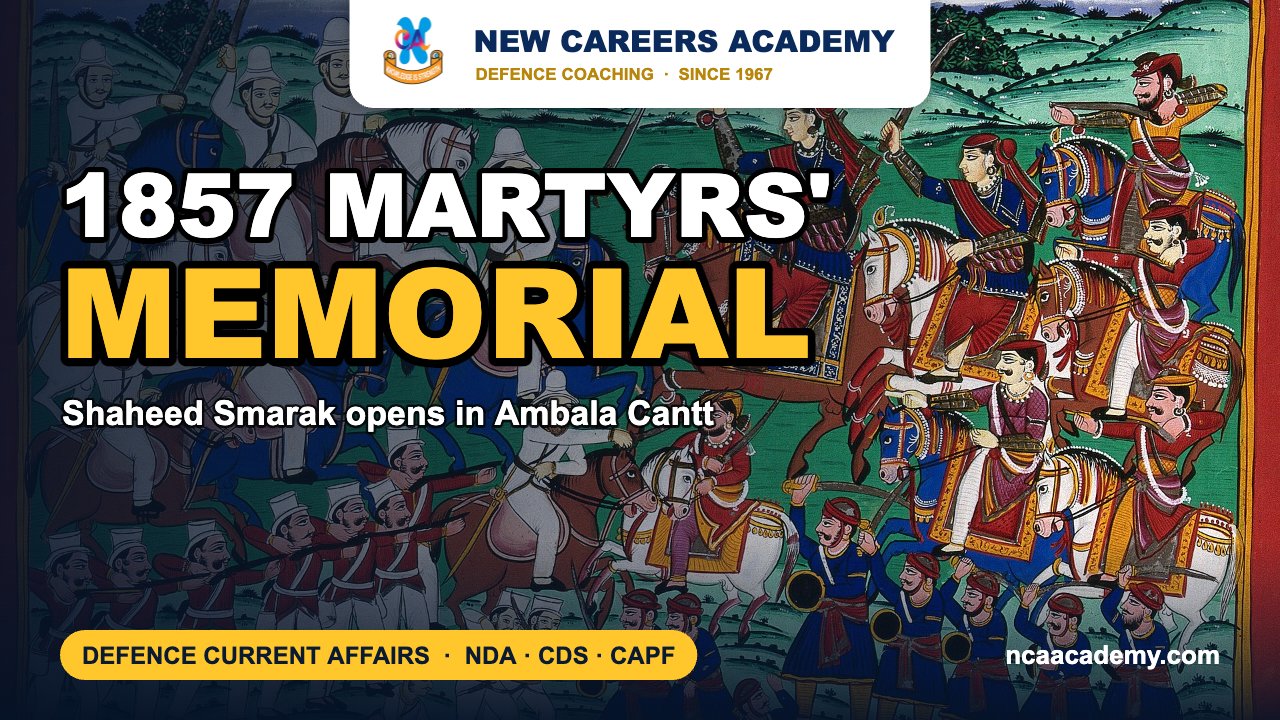
Quick answer: The Martyrs’ Memorial of the First War of Independence, officially the “Azadi Ki Pehli Ladai Ka Shaheed Smarak”, is a 22-acre memorial and museum in Ambala Cantonment, Haryana. It honours the people who fought in the 1857 uprising. Union Home Minister Amit Shah opened it on 5 November 2026.
Why the 1857 Martyrs’ Memorial is in the news
Amit Shah inaugurated the memorial in Ambala Cantt on Thursday, 5 November 2026, according to a PTI report. Speaking at the event, he said the complex had been built at a cost of Rs 594 crore. He described the 1857 struggle as a real fight for freedom, not just a rebellion, and urged young Indians to visit the site. Haryana Chief Minister Nayab Singh Saini and state minister Anil Vij, the Ambala Cantt MLA who had pushed the project for years, attended the ceremony.
Shah described Ambala as the place where the freedom struggle began on 10 May 1857. That claim comes from a regional reading of history which says troops at Ambala moved before the better-known outbreak at Meerut on the same day.
Key facts about the Shaheed Smarak, Ambala
- Location: Ambala Cantonment, Haryana, on the Ambala–Delhi National Highway.
- Area: spread over 22 acres.
- Galleries: PTI counted 22 themed galleries, while Shah mentioned 23 in his speech. They cover events in Ambala, other parts of Haryana and the rest of the country.
- Landmarks: The Tribune reported a 63-metre lotus tower and a replica banyan tree, the “Budha Bargad”, that acts as the narrator. A tree was chosen because many rebels were hanged from trees.
- Technology and craft: holography, virtual galleries, augmented reality, interactive projection and a light-and-sound show, alongside Haryanvi crafts such as Phulkari and Sarkanda work.
- Open-air theatre: seats 2,500 people.
- Content: around 130 short films, plus soil gathered from revolt sites across India. According to Anil Vij, historians have identified nearly 700 martyrs whose names and villages are being inscribed in gold letters.
Ambala’s place in the 1857 story
Ambala was a large British military cantonment in 1857. In April that year, several army units had gathered there for annual musketry practice. The new Enfield cartridges became a grievance during this time, and the Commander-in-Chief of the Bengal Army, General Anson, saw signs of trouble. Between late March and 1 May 1857, British officers’ bungalows in Ambala were hit by a series of arson attacks.
The Tribune notes a view held by some historians that the 60th and 5th Native Infantry regiments at Ambala openly revolted about nine hours before the Meerut mutiny of 10 May 1857, though their plan did not succeed. Exam answer keys still treat Meerut, 10 May 1857 as the start of the uprising.
The 1857 uprising: static GK in one table
| Centre | Leader or event | Exam point |
|---|---|---|
| Barrackpore | Mangal Pandey, 34th Bengal Native Infantry | Rebelled on the parade ground on 29 March 1857 |
| Meerut | Sepoy mutiny | Uprising began on 10 May 1857 |
| Delhi | Bahadur Shah Zafar | The 81-year-old Mughal ruler was proclaimed Emperor of Hindustan |
| Kanpur | Nana Sahib, advised by Azimullah Khan; Tatya Tope | Retaken by the British by mid-July 1857 |
| Jhansi | Rani Lakshmibai | Resisted after her adopted son was not recognised under the Doctrine of Lapse |
| Bihar | Kunwar Singh | An elderly zamindar who became one of the revolt’s key leaders |
| Gwalior | Final defeat of the rebels | 20 June 1858 |
The revolt ended East India Company rule. The Government of India Act, 1858 placed India directly under the British Crown, and Queen Victoria’s Proclamation followed on 1 November 1858. Lord Canning was Governor-General during the revolt. V D Savarkar’s 1909 book, The Indian War of Independence, helped popularise the name “First War of Independence”.
Exam angle: how NDA, CDS and CAPF can ask this
- Modern history in the NDA and CDS papers regularly asks about leaders and centres of 1857. Learn the table above.
- Questions may test the outcomes of the revolt: the end of Company rule, the 1858 Act and the Queen’s Proclamation.
- Haryana’s role and well-known cantonment towns such as Ambala and Meerut can come up under military history.
Practice MCQs
Q1. The “Azadi Ki Pehli Ladai Ka Shaheed Smarak”, inaugurated in November 2026, is located in:
(a) Meerut (b) Ambala Cantonment (c) Jhansi (d) Barrackpore
Answer: (b) The 22-acre memorial is in Ambala Cantt, Haryana.
Q2. Who was proclaimed Emperor of Hindustan by the rebels in 1857?
(a) Nana Sahib (b) Bahadur Shah Zafar (c) Birjis Qadr (d) Tatya Tope
Answer: (b) Rebels from Meerut reached Delhi and declared the Mughal ruler their emperor.
Q3. Which Act ended East India Company rule after the 1857 revolt?
(a) Charter Act, 1853 (b) Indian Councils Act, 1861 (c) Government of India Act, 1858 (d) Regulating Act, 1773
Answer: (c) The 1858 Act moved India’s administration directly to the British Crown.
Q4. Mangal Pandey, who rebelled on 29 March 1857, belonged to which unit?
(a) 19th BNI (b) 34th BNI (c) 3rd Light Cavalry (d) 60th Native Infantry
Answer: (b) He was a sepoy of the 34th Bengal Native Infantry at Barrackpore.
Frequently asked questions
Who inaugurated the 1857 Martyrs’ Memorial in Ambala?
Union Home Minister Amit Shah opened it on 5 November 2026, with Haryana Chief Minister Nayab Singh Saini present.
What did the memorial cost?
In his speech, Shah gave the cost as Rs 594 crore. Earlier reports had described it as a Rs 600-crore project.
What is the official name of the memorial?
It is called the “Azadi Ki Pehli Ladai Ka Shaheed Smarak”, meaning the Martyrs’ Memorial of the First War of Independence.
Why is Ambala linked to 1857?
Ambala was a major cantonment that saw unrest and arson in the weeks before May 1857. Some historians say regiments there revolted hours before Meerut did.
Where did the 1857 revolt formally begin?
Standard textbooks date the start of the revolt to the sepoy mutiny at Meerut on 10 May 1857.
Also read on NCA: Rani Chennamma of Kittur | Rezang La bravery revisited | Monthly defence current affairs PDFs | NDA coaching in Chandigarh
Sources: ThePrint (PTI), Open Magazine, The Tribune, Indian Rebellion of 1857. Facts as reported up to 8 November 2026.
Featured image background (representative): AnonymousUnknown author / Wikimedia Commons, Public domain.