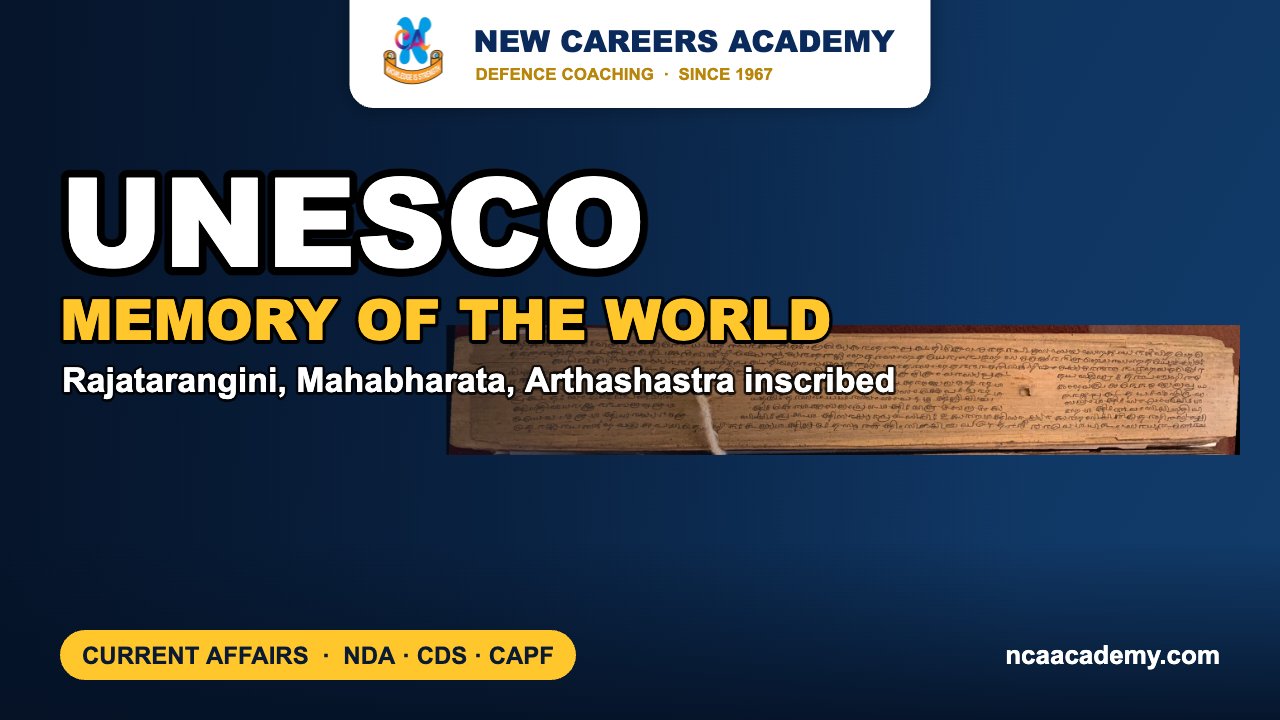
Quick answer: Manuscripts of Kalhana’s Rajatarangini, the Mahabharata and Kautilya’s Arthashastra have been added to UNESCO’s Memory of the World Asia-Pacific Regional Register. The inscription was announced on 5 November 2026 after the 11th session of the regional register in Jakarta, and it lifts India’s tally on this regional list to six.
Why the UNESCO Memory of the World Register is in the news
On 5 November 2026, the Press Information Bureau’s culture handle shared photographs of the UNESCO certificates and called the inscription a historic milestone for India’s civilisational heritage. As reported by PTI, the Indira Gandhi National Centre for the Arts (IGNCA) said the decision came at the 11th Session of the Memory of the World Asia-Pacific Regional Register, held in Jakarta, Indonesia. IGNCA, which acts as India’s nodal agency for the programme, prepared all three nomination dossiers. India now has six entries on this regional register.
Key facts about the three inscribed manuscripts
| Manuscript | Held at | Script and material | What makes it special |
|---|---|---|---|
| Kautilya’s Arthashastra | Oriental Research Institute, Mysore | Grantha script, palm leaf, 168 folios (c. 16th century) | Has 15 Adhikaranas (books) and 150 Adhyayas (chapters), with a partial commentary by Bhattasvamin |
| Mahabharata (Kashmiri recension) | Bhandarkar Oriental Research Institute (BORI), Pune | Sharada script, birch bark, about 400 years old | Acquired in Kashmir in 1875 by Georg Buhler; only 114 of 339 folios survive; used for BORI’s Critical Edition |
| Kalhana’s Rajatarangini (12th-century chronicle of Kashmir’s kings) | Oriental Research Library, Srinagar | Sharada script on old Kashmiri paper | A direct copy of the lost codex archetype; used by Marc Aurel Stein for his critical edition |
- The Mahabharata manuscript preserves the Sabha Parvan in full and parts of the Adi and Aranya Parvans.
- The Arthashastra sets out the Saptanga theory of the state and the Mandala theory of relations between states.
India’s earlier Memory of the World entries
The regional list and the international list are separate. In May 2024, at the 10th meeting of the Memory of the World Committee for Asia and the Pacific (MOWCAP) in Ulaanbaatar, Mongolia, India got its first three regional entries: the Ramcharitmanas, the Panchatantra and the Sahrdayaloka-Locana. Those were also the first nominations IGNCA had ever sent to the regional register, which began in 2008.
On the International Register, Culture Minister Gajendra Singh Shekhawat said in April 2025 that India had 14 inscriptions after the Bhagavad Gita and Natyashastra manuscripts were added. Some of the better-known Indian entries are listed below.
| Year | Entry on the International Register | Custodian |
|---|---|---|
| 1997 | I.A.S. Tamil Medical Manuscript Collection | Institute of Asian Studies, Chennai |
| 2003 | Archives of the Dutch East India Company (joint, with four other countries) | Multiple archives |
| 2005 | Saiva Manuscripts in Pondicherry | French Institute of Pondicherry |
| 2007 | Rigveda | BORI, Pune |
| 2011 | Tarikh-e-Khandan-e-Timuriyah | Khuda Bakhsh Oriental Library, Patna |
| 2011 | Laghukalachakratantrarajatika (Vimalaprabha) | The Asiatic Society, Kolkata |
| 2013 | Shantinatha Charitra | Lalbhai Dalpatbhai Museum, Ahmedabad |
| 2017 | Gilgit Manuscript | National Archives of India, New Delhi |
| 2017 | Maitreyayvarakarana | The Asiatic Society, Kolkata |
| 2025 | Bhagavad Gita manuscript collection; Natyashastra of Bharatamuni | BORI, Pune |
How the Memory of the World programme works
UNESCO started the Memory of the World programme in 1992 to protect documentary heritage such as manuscripts, archives, maps and audio-visual records. It works at three levels: an International Register, regional registers and national registers. The first international inscriptions came in 1997, and the international list had 570 entries by April 2025. There are three regional registers: Asia-Pacific, Latin America and the Caribbean, and Africa.
Do not mix this up with the World Heritage List, which covers sites and monuments, or with the list of Intangible Cultural Heritage, which covers living traditions. Memory of the World is only for documents.
Exam angle: how NDA, CDS and CAPF can ask this
- Expect match-the-following questions pairing a manuscript with its institution, for example Arthashastra with Mysore, the Mahabharata and Rigveda with BORI Pune, and Rajatarangini with Srinagar.
- Ancient Indian history questions in the CDS and NDA papers often cover Kautilya and the Mauryas, Kalhana and Kashmir’s dynasties, and the Saptanga theory.
- Be ready for statement-based questions on UNESCO’s three heritage lists (sites, intangible heritage and documentary heritage).
Practice MCQs
Q1. The Arthashastra manuscript inscribed on the Memory of the World Asia-Pacific Register in 2026 is preserved at:
(a) Bhandarkar Oriental Research Institute, Pune (b) Oriental Research Institute, Mysore (c) Asiatic Society, Kolkata (d) National Archives of India
Answer: (b) It is a 16th-century palm-leaf manuscript in Grantha script held at ORI, Mysore.
Q2. The Rajatarangini and the Kashmiri Mahabharata manuscripts recognised in 2026 are written in which script?
(a) Brahmi (b) Kharosthi (c) Sharada (d) Grantha
Answer: (c) Both manuscripts use the Sharada script.
Q3. At which venue were the Ramcharitmanas, Panchatantra and Sahrdayaloka-Locana added to the regional register in 2024?
(a) Jakarta (b) Ulaanbaatar (c) Bangkok (d) Paris
Answer: (b) They were added at the 10th MOWCAP meeting in Ulaanbaatar.
Q4. Which of the following is NOT a type of heritage that UNESCO’s Memory of the World programme covers?
(a) Manuscripts (b) Archival records (c) Monuments (d) Audio-visual records
Answer: (c) Monuments come under the World Heritage List, not Memory of the World.
Frequently asked questions
Which Indian manuscripts were added to the UNESCO Memory of the World register in 2026?
Manuscripts of Kalhana’s Rajatarangini, the Mahabharata and Kautilya’s Arthashastra were added to the Asia-Pacific Regional Register. The announcement came on 5 November 2026.
Where was the decision taken?
According to IGNCA, the decision was taken at the 11th Session of the Memory of the World Asia-Pacific Regional Register, held in Jakarta, Indonesia.
How many Indian entries are on the Asia-Pacific Regional Register now?
Six. The first three, added in 2024, were the Ramcharitmanas, the Panchatantra and the Sahrdayaloka-Locana. The other three are the 2026 additions.
Which Indian body prepares these nominations?
The Indira Gandhi National Centre for the Arts (IGNCA) houses India’s Memory of the World nodal agency. It prepared all three 2026 dossiers.
Also read on NCA: UNESCO Tentative List: India’s sites | Monthly defence current affairs PDFs | CDS coaching in Chandigarh
Sources: Deccan Chronicle (PTI), Republic World, ThePrint (2024), The Week (PTI, 2025), Memory of the World Register in Asia and the Pacific. Facts as reported up to 8 November 2026.
Featured image background: Unknown scribe / Wikimedia Commons, Public domain.