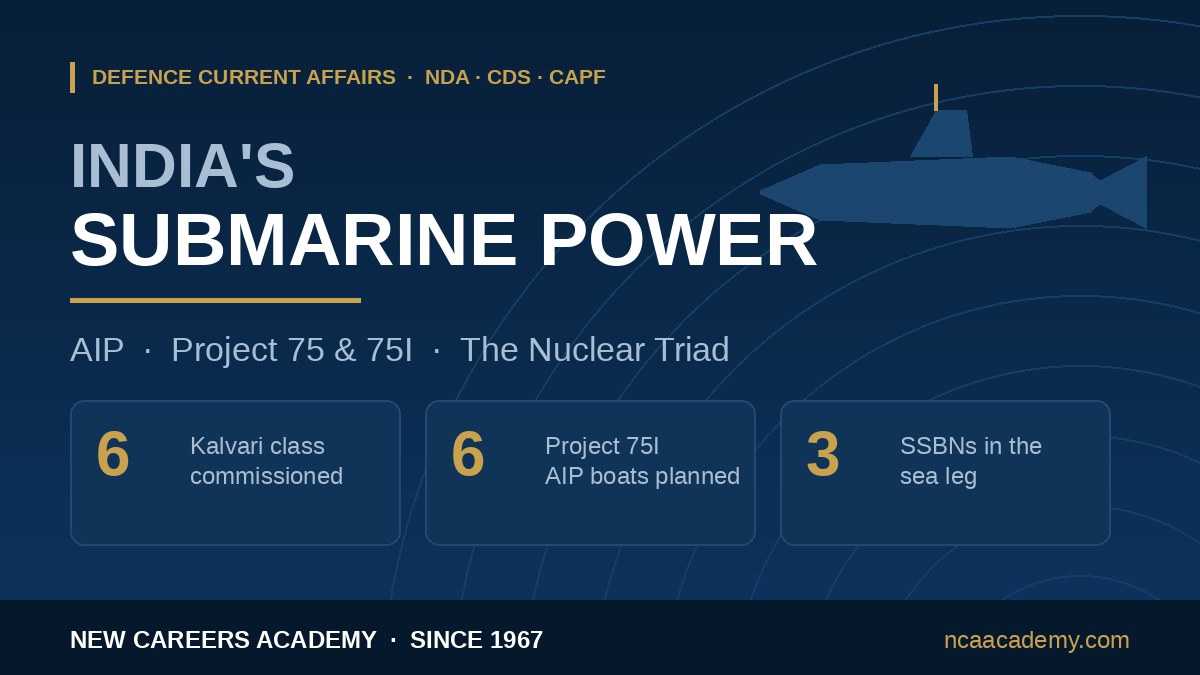
Quick answer: India’s submarine power rests on three layers: six Scorpene-based Kalvari-class (Project 75) diesel-electric boats, six planned AIP-equipped Project 75I boats with Germany’s TKMS, and the nuclear-powered Arihant-class SSBNs (INS Arihant, Arighaat and Aridhaman) that form the sea leg of India’s nuclear triad. This guide gives NDA, CDS and CAPF aspirants every fact, term and MCQ-ready table they need.
Submarines are one of the most repeated “Defence & Science-Tech” areas in the UPSC-set General Knowledge papers. The Navy’s undersea force is also a favourite topic in SSB lecturettes and group discussions. At NDA coaching in Chandigarh, our faculty (59+ years of experience since 1967, 39,000+ selections) teach this topic as a fixed revision block, and the notes below follow that same structure.
Watch: India’s Submarine Power explained (video)
Watch the video above for a visual walkthrough of AIP, the Kalvari class and the SSBN fleet, then use the written notes below for quick revision. Open the video on YouTube.
Key takeaways (30-second revision)
- AIP extends how long a conventional submarine can stay underwater (about two weeks); it is not nuclear.
- Project 75 gave India six Scorpene-based Kalvari-class submarines, all commissioned by January 2025.
- Project 75I will add six AIP submarines built by Mazagon Dock with Germany’s TKMS; the contract was in final approval as of 1 October 2026.
- INS Aridhaman, reported commissioned on 3 April 2026, is India’s third SSBN after INS Arihant and INS Arighaat.
- India’s nuclear triad = land (Agni) + air (Rafale, Su-30MKI, Mirage 2000) + sea (SSBNs), under a No First Use policy.
- Video explainer
- What is an AIP submarine?
- Project 75 (Kalvari class): the Scorpene story
- India’s AIP: DRDO fuel-cell system and its status
- Project 75I: the next six submarines
- SSBNs: INS Arihant, Arighaat and Aridhaman
- The nuclear triad explained
- Project 77 and Chakra III: nuclear attack submarines
- Quick-revision table
- Practice MCQs with answers
- FAQs
What is an AIP submarine?
AIP (Air Independent Propulsion) lets a conventional (non-nuclear) submarine run its propulsion without surfacing or using a snorkel to get air for its diesel engines. A normal diesel-electric submarine must come up near the surface every few days to recharge its batteries, which makes it detectable. An AIP boat can stay submerged for around two weeks at slow speed, so it is much quieter and harder to find.
Common AIP types are fuel cells (used by Germany’s Type 212A/214), Stirling engines (Sweden), and closed-cycle steam turbines (France’s MESMA). India’s indigenous system uses a phosphoric acid fuel cell (PAFC), in which hydrogen is generated on board.
How does an AIP submarine work? (step by step)
- The submarine carries fuel (hydrogen, or a fuel that produces it) and oxygen in tanks inside the hull.
- A fuel cell combines hydrogen and oxygen to make electricity, with water as the by-product.
- That electricity charges the batteries and drives the electric motor, so the diesel engines stay off.
- With no need to snorkel, the boat stays submerged for about two weeks at slow speed and makes very little noise.
Exam point: AIP is not nuclear propulsion. An AIP boat is still a conventional submarine; it only extends underwater endurance.
Project 75 (Kalvari class): the Scorpene story
Under Project 75, India built six Scorpene-design submarines at Mazagon Dock Shipbuilders Limited (MDL), Mumbai, with technology from France’s Naval Group. The contract was signed in 2005, and the programme cost roughly ₹23,000 crore. All six have now been commissioned:
| Submarine | Pennant | Commissioned |
|---|---|---|
| INS Kalvari | S21 | December 2017 |
| INS Khanderi | S22 | September 2019 |
| INS Karanj | S23 | March 2021 |
| INS Vela | S24 | November 2021 |
| INS Vagir | S25 | January 2023 |
| INS Vagsheer | S26 | January 2025 |
The class is named after INS Kalvari, India’s first submarine (a Russian Foxtrot-class boat commissioned in 1967). Before Project 75, the Navy’s conventional force was the Russian-origin Sindhughosh (Kilo) class and the German-design Shishumar (Type 209) class, both now ageing.
India’s AIP: DRDO fuel-cell system and its status
The Kalvari class was delivered without AIP. To fix this, DRDO’s Naval Materials Research Laboratory (NMRL), Ambernath developed a fuel-cell AIP with Larsen & Toubro (lead integrator), Thermax and C-DAC. A 270 kW land-based prototype passed endurance and maximum-power tests in March 2021.
- January 2023: NMRL and Naval Group signed an agreement for the detailed design phase to integrate AIP in the Kalvari class.
- How it fits: an extra “plug” section of about 10 metres is inserted into the hull during a normal refit, lengthening the boat from about 67.5 m to about 77.5 m.
- December 2024: a ₹1,990 crore contract was signed for AIP integration on the Kalvari class (alongside an ₹877 crore torpedo-integration contract).
- March 2025: MDL began plate-cutting for the first AIP plug.
Current status: reports through 2025–26 say integration has slipped, with the Navy targeting INS Khanderi’s refit as the next opportunity. Check the latest official update before your exam, as this changes quickly.
Project 75I: the next six submarines
Project 75I (India) is the Navy’s plan to build six larger, AIP-equipped conventional submarines at MDL with Germany’s thyssenkrupp Marine Systems (TKMS) as technology partner. The design is based on the German Type 214. The boats displace around 3,000 tonnes, and AIP is built in from the start rather than retrofitted.
- It is a Strategic Partnership (SP) model project under Make in India.
- The MDL-TKMS bid cleared technical evaluation and entered cost negotiations; on 1 October 2026 the Defence Secretary said the deal, worth over ₹80,000 crore, was in its final approval stage. Earlier estimates ranged from ₹70,000 to ₹99,000 crore, and the final contract was not yet signed at the time of writing.
SSBNs: INS Arihant, Arighaat and Aridhaman
An SSBN is a nuclear-powered ballistic missile submarine. India’s SSBNs are built under the secret Advanced Technology Vessel (ATV) project at the Ship Building Centre, Visakhapatnam, and are powered by an indigenous pressurised water reactor developed with BARC.
| SSBN | Pennant | Commissioned | Key points |
|---|---|---|---|
| INS Arihant | S2 | 2016 (quietly) | India’s first indigenous SSBN; four launch tubes; K-15 Sagarika, K-4 missiles |
| INS Arighaat | S3 | August 2024 | Second SSBN; higher indigenous content |
| INS Aridhaman | S4 | 3 April 2026 (reported) | Larger (about 7,000 tonnes); reported eight launch tubes; K-4 capable |
| S4* | S4* | Expected around 2027 | Launched October 2024; in sea trials |
Note for aspirants: media reports confirmed the Aridhaman commissioning, but the government did not make a formal announcement, as is usual for this programme. Two further larger S5-class SSBNs are reported to be under construction.
Missile range facts worth remembering: K-15 Sagarika is about 750 km and K-4 about 3,500 km, both submarine-launched ballistic missiles (SLBMs) developed by DRDO.
The nuclear triad explained
A nuclear triad is the ability to deliver nuclear weapons from three platforms: land, air and sea. Having all three gives a country a credible second-strike capability, meaning it can retaliate even after being hit first.
| Leg | India’s platforms |
|---|---|
| Land | Agni series ballistic missiles (also Prithvi) |
| Air | Nuclear-capable fighter aircraft such as the Mirage 2000, Su-30MKI and Rafale |
| Sea | Arihant-class SSBNs with K-15 and K-4 SLBMs |
India’s policy is No First Use (NFU) and Credible Minimum Deterrence, set out in the nuclear doctrine of 2003. The Nuclear Command Authority and the Strategic Forces Command (SFC) control the arsenal. With three SSBNs in service, India can keep at least one on patrol at all times, which analysts call continuous at-sea deterrence.
Project 77 and Chakra III: nuclear attack submarines
An SSN is a nuclear-powered attack submarine. It carries conventional weapons and hunts ships and submarines; it is different from an SSBN.
- Project 77 (sometimes called Project 75 Alpha): a plan for six indigenous SSNs of roughly 10,000 tonnes, to be built at Visakhapatnam. The first two have reportedly been approved, with deliveries expected in the mid-2030s.
- INS Chakra III: a Russian Akula-class SSN being leased for 10 years under a 2019 agreement worth about US$3 billion. Delivery has slipped and is now expected around 2027–28. India earlier leased Chakra I (1988) and Chakra II (2012).
Quick-revision table
| Topic | Remember this |
|---|---|
| AIP | Extends submerged endurance of a conventional submarine; not nuclear |
| Project 75 | 6 Scorpene (Kalvari class), MDL + Naval Group (France) |
| Last Kalvari-class boat | INS Vagsheer, January 2025 |
| Indigenous AIP | DRDO-NMRL phosphoric acid fuel cell, with L&T and Thermax |
| Project 75I | 6 AIP boats, MDL + TKMS (Germany), Type 214-based |
| SSBN project | Advanced Technology Vessel (ATV), Visakhapatnam |
| 3 SSBNs | Arihant (2016), Arighaat (2024), Aridhaman (2026) |
| Doctrine | No First Use + credible minimum deterrence |
| SSN programme | Project 77 (6 planned); Chakra III lease from Russia |
Practice MCQs (NDA / CDS / CAPF style)
Q1. Which organisation developed India’s fuel-cell based AIP system?
(a) ISRO (b) DRDO-NMRL (c) BARC (d) HAL
Answer: (b) DRDO-NMRL
Q2. The Kalvari-class submarines are built at:
(a) Cochin Shipyard (b) Garden Reach (c) Mazagon Dock, Mumbai (d) Hindustan Shipyard
Answer: (c) Mazagon Dock, Mumbai
Q3. Project 75I submarines are being developed with which foreign partner?
(a) Naval Group, France (b) TKMS, Germany (c) Rubin, Russia (d) Navantia, Spain
Answer: (b) TKMS, Germany
Q4. Which of these is NOT a leg of India’s nuclear triad?
(a) Agni missiles (b) Nuclear-capable aircraft (c) SSBN submarines (d) Diesel-electric Kalvari-class submarines
Answer: (d). Kalvari-class boats are conventional and carry no nuclear weapons.
Q5. INS Aridhaman is India’s ___ SSBN.
(a) first (b) second (c) third (d) fourth
Answer: (c) third
Frequently asked questions
What is AIP in a submarine?
AIP stands for Air Independent Propulsion. It allows a conventional submarine to run its propulsion underwater without surfacing for air, so it can stay submerged for about two weeks instead of a few days. This makes the boat quieter and far harder to detect. AIP does not make a submarine nuclear-powered.
How many submarines does India have under Project 75?
Six. Under Project 75, India built six Scorpene-design Kalvari-class submarines at Mazagon Dock Shipbuilders in Mumbai with French Naval Group technology. INS Kalvari was commissioned in December 2017 and the sixth, INS Vagsheer, in January 2025.
What is the difference between Project 75 and Project 75I?
Project 75 produced six Scorpene-based Kalvari-class submarines without AIP. Project 75I is the follow-on plan for six larger, German-designed submarines with AIP built in. Project 75I is being negotiated by Mazagon Dock and TKMS and was awaiting final approval and contract signature at the time of writing.
What is the difference between an SSN and an SSBN?
An SSBN is a nuclear-powered submarine that carries nuclear ballistic missiles for deterrence, such as INS Arihant. An SSN is a nuclear-powered attack submarine that carries conventional weapons to hunt ships and submarines, such as the planned Project 77 boats.
Has India completed its nuclear triad?
India has operated all three legs (land, air and sea) since INS Arihant entered service in 2016. The commissioning of INS Aridhaman in April 2026 strengthened the sea leg by allowing continuous patrols, and more SSBNs are under construction.
Is this topic important for NDA, CDS and CAPF exams?
Yes. Defence technology, submarine classes, missile ranges and the nuclear doctrine appear regularly in the General Knowledge and Current Affairs sections, and in SSB lecturettes. Check the official notifications on upsc.gov.in for syllabus and exam dates.
Prepare with India’s oldest defence coaching institute
DHALIWAL’S NEW CAREERS ACADEMY (NCA Academy), founded in 1967, has 39,000+ selections across NDA, CDS, AFCAT, CAPF and SSB. A new classroom batch starts every Tuesday at our Mohali campus, and online batches run Tuesday to Sunday.
- NDA coaching in Chandigarh | Online NDA coaching | NDA coaching fees
- CDS coaching in Chandigarh | Online CDS coaching
- CAPF coaching in Chandigarh | SSB coaching in Chandigarh
Call: +91-95010-70051 | +91-62396-61414 WhatsApp: +91-90410-12051 Email: admissions@ncaacademy.com
Mohali campus: SCO 71, Sector 91, SAS Nagar (Mohali) 140307 Chandigarh counselling office: 2570, Sector 35-C, Chandigarh 160035
Facts reflect publicly reported information as of 30 October 2026. Submarine programme details are updated often, so verify the latest status before your exam.