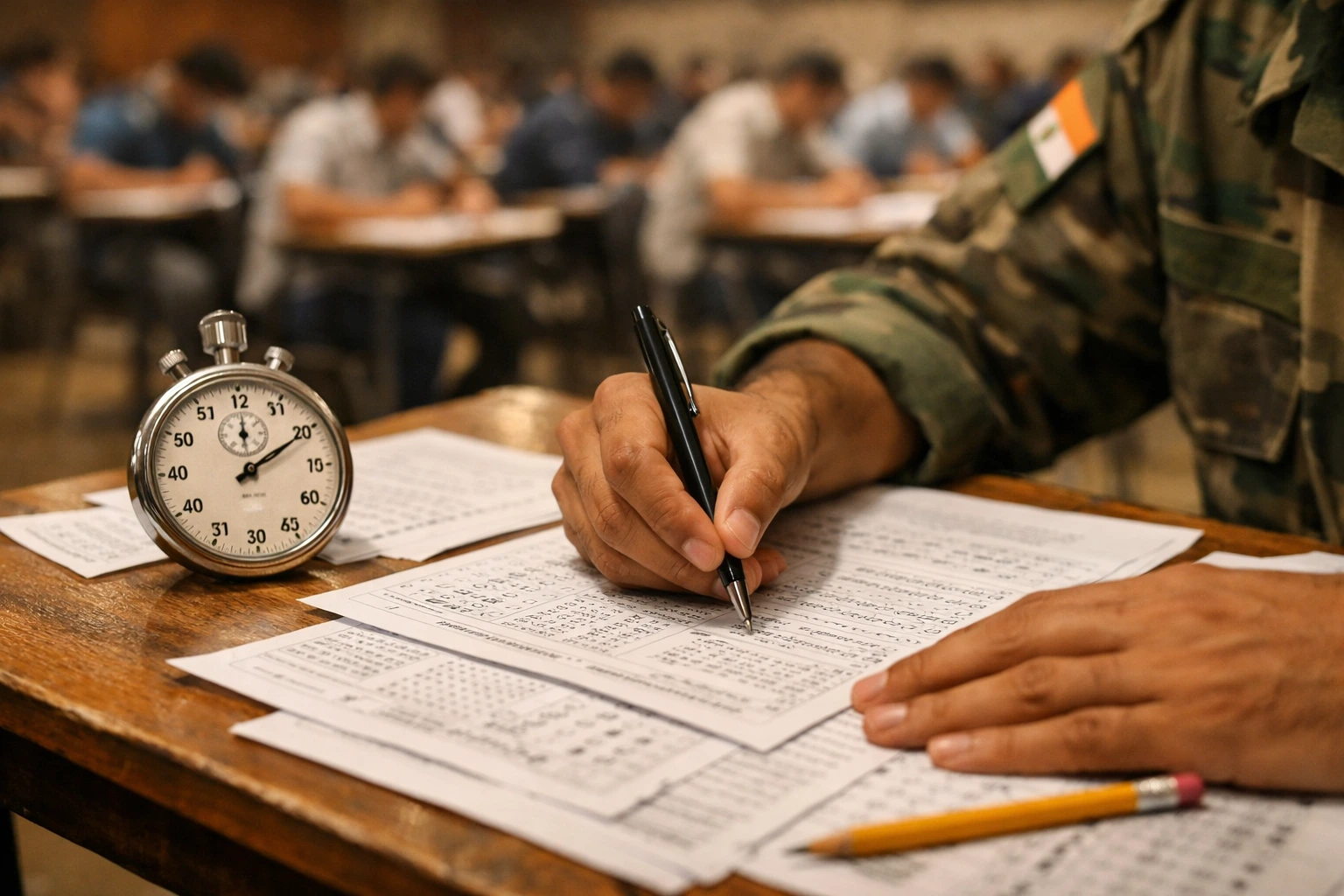
SSB psychological tests 2026 — the psychology round is the most mysterious part of the SSB interview, accounting for a major share of your assessment. This complete guide covers SSB psychological tests 2026 including TAT (Thematic Apperception Test), WAT (Word Association Test), SRT (Situation Reaction Test), and Self Description with examples, do’s and don’ts. Expert preparation tips by NCA Academy, the
best SSB coaching in Chandigarh.
Table of Contents — SSB Psychological Tests 2026
The
psychological tests in SSB are conducted on Day 2 of the SSB interview and are considered one of the most important stages of the entire selection process. Unlike GTO tasks where you interact with others, psychological tests are
individual written assessments that reveal your subconscious personality traits, thought patterns, and emotional responses.The psychologist at SSB uses four tests —
TAT, WAT, SRT, and Self Description (SD) — to build a comprehensive personality profile. The key to success is
consistency across all four tests. At
NCA Academy’s SSB coaching in Chandigarh, our trained psychologists help candidates understand what each test measures and how to respond authentically while showcasing officer-like qualities.
Overview of SSB Psychological Tests
| Test | Full Form | Duration | What It Measures |
|---|
| TAT | Thematic Apperception Test | ~48 min (4 min × 12 pictures) | Thought process, imagination, problem-solving approach, hidden desires |
| WAT | Word Association Test | ~15 min (15 sec × 60 words) | Spontaneous thoughts, mindset, subconscious tendencies |
| SRT | Situation Reaction Test | 30 min (60 situations) | Practical thinking, decision-making, initiative, social awareness |
| SD | Self Description | 15 min | Self-awareness, how others perceive you, aspirations |
TAT (Thematic Apperception Test) — Complete Guide
How TAT Works
You’re shown
12 pictures (11 ambiguous pictures + 1 blank slide). For each picture, you get
30 seconds to observe and
4 minutes to write a story. The blank slide requires you to create your own imaginary scene and story.
What the Psychologist Looks For
- Who is the hero? — Usually a projection of yourself
- What is the hero doing? — Shows your approach to challenges
- What is the hero feeling? — Reveals emotional depth
- What is the outcome? — Positive outcomes indicate optimism and determination
TAT Story Structure (4-Minute Formula)
| Section | Time | What to Write |
|---|
| What led to the situation | 30 sec | Brief background — who, where, what happened before |
| What is happening now | 1 min | Describe the current situation, challenges faced |
| What the hero thinks/feels | 30 sec | Emotional response, motivation, thought process |
| What action the hero takes | 1 min | Specific, decisive actions showing OLQs |
| Outcome | 1 min | Positive resolution, lesson learned, impact on others |
TAT Do’s and Don’ts
| Do’s | Don’ts |
|---|
| Make the hero proactive and decisive | Don’t write passive heroes who wait for help |
| Include realistic, practical actions | Don’t write supernatural or unrealistic endings |
| Show emotions naturally | Don’t make stories overly dramatic or cinematic |
| End with positive outcomes | Don’t write sad, hopeless, or violent endings |
| Vary your themes across stories | Don’t repeat the same theme (army/patriotism) in every story |
| Write in simple, clear language | Don’t use complex vocabulary to impress |
| Include social themes occasionally | Don’t write every story about defence/military |
WAT (Word Association Test) — Complete Guide
How WAT Works
You’re shown
60 words one at a time, with
15 seconds per word. For each word, you write a sentence that comes to your mind. The test measures your spontaneous thought patterns and subconscious mindset.We’ve covered WAT extensively in our dedicated guide:
WAT Words for SSB 2026 — 300+ Practice Words. Here we’ll focus on the psychological principles behind it.
What the Psychologist Analyzes
| Response Type | What It Indicates | Example (Word: “Failure”) |
|---|
| Positive/Constructive | Optimism, resilience, growth mindset | “Failure teaches valuable lessons for future success” |
| Negative/Pessimistic | Low confidence, defeatist attitude | “Failure is the worst thing that can happen” |
| Neutral/Factual | Balanced thinking, objectivity | “Failure is a natural part of the learning process” |
| Aggressive/Extreme | Impulsive tendencies, poor emotional control | “Failure should be punished severely” |
WAT Golden Rules
- Write the FIRST thing that comes to mind — don’t overthink
- Form complete, meaningful sentences — not single words or phrases
- Be positive but realistic — not every sentence needs to be about patriotism
- Show variety — involve self, others, and society in your sentences
- Never skip a word — even if you write a simple sentence, write something
SRT (Situation Reaction Test) — Complete Guide
How SRT Works
You’re given a booklet with
60 real-life situations and have
30 minutes to write your response to each (about 30 seconds per situation). Each response should be
1-2 lines describing what you would DO in that situation.
Categories of SRT Situations
| Category | Percentage | Example Situation | Ideal Response Approach |
|---|
| Social/Community | 25% | You see a child drowning in a lake | Take immediate action, involve others, show initiative |
| Personal Dilemma | 20% | Your friend asks you to lie to cover for them | Show moral courage, diplomatic honesty |
| Emergency/Crisis | 20% | Fire breaks out in a crowded theatre | Quick thinking, organize evacuation, leadership |
| Professional/Work | 15% | Your boss unfairly blames you for a colleague’s mistake | Handle professionally, speak to boss privately, resolve |
| Group/Team | 10% | Your team refuses to follow your plan during a trek | Listen to alternatives, convince logically, adapt |
| Self-Improvement | 10% | You realize you have a fear of public speaking | Take proactive steps to overcome, practice, seek help |
SRT Response Formula
Every SRT response should follow this pattern:
Action + Reasoning + OutcomeExample: “I would immediately jump in to rescue the child (action), as saving a life is the priority (reasoning), and then ensure the child receives medical attention (outcome).”
Common SRT Mistakes
- Writing what you SHOULD do vs what you WOULD do — Be genuine, not preachy
- Over-delegating — “I would call the police” for every situation shows lack of initiative
- Being unrealistic — “I would single-handedly fight 5 criminals” is not practical
- Leaving situations blank — Always write something, even a brief response
- Being too wordy — Stick to 1-2 lines, be crisp and action-oriented
Self Description (SD) — Complete Guide
How SD Works
You get
15 minutes to write about yourself from 5 perspectives:
| Perspective | Time | What to Write |
|---|
| What your parents think about you | 3 min | Qualities, expectations, relationship dynamics |
| What your teachers/employer think about you | 3 min | Academic/professional qualities, work ethic, behavior |
| What your friends think about you | 3 min | Social personality, reliability, fun factor, loyalty |
| What you think about yourself | 3 min | Honest self-assessment, strengths, weaknesses, aspirations |
| What kind of person you want to become | 3 min | Goals, values, officer-like vision for yourself |
SD Writing Tips
- Be consistent with your TAT/WAT/SRT responses — The psychologist cross-checks all four tests
- Include specific examples — “My friends say I’m helpful” is weak; “My friends say I organized the entire college fest when no one else volunteered” is strong
- Acknowledge weaknesses — Mention 1-2 genuine weaknesses with how you’re working on them
- Don’t paint yourself as perfect — Realistic self-assessment shows maturity
- Show alignment between others’ views and self-view — Massive disconnect suggests poor self-awareness
The Secret: Consistency Across All 4 Tests
The single most important factor in psychological testing is
consistency. The psychologist looks for a coherent personality across all four tests:
| If Your TAT Shows… | Your WAT Should Show… | Your SRT Should Show… | Your SD Should Show… |
|---|
| Initiative and leadership | Positive, action-oriented sentences | Taking charge in situations | Others describing you as a leader |
| Empathy and social concern | Awareness of others’ feelings | Helping people in distress | Friends calling you caring |
| Courage and decisiveness | Bold, clear sentences | Quick decision-making in crises | Self-aware of your brave actions |
Inconsistency is the #1 reason candidates fail psychological evaluation. If your TAT heroes are bold leaders but your SRT responses delegate everything to others, the psychologist notes a contradiction.
How NCA Academy’s Psychology Training Works
New Careers Academy, the
best SSB coaching institute in Chandigarh since 1967, offers:
- Individual psychological profiling before training begins
- 100+ TAT practice sessions with feedback from trained psychologists
- 500+ SRT situation practice under timed conditions
- WAT speed training to build genuine positive association
- Self-Description workshops for authentic self-presentation
- Cross-consistency checks to ensure your personality projection is unified
Our
online SSB coaching program also includes complete psychological test preparation with video modules and personalized feedback.
Register for NCA Academy’s SSB Course today.
Frequently Asked Questions (FAQ)
Can I prepare for SSB psychological tests or are they purely spontaneous?
You absolutely should prepare — but the preparation is about
developing genuine positive thinking patterns, not memorizing responses. Regular practice of TAT story writing, WAT sentences, and SRT situations builds the mental habit of constructive, action-oriented thinking. At
NCA Academy, we focus on personality development rather than scripted responses.
What happens if my TAT stories are different from my SRT responses?
The psychologist looks for
consistency across all tests. If your TAT hero is brave and decisive but your SRT responses are passive and delegation-heavy, it flags inconsistency. This doesn’t automatically disqualify you, but it weakens your psychological profile. Focus on being yourself consistently across all tests.
Should I write all positive stories in TAT?
Your stories should be
predominantly positive with realistic elements. It’s natural to show the hero facing challenges — what matters is how the hero responds. A story where the hero faces a tough situation and overcomes it through effort is better than a story where everything goes perfectly with no struggle.
How important are psychological tests compared to GTO and interview?
All three assessors (Psychologist, GTO, IO) have
equal weight in the final conference. However, the psychological assessment is unique because it reveals your
subconscious personality — things you might hide in interview or GTO. A strong psychological profile can significantly boost your recommendation chances.
What if I can’t complete all 60 SRT situations in 30 minutes?
Aim to complete at least
50-55 situations. Speed comes with practice — start with 2-3 practice sets per week, timing yourself strictly. Write
crisp 1-2 line responses rather than long paragraphs. At NCA Academy, we conduct timed SRT practice daily to build speed and quality.
Is the blank slide in TAT a trap?
No, the blank slide is an
opportunity to showcase your best self. Without picture constraints, you can create any scenario. Write a story that naturally demonstrates your strongest OLQs — leadership, initiative, social responsibility. This is your chance to project the officer you aspire to be.
📚 Complete Your SSB Preparation — Read These Next
Why NCA Academy Is the Best SSB Coaching in Chandigarh & India
NCA Academy (New Careers Academy) is rated among the
best SSB coaching institutes in Chandigarh and one of the
top SSB coaching centres in India. Whether you prefer classroom training or
online SSB coaching, NCA Academy delivers results.
Why Candidates Choose NCA Academy for SSB Coaching
- Proven Track Record: 1000+ SSB recommendations across NDA, CDS, AFCAT, TES & ACC entries
- Expert Faculty: Retired defence officers and psychologists with 15+ years of SSB assessment experience
- Complete SSB Preparation: Personal interview, GTO, psychology, physical — all under one roof in Chandigarh
- Online SSB Coaching: Live interactive sessions for candidates across India who cannot travel to Chandigarh
- Mock SSBs: Full 5-day simulated SSB experience at our Chandigarh centre
- Individual Mentorship: One-on-one sessions to build OLQs and officer-like personality
Whether you are searching for
SSB coaching in Chandigarh, the
best SSB coaching in India, or reliable
online SSB coaching — NCA Academy’s RUDRA Batch is your answer.
JOIN NCA ACADEMY SSB COACHING →
View All NCA Academy Courses |
SSB Complete Guide
📖 CDS Aspirants — Essential Guides
Official Resources for SSB Psychological Tests 2026
💻 Prefer expert SSB guidance from home? Explore NCA’s online SSB coaching in India — live mock interviews, GTO and psychology training.
📝 Complete the set: SSB Self Description (SD) examples & how to write it.
🎯 Want expert guidance for the SSB? Explore the SSB coaching in India at New Careers Academy — ex-officer mentors, live mock SSB and a proven selection record since 1967.
New SSB guides you should read

Written by
Capt. Dhaliwal · Director, New Careers Academy
Ex-Indian Army officer and SSB mentor at NCA Academy, Chandigarh (est. 1967), coaching NDA, CDS, AFCAT and SSB aspirants since the 1980s. About the author →
Reviewed by Hartaj Dhaliwal — SSB Strategist, NCA · third-generation officer · recommended by the SSB three times.