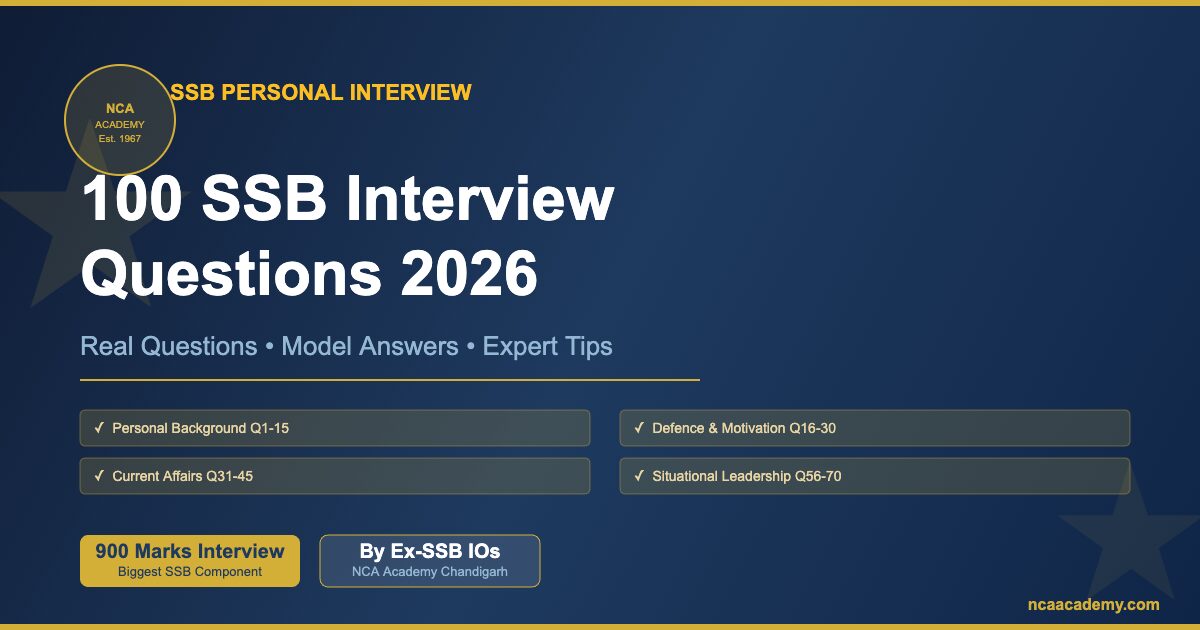
SSB interview questions 2026 — if you are preparing for the Services Selection Board personal interview, this is the most comprehensive guide you will find anywhere. We cover 100 real SSB interview questions with model answers across every category — personal background, defence motivation, current affairs, situational leadership, and more — drawn from NCA Academy’s 57 years of SSB coaching experience in Chandigarh.
Whether you are appearing through NDA, CDS, AFCAT, TES, or MNS, the SSB personal interview is your final gate to a commission. Use this guide to walk in fully prepared.
Quick Answer — SSB Interview Questions 2026
The SSB Personal Interview is a one-on-one conversation with the Interviewing Officer, built largely around your PIQ (Personal Information Questionnaire). Expect questions across personal background, defence motivation, current affairs, education, situational judgement and hobbies. The key is honest, specific, self-aware answers backed by real examples — not memorised lines. This guide gives 100 real SSB interview questions with model answers for 2026, plus the rules examiners actually reward.
Last updated: 9 June 2026 — refreshed for the 2026 SSB cycle. See also the SSB 5-day schedule and the SSB OIR test guide.
⚡ Key Takeaways
- SSB personal interview is 900 marks — the single biggest component of final merit
- Interview lasts 30–60 minutes; IO tests 15 Officer-Like Qualities (OLQs)
- 100 Q+A organised across 8 categories so you can prepare section by section
- Current Affairs section updated for 2025–26 defence events
- Repeater-specific questions included — one of the few guides that covers this
- NCA Academy students average 3× higher SSB recommendation rate vs national average
Table of Contents
- How the SSB Personal Interview Works
- Personal Background Questions (Q1–Q15)
- Defence & Motivation Questions (Q16–Q30)
- Current Affairs & GK Questions (Q31–Q45)
- Education & Career Questions (Q46–Q55)
- Situational & Leadership Questions (Q56–Q70)
- Hobby & Interest Questions (Q71–Q80)
- Rapid Fire & Opinion Questions (Q81–Q90)
- Repeater-Specific Questions (Q91–Q100)
- 10 Golden Rules for SSB Personal Interview
- How NCA Academy Prepares You
- FAQ
How the SSB Personal Interview Works
The SSB personal interview is conducted by the Interviewing Officer (IO) — typically a Lt. Colonel or equivalent — on Day 4 or Day 5 of the five-day SSB process. The IO has full access to your PIQ form, your performance in psychological tests (TAT, WAT, SRT, SD), and the GTO tasks. The interview is not a quiz — it is a structured conversation to assess your Officer-Like Qualities (OLQs).
| Parameter | Details |
|---|---|
| Conducted by | Interviewing Officer (IO) — usually Lt. Col. rank |
| Duration | 30–60 minutes (can extend to 90 min for repeaters) |
| Marks | 900 (largest single component in SSB) |
| Day | Day 4 or Day 5 of the 5-day process |
| Format | One-on-one; semi-structured conversation |
| OLQs assessed | All 15 — Reasoning Ability, Social Adaptability, Courage, Stamina, etc. |
| Key documents reviewed | PIQ form, psychological test results, GTO observations |
Personal Background Questions (Q1–Q15)
These are the first questions in almost every SSB interview. The IO uses your PIQ form answers to probe deeper. Be consistent, specific, and confident. Never contradict what you wrote on the PIQ.
Q1. Tell me something about yourself.
Model Answer: “Sir, I am [Name] from [City]. I completed my schooling from [School] with [percentage/grade]. I have been passionate about the Indian Army since childhood — my father served as a Subedar Major in the Infantry, and watching him in uniform inspired me deeply. I am a national-level chess player and believe that strategic thinking is one of my strongest attributes. I am appearing through CDS Entry this time after thorough preparation at NCA Academy, Chandigarh.”
Q2. Tell me about your family background.
Model Answer: Speak about each family member briefly — their profession, their influence on your character. Highlight any defence connection. If none, emphasise values instilled by your family: discipline, honesty, service.
Q3. What is your biggest strength?
Tip: Pick one OLQ-aligned strength (e.g., decision-making under pressure) and back it with a real example. Avoid generic words like “hardworking.”
Q4. What is your biggest weakness?
Tip: Choose a genuine but non-fatal weakness. More importantly, describe what you are actively doing to overcome it. Never say “I have no weakness.”
Q5. Why did you choose [your college/stream]?
Be honest. If you chose engineering because of parental pressure but later found passion, say so — the IO values self-awareness over perfection.
Q6. Who is your role model and why?
You can name a military figure (Field Marshal Sam Manekshaw, General Bipin Rawat) or a non-military figure. Justify your choice with specific qualities, not just fame.
Q7. Describe an incident that shaped your personality.
Use the STAR method: Situation, Task, Action, Result. Pick an incident that reveals an OLQ — courage, social adaptability, or initiative.
Q8. What are your achievements so far?
List academic, sports, leadership, and community achievements. Rank them by relevance to the military. Be specific — “district-level cricket captain” is stronger than “good at sports.”
Q9. How has your upbringing prepared you for the military?
Connect your personal history to OLQs. If you grew up in a joint family, highlight conflict resolution. If you were a school prefect, highlight leadership.
Q10. Are you close to your family? Will you be able to handle separation?
This tests emotional stability and sacrificial attitude. Acknowledge the challenge and demonstrate maturity — “Sir, I love my family deeply. But I also understand that serving the nation is the highest form of service, and my family fully supports this choice.”
Q11. How do your friends describe you?
Answers should align with OLQs. “My friends say I am the one they call when they need clear-headed advice in a crisis” is excellent.
Q12. What was your most difficult moment in life? How did you handle it?
Be genuine. Handling adversity with composure is exactly what the IO is looking for. Avoid melodrama.
Q13. What do you do in your free time?
Be honest and specific. “I read military history” or “I run 5km every morning” is far better than “watching TV.”
Q14. Have you had any experience of leadership outside college?
NSS, NCC, sports captaincy, community work, Scout & Guide — all count. Describe the situation and your specific role.
Q15. Tell me about your hometown. What makes it special?
Know your city’s history, famous personalities, economic importance, and any military heritage. This also tests general awareness.
Defence & Motivation Questions (Q16–Q30)
This is the most critical category. The IO must be convinced that your desire to join the armed forces is genuine, informed, and long-standing — not a fallback option after other careers failed.
Q16. Why do you want to join the Indian Army/Navy/Air Force?
Model Answer: “Sir, for me it is not a career — it is a calling. I have always believed that the most meaningful life is one lived in service of something greater than oneself. The armed forces offer that, along with a life of adventure, discipline, and constant growth. I specifically want the Army because ground combat leadership, commanding soldiers, and being operationally deployed is where I see myself contributing best.”
Q17. Why not a civil services job? The pay is better and it is safer.
Don’t be defensive. Acknowledge the UPSC path’s merits, then explain why the military aligns better with your personality and values.
Q18. What do you know about the entry you are applying through?
Know every detail: eligibility, training academy, service conditions, bond period. Ignorance here is a red flag.
Q19. Which arm or service would you prefer and why?
Research Infantry, Armoured Corps, Artillery, Engineers, Signals, etc. Give a genuine, informed reason aligned with your strengths.
Q20. What do you know about the current operational situation on our borders?
Cover: Line of Actual Control (LAC) situation in Eastern Ladakh, Pakistan border, active insurgencies in the Northeast, and recent ceasefire developments. Be factual, not political.
Q21. Are you aware of the Agnipath scheme? What is your opinion on it?
Explain the scheme accurately: 4-year service, 25% retention as Agniveers. Give a balanced view — acknowledge the debate but emphasise the scheme’s strategic rationale for a younger force profile.
Q22. If you are not selected today, what will you do?
Show resilience: “Sir, I will analyse the feedback, continue my preparation, and reappear. My commitment to joining the armed forces is not conditional on this attempt.”
Q23. What qualities does an officer need that a soldier does not?
Think: decision-making authority, strategic thinking, man-management, administrative responsibility, bearing under pressure, and moral courage to make unpopular but right calls.
Q24. What do you know about the life of an officer in the field?
Field postings, peace postings, Counter-Insurgency (CI) ops, HAP allowances, annual confidential reports, command tenures — know the life you are choosing.
Q25. Would you be willing to serve in a conflict zone? Are you prepared to die for the country?
Answer with dignity and conviction — not bravado. “Sir, I joined knowing that risk is inherent to this uniform. I am mentally prepared for what this commitment entails.”
Q26. Name three Indian Army Generals you admire and why.
Good answers: Field Marshal Sam Manekshaw (1971 war), General K.M. Cariappa (first C-in-C), General Bipin Rawat (CDS, military reforms). State specific reasons for each.
Q27. What is the difference between bravery and recklessness?
Bravery is calculated courage — you assess risk and act despite it for a higher purpose. Recklessness is action without regard for consequence. An officer must be brave, never reckless.
Q28. How will you handle a situation where you disagree with your commanding officer’s order?
Express your disagreement through proper channels — brief the CO privately, state your concern clearly. Once an order is confirmed, execute it fully and professionally.
Q29. What are the core values of the Indian Army?
The Indian Army’s ethos: Courage (Shauryam), Camaraderie, Commitment, Integrity (Chevalry) — codified in ARMY values. Also: “Service Before Self.”
Q30. Where do you see yourself in 10 years if you get commissioned?
Realistic answer: Company Commander / Squadron Commander, having completed your mandatory professional courses (LDMC, Higher Command). Show ambition within realistic military timelines.
Current Affairs & GK Questions (Q31–Q45)
The IO expects an officer-candidate to be aware of the world. Defence current affairs, national security, geopolitics, and major government policy are all fair game. Questions are most commonly drawn from the last 12 months.
Q31. What is India’s current defence budget and how does it compare globally?
India’s defence budget for 2025–26 is approximately ₹6.81 lakh crore — around 1.9% of GDP. India ranks 4th globally in defence spending after the USA, China, and Russia.
Q32. What is the significance of the India-Maldives relationship in 2025?
After President Muizzu’s “India Out” stance and subsequent recalibration, India-Maldives ties were restored with India maintaining defence cooperation and infrastructure projects. Strategically important for Indian Ocean Region dominance.
Q33. What is Operation Sindoor?
Operation Sindoor was India’s precision military strike in May 2025 against terrorist infrastructure across the Line of Control in Pakistan and Pakistan-Occupied Kashmir, following the Pahalgam terror attack. It was a tri-services operation demonstrating India’s new doctrine of punitive response.
Q34. What is QUAD and why does it matter for India?
QUAD (Quadrilateral Security Dialogue) is a strategic grouping of India, USA, Australia, and Japan. It matters because it supports a free and open Indo-Pacific, counters Chinese maritime assertiveness, and involves joint military exercises (Malabar being the naval component).
Q35. What do you know about INS Vikrant?
INS Vikrant is India’s first indigenously built aircraft carrier, commissioned in 2022. Displaces 45,000 tonnes, can carry MiG-29K fighters and helicopters. Marks India’s entry into the league of nations capable of building aircraft carriers.
Q36. What is the significance of Aatmanirbhar Bharat in defence?
India aims to reduce defence imports from 60% to 30% by 2025. Key milestones: Tejas Mk1A, ATAGS howitzer, Pinaka rocket system, INS Vikrant — all indigenously developed. This reduces strategic dependence and builds a defence industrial base.
Q37. What is the Line of Actual Control (LAC) and why is it contested?
LAC is the de facto boundary between India and China — approximately 3,488 km. It is contested because China and India have different perceptions of where it lies in three sectors: Western (Ladakh), Middle (Himachal/Uttarakhand), and Eastern (Arunachal Pradesh). The 2020 Galwan clash brought it to global attention.
Q38. What are the 15 Officer-Like Qualities (OLQs) assessed at SSB?
Effective Intelligence, Reasoning Ability, Organising Ability, Power of Expression, Social Adaptability, Cooperation, Sense of Responsibility, Initiative, Self-Confidence, Speed of Decision, Ability to Influence the Group, Liveliness, Determination, Courage, and Stamina.
Q39. What do you know about India’s nuclear doctrine?
India follows a “No First Use” (NFU) nuclear doctrine — India will not use nuclear weapons first but retains the right to massive retaliation if struck. India is also committed to credible minimum deterrence.
Q40. Name India’s most recent missile system and its significance.
Agni-V: intercontinental ballistic missile with ~5,000 km range, MIRV-capable (Multiple Independently targetable Reentry Vehicles — tested in 2024). Hypersonic weapon systems are also under development. BrahMos supersonic cruise missile is operational and export-ready.
Q41. What is the significance of the CDS (Chief of Defence Staff) post?
Created in January 2020, the CDS acts as single-point military adviser to the government and heads the Department of Military Affairs. It is designed to bring tri-service jointness and theatre-command restructuring to India’s military.
Q42. What is India’s stance on the Russia-Ukraine war?
India has maintained strategic autonomy — abstaining from UN resolutions condemning Russia while continuing to purchase discounted Russian oil. India has called for dialogue and a diplomatic resolution, protecting its historical Russia relationship while deepening Western ties.
Q43. What is Article 370 and what happened to it?
Article 370 granted special autonomous status to Jammu & Kashmir. In August 2019, the Indian government abrogated it and bifurcated J&K into two Union Territories — J&K and Ladakh. J&K was restored to full statehood in 2024.
Q44. What is the Galwan Valley incident?
On 15–16 June 2020, Indian and Chinese soldiers clashed at Galwan Valley in Eastern Ladakh. Twenty Indian soldiers were killed (the highest casualties since 1975). India’s firm response and prolonged standoff led to mutual disengagement at several friction points by 2024.
Q45. What is the importance of the Indian Ocean Region (IOR) for India’s security?
Over 90% of India’s trade by volume passes through the IOR. Energy security (Gulf oil routes), anti-piracy, HADR operations, and countering China’s “String of Pearls” strategy all depend on Indian naval dominance in the IOR.
Education & Career Questions (Q46–Q55)
Q46. Why did you choose your particular stream/subject?
Be honest. Link it back to natural aptitude or curiosity, and then connect how it will help you as an officer (e.g., engineering for Corps of Engineers, science for technical arms).
Q47. Your academic record is not great — explain.
Acknowledge it without making excuses. If there is a genuine reason (family hardship, health), state it briefly. More importantly, show what you did to recover and what you learned.
Q48. Why didn’t you pursue higher education (Masters/MBA) instead of joining the military?
The military is your calling, not a fallback. Show that you have considered alternatives and made a conscious, informed choice.
Q49. Which subject do you find most interesting and why?
Pick one and demonstrate depth — not just textbook knowledge. The IO is testing intellectual curiosity.
Q50. What extracurricular activities did you participate in during college?
NCC, NSS, sports teams, cultural events, technical clubs — connect each to a character trait or OLQ it developed.
Q51. Do you have any work experience? How has it prepared you for the military?
Even internships teach time management, teamwork, and meeting deadlines under pressure — all military-relevant skills.
Q52. Have you appeared in any competitive exams? How did you prepare?
Demonstrates self-discipline and structured preparation. Mention UPSC written, AFCAT, NDA written — and your preparation methodology.
Q53. What do you read? Name the last book you read.
Ideally, name a military book (e.g., “The Swordsmaster” by Lt. Gen. P.C. Katoch, “A Soldier’s General” by Gen. Bikram Singh) or a leadership book. Be ready to discuss its core idea.
Q54. How do you manage stress during exams or high-pressure situations?
Give a concrete technique: physical exercise, breaking problems into smaller tasks, mindfulness, or competitive sports. Show self-awareness and control.
Q55. What would you have done if the military option were not available?
Give an honest, thoughtful answer. This assesses whether your ambition is genuine and varied, or narrow and desperate.
Situational & Leadership Questions (Q56–Q70)
These are the hardest and most important questions. They test how you think and act under pressure — the very core of what an officer must do every day.
Q56. You are leading a patrol and one of your soldiers gets injured badly. You are 10 km from the nearest post and under possible enemy surveillance. What do you do?
Prioritise casualty — CASEVAC immediately. Secure the area, establish communication with base, request QRT/helicopter if available. Never abandon a soldier. Lead from the front.
Q57. Your unit is given an impossible task with limited resources. How do you approach it?
Assess resources, identify constraints, prioritise objectives, improvise with available means, and communicate clearly with superiors. Show “can-do” attitude while being realistic.
Q58. You discover that a senior officer in your unit is involved in corruption. What do you do?
Document evidence, report through proper channels (CO, then higher formation), and maintain confidentiality. Moral courage is non-negotiable — but so is due process.
Q59. How would you motivate a soldier who has lost the will to fight?
Understand the root cause first — personal problem, battle fatigue, family crisis. Address it empathetically. Connect him back to his duty, his comrades, and the larger mission.
Q60. You make a wrong call that costs your unit a mission objective. What do you do?
Own it — immediately and completely. Brief your CO, extract lessons, rebuild confidence in your team. Leaders who own mistakes build more trust than those who never make them.
Q61. You have two equally deserving soldiers for a single recommendation. How do you choose?
Establish transparent, merit-based criteria. Document your reasoning. Communicate your decision honestly to both. Never use favouritism.
Q62. What would you do if you were ordered to do something you believed was unethical but not illegal?
Flag your concern clearly to the superior officer through private channels. If the order stands, evaluate whether it crosses a moral line that requires you to formally object. Officers have both duty and conscience.
Q63. How do you handle a soldier who constantly questions your authority?
Investigate whether the challenge is ego-driven or whether he is raising legitimate points. Address ego with firm but respectful boundary-setting. Address legitimate concerns with acknowledgment and resolution.
Q64. Your vehicle breaks down in a remote area during a mission. You have no communication. What do you do?
Stay calm, assess the situation, attempt field repairs, orient yourself using map and compass, establish local security, send a runner to nearest habitation or post if required. Use your training.
Q65. How do you balance the welfare of your men with the demands of the mission?
Mission first — always. But welfare and mission are rarely mutually exclusive. A well-rested, well-fed soldier performs better. The best officers ensure both are never compromised beyond necessity.
Q66. A natural disaster strikes near your unit’s area. You receive no orders. What do you do?
The military’s HADR doctrine empowers junior leaders to act. Assess the scale, inform your CO, and begin immediate humanitarian assistance with available resources — don’t wait for orders when lives are at stake.
Q67. You are the first officer at the scene of a communal riot. Your orders are to maintain peace. Angry mobs are approaching each other. What do you do?
Deploy your platoon to physically separate the mobs. Identify leaders on both sides and negotiate. Minimum force principle — graduated response. Call for backup. Protect civilians first.
Q68. How do you handle failure — personal or professional?
Show emotional maturity: accept it, analyse root cause, extract lessons, adapt, and move forward with renewed determination. Failure avoided is a lesson missed.
Q69. Describe your leadership style.
Use evidence, not labels. “I lead from the front on physical tasks, consult my team on planning, set clear expectations, and hold myself to the same standard I expect from my soldiers.”
Q70. What would you do if a fellow officer — your friend — was found cheating on an evaluation?
Integrity above friendship — always. Report it through proper channels. True friendship means holding people to the right standards, not protecting them from consequences.
Hobby & Interest Questions (Q71–Q80)
Q71. What are your hobbies and how do they connect to being an officer?
Chess → strategic thinking. Team sports → leadership, communication. Trekking → physical stamina, navigation, risk assessment. Make the connection explicit.
Q72. Are you physically fit? What is your current fitness routine?
Be specific: “I run 5km in under 25 minutes, do 40 push-ups and 15 pull-ups. I train 6 days a week.” Vague answers like “I exercise regularly” are red flags.
Q73. Have you played any team sport at a competitive level?
Team sports reveal how you function within a group. If yes, describe your role in the team. If not, explain what other group activities you have been part of.
Q74. Do you follow any sport? What can cricket/football teach us about leadership?
Cricket: field placement strategy, managing different personalities, adapting to conditions. Football: instant team communication, positional discipline, high-pressure decision-making.
Q75. What kind of music, films, or art do you enjoy? Why?
The IO is checking for a well-rounded personality. You don’t need to like military films exclusively. Show genuine taste and the ability to discuss it thoughtfully.
Q76. Have you travelled across India? Which region interested you most and why?
Demonstrates curiosity about your own country. Mention geographical, cultural, or historical significance. Shows you see India beyond your hometown.
Q77. Do you have any adventure activity experience — trekking, rock climbing, paragliding?
Even one significant adventure experience demonstrates risk tolerance, physical courage, and initiative — all valued OLQs.
Q78. What was the last movie you watched? Did you relate to any character?
Be honest. If it was a military film, discuss the leadership lessons. If it was something else, connect it genuinely. Don’t pretend to have watched something you haven’t.
Q79. What do you do to stay updated — newspapers, podcasts, or social media?
Ideal answer: “I read The Hindu and Livemint daily, follow CLAWS (Centre for Land Warfare Studies) for defence analysis, and listen to the Geopolitics With GP podcast.” Shows structured information habits.
Q80. If you had one month of free time, what would you do?
Show initiative and ambition — not just rest. A trekking expedition, volunteering, learning a skill, or travelling with a purpose all reflect well. Pure leisure for a month is a red flag.
Rapid Fire & Opinion Questions (Q81–Q90)
These questions test your spontaneity, presence of mind, and ability to form and express coherent opinions quickly. The IO may fire these back-to-back. Answer briefly but with conviction.
Q81. Which is the best regiment in the Indian Army and why? — Any answer works if justified. Example: “Para SF for their multi-role capability and exceptional selection standards.”
Q82. One word to describe yourself. — Pick an OLQ: “Decisive.” “Resilient.” “Dependable.” Be ready to justify it with an example if asked.
Q83. Army or Air Force — which is harder to get into? — Both are extremely competitive at different levels. Acknowledge both routes have their unique demands.
Q84. If you could change one thing about India, what would it be? — Think big-picture and constructively. Corruption, education quality, regional inequality — pick one and briefly justify.
Q85. What is your opinion on women in combat roles? — India has opened almost all combat roles to women. Give a reasoned, respectful, and current answer — based on capability and merit, not gender.
Q86. Who is a greater leader — Napoleon or Churchill? — No right answer. The IO wants to see how you structure an argument. Compare on strategic vision, handling adversity, and legacy.
Q87. Would you rather be feared or respected as a leader? — “Respected, always. Fear produces compliance; respect produces loyalty and discretionary effort.”
Q88. What is more important — intelligence or hard work? — “Persistent hard work, directed intelligently, outperforms raw intelligence. Most military situations reward preparation and tenacity over raw IQ.”
Q89. Name one thing about India that makes you proud. — Options: Indian Army’s humanitarian record, ISRO’s Mars mission on a budget, constitutional democracy surviving for 75+ years. Be genuine.
Q90. If not India, which country’s military would you want to serve in? — Israel (IDF for innovation), USA (scale and technology), or UK (SAS tradition) — justify with a specific reason.
Repeater-Specific Questions (Q91–Q100)
If this is your second or third SSB attempt, the IO will spend significant time on your previous attempt(s). These questions are tougher — the IO is looking for genuine growth and self-awareness, not just persistence.
Q91. You have appeared before. Why were you not recommended last time?
Never blame the SSB, the IO, or external factors. Demonstrate honest self-reflection: “I believe I lacked the maturity to articulate my decision-making process clearly. I have since worked on this through [specific action].”
Q92. What have you done differently since your last attempt?
Be specific: new fitness routine, leadership role taken up, community work, reading, additional courses. “Nothing much” is disqualifying.
Q93. At what stage were you screened out last time?
If Stage I (OIR + PPDT) — the IO will probe your Officer Intelligence Rating and group skills. If Stage II — they will probe why you couldn’t cross the final interview. Be honest.
Q94. Are you more nervous this time or less, knowing what to expect?
Less nervous — because you have experienced the process and used that knowledge to genuinely prepare. “More confident” with a genuine reason shows growth.
Q95. If you are not selected again, what is your plan?
Show that your life has purpose beyond SSB, while making clear the military remains your primary goal. A repeater with no backup plan looks desperate; one with a clear plan looks mature.
Q96. What feedback, if any, did you receive from your previous SSB?
SSB doesn’t give written feedback. But if you attended a debrief or have insights from NCA coaching, share them. Demonstrates you actively sought feedback rather than feeling sorry for yourself.
Q97. Has your motivation to join the military changed after your first attempt?
“If anything, it has deepened. Going through the process showed me the level of officer the military demands — and that standard made me want to achieve it more, not less.”
Q98. Do you think there is anything fundamentally not officer-like about you?
A dangerous question for those who are not self-aware. If you have worked on a genuine gap, acknowledge it and describe the improvement. Claiming perfection is worse than acknowledging a flaw.
Q99. Why should we recommend you now when we did not before?
“Because I am not the same person who sat in front of an IO [X] months ago. I have [specific examples of growth]. My OLQs have been tested in real situations since then, and I am better prepared to demonstrate them.”
Q100. Is there anything you would like to tell me that I haven’t asked?
Use this to volunteer one strong, genuine example of leadership or character that did not come up. Or express sincere gratitude for the opportunity. Do not ramble — one clear, confident statement.
10 Golden Rules for the SSB Personal Interview
- Be consistent — your answers must match your PIQ form. The IO will cross-check.
- Never lie — experienced IOs can detect fabrication instantly. One caught lie ends your candidature.
- Speak first, then pause — never pause then speak — hesitation signals lack of confidence. Think quickly and commit to an answer.
- Use the STAR method for situational answers — Situation, Task, Action, Result.
- Know your PIQ form by heart — every line is a potential question thread.
- Maintain steady eye contact — not staring, but confident and natural.
- Dress correctly — formals, neatly ironed, no excessive accessories. The IO notices.
- Know the news — read the newspaper every day for 30 days before SSB. Current affairs are non-negotiable.
- End answers with a conclusion — rambling without a conclusion signals unclear thinking.
- If you don’t know, say so — “Sir, I am not aware of the exact details, but my understanding is…” is far better than bluffing.
How NCA Academy Prepares You for the SSB Personal Interview
NCA Academy in Chandigarh has been the leading SSB coaching institute since 1967. Our SSB interview preparation programme is built around mock interviews with ex-SSB Board Presidents and IOs — giving you the most realistic preparation possible.
What You Get at NCA Academy SSB Coaching
- 10+ mock personal interviews with ex-IO officers — each with detailed feedback
- PIQ form coaching — how to fill it strategically and consistently
- Current Affairs daily sessions — defence, geo-politics, and India’s security landscape
- Body language and communication coaching — eye contact, posture, voice modulation
- Situation Reaction Test practice — 60 SRT responses in 30 minutes
- Group Discussion & GTO coaching — complete Stage II preparation
- 57 years of SSB track record | Chandigarh’s #1 Defence Coaching Institute
Related SSB 2026 Guides
- SSB OIR Test — Complete Guide to Pattern & Questions
- SSB Interview 5-Day Schedule — What Happens Each Day
- SSB Psychological Tests — TAT, WAT, SRT & Self-Description
- SSB Dress Code & What to Carry — Day-Wise Checklist
- SSB Rejection Reasons — Why Candidates Fail
- How to Crack SSB in Your First Attempt — 60-Day Strategy
- NDA 2 2026 Notification & Exam Guide
Frequently Asked Questions
How long does the SSB personal interview last?
The SSB personal interview typically lasts 30 to 60 minutes. For repeaters or candidates with complex backgrounds, it can extend to 90 minutes. The IO controls the duration based on how much he wants to explore.
How many marks is the SSB personal interview worth?
The SSB personal interview is worth 900 marks — the single largest component in the entire SSB merit calculation. This is why it can make or break an otherwise strong candidate.
What should I wear to the SSB personal interview?
Wear clean, ironed formals — a collared shirt with formal trousers, polished shoes, and a tie if you are comfortable with one. Avoid casual wear, excessive accessories, or strongly scented products. Your appearance should be neat and professional without being overdressed.
Can I be rejected at the personal interview stage after passing GTO?
Yes. All three components — Psychology, GTO, and Personal Interview — are assessed independently. A very poor personal interview can result in non-recommendation even if you performed well in GTO and Psychology. The conference board makes the final call based on all three.
How should I prepare for SSB interview current affairs questions?
Read a quality English newspaper (The Hindu, Indian Express) daily for at least 30 days before SSB. Focus especially on defence news, India’s foreign policy, border situations, and major government policy. Keep a daily notes diary and review it every week.
What is the PIQ form and why does it matter so much?
The Personal Information Questionnaire (PIQ) is filled on Day 1 of SSB. The IO uses it as the foundation for your personal interview — every hobby, achievement, and family detail you write becomes a potential question thread. Fill it thoughtfully and truthfully, and memorise every word you write.
How many times can I appear for SSB?
You can appear for SSB as many times as you remain eligible for the entry you are applying through. For NDA, the age cut-off applies. For CDS, you can attempt until the age eligibility expires. There is no cap on the number of SSB attempts.
What is the recommended SSB interview? How is it different from a non-recommend?
A “Recommended” (Conf-Recommended) result means the conference board assessed you as suitable for officer training. You then undergo a medical examination. A “Non-Recommended” (NR) means you will not be progressing in this attempt. SSB does not provide written reasons for NR.
Should I mention that I want to join a specific regiment?
Yes — if you have a genuine, informed reason. Naming a preference (e.g., Armoured Corps, Para SF, Corps of Engineers) and explaining why demonstrates that you have researched the military and have a clear vision for your service. Vague answers like “wherever the Army needs me” can seem evasive.
How is NCA Academy’s SSB coaching different from other institutes?
NCA Academy has been producing SSB-recommended officers since 1967 — making it India’s oldest active defence coaching institute. Our mock interviews are conducted by ex-SSB Interviewing Officers, not generic trainers. Our students benefit from 57 years of institutional memory on what boards look for and how preparation converts to recommendations.
💻 Prefer expert SSB guidance from home? Explore NCA’s online SSB coaching in India — live mock interviews, GTO and psychology training.
🎯 Want expert guidance for the SSB? Explore the professional SSB coaching in India at New Careers Academy — ex-officer mentors, live mock SSB and a proven selection record since 1967.
New SSB guides you should read
Written by
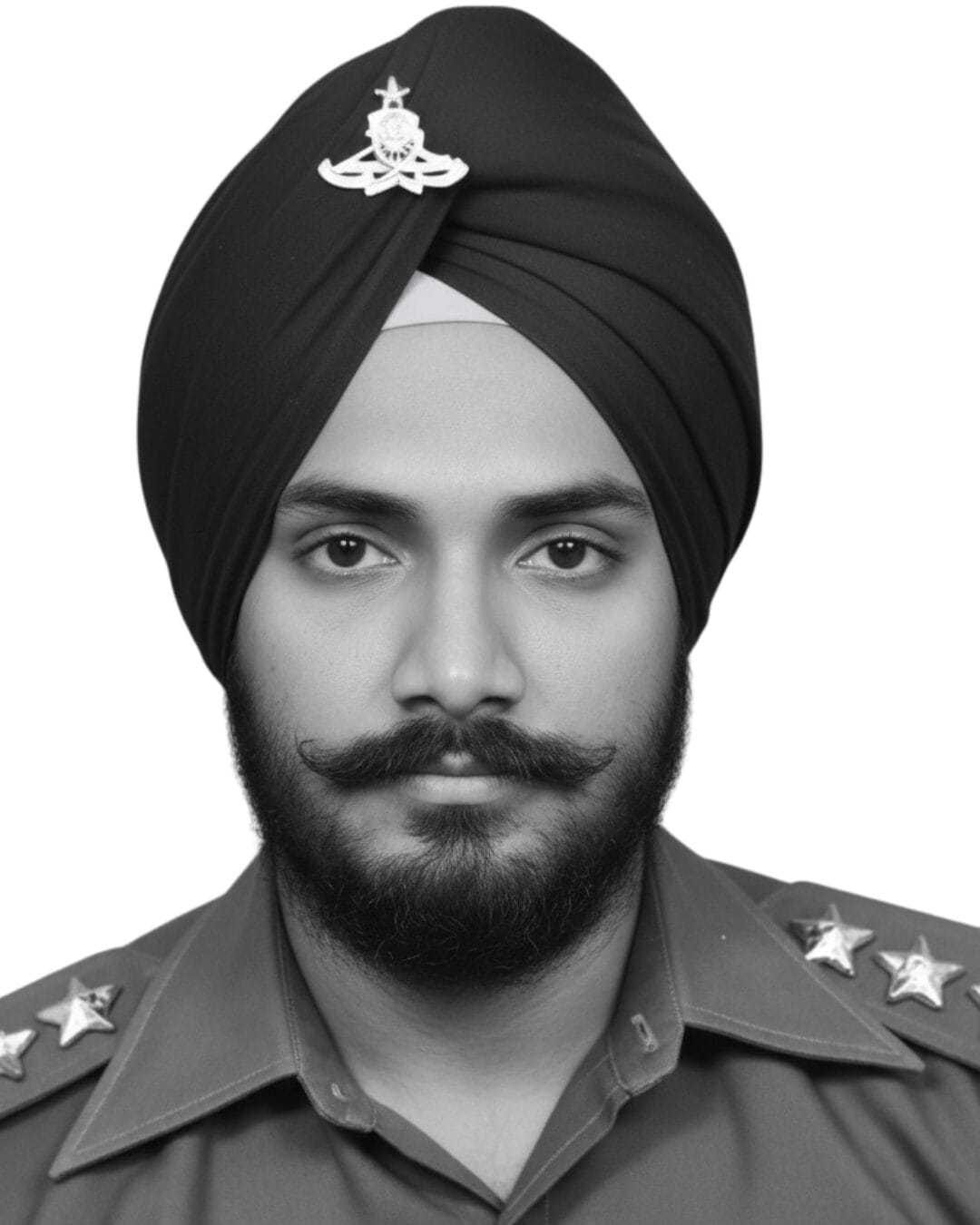
Capt. Dhaliwal · Director, New Careers Academy
Ex-Indian Army officer and SSB mentor at NCA Academy, Chandigarh (est. 1967), coaching NDA, CDS, AFCAT and SSB aspirants since the 1980s. About the author →
Reviewed by Hartaj Dhaliwal — SSB Strategist, NCA · third-generation officer · recommended by the SSB three times.