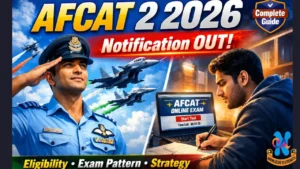
AFCAT 2 2026 Notification: Complete Guide & Why New Careers Academy for Your AFCAT Preparation
Definition and Overview
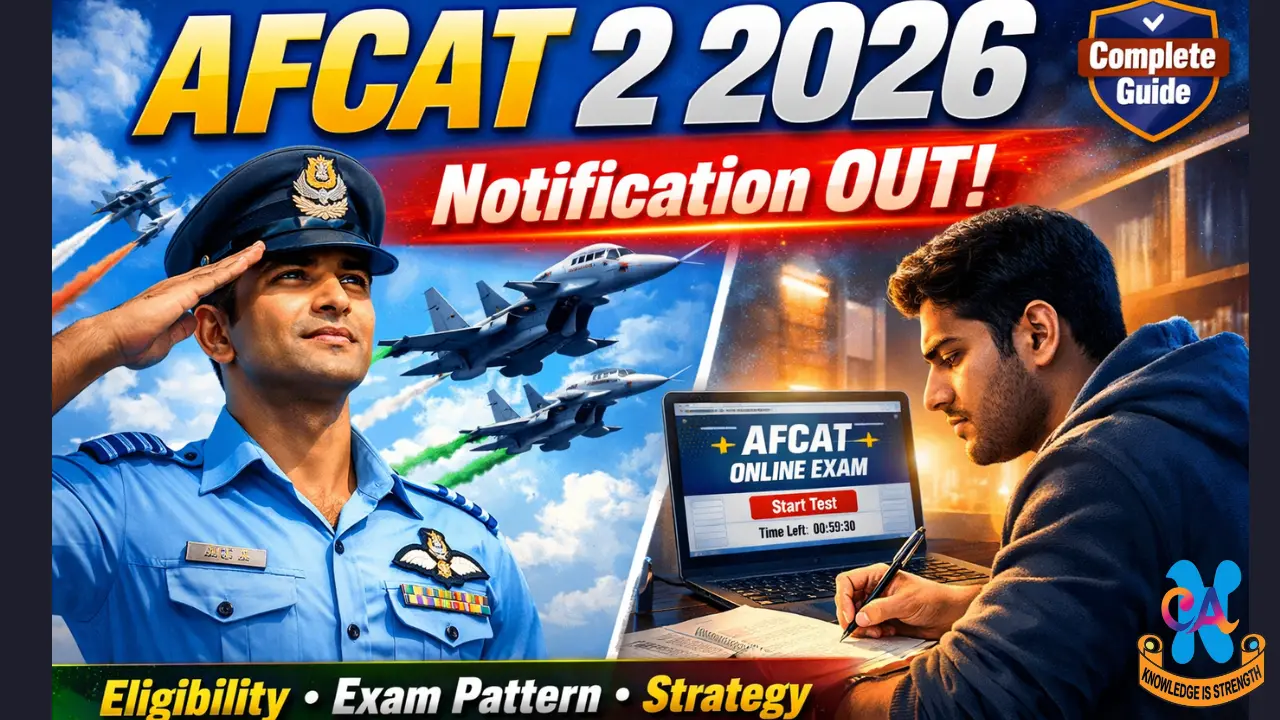
AFCAT 2 2026 refers to the second Air Force Common Admission Test scheduled for 2026, conducted by the Indian Air Force for selecting officers in Flying Branch, Ground Duty (Technical and Non-Technical) branches. The examination is held twice annually. AFCAT 2 2026 notification contains details about exam dates, eligibility criteria, application process, vacancies, and selection procedure.
AFCAT 2 2026 Quick Facts
What is AFCAT 2 2026? AFCAT 2 2026 is the Indian Air Force recruitment examination for commissioning officers in Flying, Technical, and Non-Technical branches. It is the second exam of 2026.
Expected Notification Date: August 2026 (tentative)
Expected Exam Date: November-December 2026 (tentative)
Eligibility:
- Age: 20-24 years (Flying/Ground Duty Technical), 20-26 years (Ground Duty Non-Technical)
- Education: Graduate degree (specific requirements vary by branch)
- Marital Status: Unmarried (for Flying Branch and some GD branches)
Exam Pattern:
- Duration: 2 hours
- Questions: 100 (Multiple Choice)
- Subjects: General Awareness, Verbal Ability, Numerical Ability, Reasoning & Military Aptitude
- Negative Marking: 0.25 marks per wrong answer
Selection Process: Online Test → AFSB Interview → Medical Examination → Merit List
AFCAT 2 2026 Notification: Important Dates
Expected Timeline (Subject to Official Announcement)
Notification Release: August 2026 (tentative)
Online Application Start Date: August 2026 (1st week)
Online Application Last Date: September 2026 (last week)
Admit Card Release: November 2026 (2nd week)
Examination Date: November/December 2026 (last weekend typically)
Result Declaration: December 2026/January 2027
AFSB Interview: January-April 2027
Final Merit List: May-June 2027
Note: Exact dates will be announced on the official Indian Air Force website (careerindianairforce.cdac.in). Candidates should check regularly for official notification.Candidates waiting for the AFCAT 2 2026 notification should regularly check the official website
Previous Year Pattern
| Exam | Notification Month | Exam Month |
|---|---|---|
| AFCAT 2 2025 | August 2025 | November 2025 |
| AFCAT 1 2025 | January 2025 | February 2025 |
| AFCAT 2 2024 | August 2024 | November 2024 |
| AFCAT 1 2024 | December 2023 | February 2024 |
As per official records, AFCAT follows a consistent biannual schedule with notifications typically released 3 months before the examination.
Eligibility Criteria for AFCAT 2 2026
Age Limit (As on the Date of Course Commencement)
Flying Branch:
- Minimum Age: 20 years
- Maximum Age: 24 years
- Age relaxation: Upper age limit extended to 26 years for candidates with valid and current Commercial Pilot License issued by DGCA (India)
Ground Duty (Technical):
- Minimum Age: 20 years
- Maximum Age: 26 years
Ground Duty (Non-Technical):
- Minimum Age: 20 years
- Maximum Age: 26 years
Meteorology Branch:
- Minimum Age: 20 years (completed)
- Maximum Age: 26 years
Educational Qualification
Flying Branch:
- Graduate degree in any discipline from a recognized university
- Minimum 60% marks in graduation (50% for SC/ST candidates)
- Mathematics and Physics at 10+2 level mandatory
Ground Duty (Technical) – Aeronautical Engineer (Electronics) and Aeronautical Engineer (Mechanical):
- 4-year degree in Engineering/Technology in specified streams
- Minimum 60% marks (50% for SC/ST)
- Passed sections of AMIE/Graduate membership examinations recognized by AICTE
Technical Branches – Specific Stream Requirements:
Aeronautical Engineer (Electronics): Electronics, Telecommunication, Instrumentation, Aerospace, Computer Science, IT
Aeronautical Engineer (Mechanical): Mechanical, Aerospace, Computer Science, IT
Ground Duty (Non-Technical) – Administration and Logistics:
- Graduate degree in any discipline
- Minimum 60% marks (50% for SC/ST)
Ground Duty (Non-Technical) – Accounts:
- Graduate degree with Commerce as one subject
- OR Graduate with 2 years post-qualification work experience in accounts/finance
- Minimum 60% marks (50% for SC/ST)
Ground Duty (Non-Technical) – Education:
- Post Graduate degree with minimum 50% marks (45% for SC/ST)
- OR 4-year graduate degree with 60% marks (50% for SC/ST)
Meteorology Branch:
- Post Graduate degree in any branch of Science/Maths/Statistics/Geography/Computer Applications/Environmental Science/Applied Physics/Oceanography/Meteorology/Agricultural Meteorology/Ecology & Environment/Geophysics
- OR 4-year Bachelor of Engineering/Technology degree
- Minimum 50% marks (45% for SC/ST)
- Mathematics and Physics at 10+2 level mandatory
Physical Standards
Height:
- Flying Branch: 162.5 cm minimum (relaxation for tribal/Gorkhas)
- Ground Duty: 157.5 cm minimum
Weight: Proportionate to height and age
Vision Standards (Flying Branch):
- Distant Vision: 6/6 in one eye, 6/9 in other (correctable to 6/6)
- Hypermetropia: +2.0D
- Myopia: Nil
- Color perception: CP-I
Vision Standards (Ground Duty Technical/Non-Technical):
- Distant Vision: 6/60 correctable to 6/6
- More relaxed standards than Flying Branch
Leg Length:
- Minimum: 99 cm
- Maximum: 120 cm (For Flying Branch)
Thigh Length:
- Maximum: 64 cm (For Flying Branch)
Marital Status
Flying Branch: Unmarried only (male and female candidates)
Ground Duty Technical: Unmarried only
Ground Duty Non-Technical: Unmarried only (for specific entries; some entries allow married candidates – check official notification)
Nationality
Candidates must be:
- Citizen of India, or
- Subject of Nepal, or
- Subject of Bhutan, or
- Tibetan refugee who came to India before January 1, 1962, or
- Person of Indian origin from Pakistan, Burma, Sri Lanka, Kenya, Uganda, Tanzania, Zambia, Malawi, Zaire, Ethiopia, or Vietnam with intention of permanent settlement
Gender
Both male and female candidates are eligible for all branches. Female candidates were first inducted into Flying Branch in 2016 and continue to be eligible.Once the AFCAT 2 2026 notification is released, application links will be activated.Understanding details mentioned in the AFCAT 2 2026 notification is crucial before applying.
AFCAT 2 2026 Exam Pattern
Online Examination Structure
Mode: Computer-based test (Online)
Duration: 2 hours (120 minutes)
Total Questions: 100 (Multiple Choice Questions)
Total Marks: 300
Negative Marking: Yes, 0.25 marks deducted for each wrong answer
Sections: 4 sections covering different topics
Section-wise Distribution
| Section | Number of Questions | Marks per Question | Total Marks | Topics Covered |
|---|---|---|---|---|
| General Awareness | 25 | 3 | 75 | History, Geography, Polity, Environment, Science, Defence, Current Affairs, Sports |
| Verbal Ability in English | 25 | 3 | 75 | Comprehension, Error Detection, Sentence Completion, Synonyms, Antonyms, Testing of Vocabulary |
| Numerical Ability | 20 | 3 | 60 | Decimal Fraction, Simplification, Average, Percentage, Ratio & Proportion, Profit & Loss |
| Reasoning and Military Aptitude Test | 30 | 3 | 90 | Verbal Skills, Spatial Ability, Logical Reasoning, Situational Judgement |
Question Paper Characteristics
Language: English only
Type: Objective (4 options per question)
Difficulty Level: Moderate (comparable to graduation level)
Calculator: Not allowed
Rough Work: Available on question paper booklet
AFCAT 2 2026 Syllabus
General Awareness (25 Questions, 75 Marks)
Topics Covered:
History:
- Ancient, Medieval, and Modern Indian History
- Freedom Struggle
- Indian National Movement
- Post-Independence India
Civics and Polity:
- Indian Constitution basics
- Fundamental Rights and Duties
- Government structure
- Important constitutional amendments
Geography:
- Physical, Social, and Economic Geography of India and the World
- Rivers, Mountains, Climate
- Natural resources
- Environmental issues
Current Affairs:
- National and International events (last 6-12 months)
- Sports achievements
- Awards and honors
- Defence-related news
- Scientific developments
Defence:
- Defence organizations (DRDO, HAL, ISRO)
- Military operations
- Weapons and equipment
- Defence agreements
Science:
- Basic Physics, Chemistry, Biology
- Scientific principles and applications
- Technology developments
Sports:
- Major tournaments
- Indian and international sports personalities
- Olympic Games, Commonwealth Games
Verbal Ability in English (25 Questions, 75 Marks)
Topics Covered:
Comprehension:
- Passage reading
- Inference-based questions
- Main idea identification
Vocabulary:
- Synonyms
- Antonyms
- One-word substitution
- Idioms and phrases
Grammar:
- Error detection (grammatical errors)
- Sentence improvement
- Fill in the blanks
- Active-Passive voice
- Direct-Indirect speech
Sentence Formation:
- Sentence completion
- Sentence arrangement
- Jumbled sentences
Numerical Ability (20 Questions, 60 Marks)
Topics Covered:
Arithmetic:
- Decimal fractions
- Simplification (BODMAS)
- Average
- Percentage
- Ratio and Proportion
- Profit and Loss
- Simple and Compound Interest
- Time and Work
- Time and Distance
Algebra:
- Basic algebraic expressions
- Linear equations
- Quadratic equations
Geometry:
- Triangles, circles
- Area and perimeter
- Volume and surface area
Data Interpretation:
- Tables
- Bar graphs
- Pie charts
- Line graphs
Reasoning and Military Aptitude Test (30 Questions, 00 Marks)
Topics Covered:
Verbal Reasoning:
- Analogy
- Classification
- Series completion
- Coding-Decoding
- Blood relations
- Direction sense
Non-Verbal Reasoning:
- Figure series
- Figure classification
- Mirror images
- Paper folding and cutting
- Embedded figures
Spatial Ability:
- 3D visualization
- Rotation of figures
- Pattern recognition
Logical Reasoning:
- Statement and assumptions
- Statement and conclusions
- Syllogism
- Cause and effect
- Logical deduction
Military Aptitude:
- Situational judgement
- Decision-making scenarios
- Leadership qualities assessment
- Team dynamics
- Officer-like qualities (OLQ) based questions
Aspirants should download and carefully read the AFCAT 2 2026 notification PDF
Selection Process for AFCAT 2 2026
Stage 1: Online Examination
Candidates who apply and meet eligibility criteria appear for AFCAT online test. Those who score above the cutoff marks are shortlisted for AFSB interview.
Cutoff Determination: AFSB cutoff is based on:
- Number of vacancies
- Number of candidates appeared
- Difficulty level of paper
- Category (General/OBC/SC/ST)
Expected Cutoff Range: 140-160 marks out of 300 (varies by branch and category)
Stage 2: Air Force Selection Board (AFSB) Interview
AFSB interview is conducted over 5 days at one of the AFSB centers (Dehradun, Mysore, Varanasi, Gandhinagar).
Day 1: Screening
- Officer Intelligence Rating (OIR) Test (verbal and non-verbal reasoning)
- Picture Perception and Description Test (PPDT)
- Group discussion
- Candidates who clear screening proceed to next stages
Day 2-4: Detailed Testing
Psychological Tests:
- Thematic Apperception Test (TAT)
- Word Association Test (WAT)
- Situation Reaction Test (SRT)
- Self Description Test (SD)
Group Testing Officer (GTO) Tasks:
- Group discussions
- Group planning exercise
- Progressive group tasks
- Half group tasks
- Lecturette
- Individual obstacles
- Command tasks
Personal Interview:
- Conducted by Interviewing Officer
- Questions on Personal Information Questionnaire (PIQ)
- Current affairs, hobbies, family background
- Motivation for joining Air Force
- Academic knowledge
Day 5: Conference All assessors (Psychologist, GTO, Interviewing Officer) meet to finalize recommendations.
AFSB Marks: Total 300 marks (combined assessment)
Stage 3: Medical Examination
Candidates recommended by AFSB undergo detailed medical examination conducted by Air Force medical team.
Medical Standards Checked:
- Vision (detailed eye examination)
- Hearing
- Blood tests
- X-rays
- ENT examination
- Dental check
- Psychological fitness
- Anthropometric measurements (height, weight, leg length, thigh length for Flying Branch)
Medical Categories: Candidates are placed in different medical categories based on fitness level. Flying Branch requires highest medical standards.
Stage 4: Merit List Preparation
Final merit list is prepared based on:
- AFCAT marks (300)
- AFSB marks (300)
- Total: 600 marks
Medical fitness is mandatory. Only medically fit candidates with highest combined scores are selected based on vacancy numbers.
Stage 5: Joining and Training
Selected candidates receive joining instructions and report to:
- Air Force Academy, Dundigal (Hyderabad) for Flying Training
- Air Force Technical College, Bangalore for Technical Branch
- Air Force Academy for Ground Duty training
Training Duration:
- Flying Branch: 74 weeks
- Ground Duty Technical: 74 weeks
- Ground Duty Non-Technical: 52 weeks
Why New Careers Academy for Your AFCAT Preparation
Start with a benchmark: attempt NCA’s free AFCAT mock test — 3 full-length papers on the real 120-minute exam pattern, with section-wise scores and All India Rank.
Specialized AFCAT-Focused Curriculum
New Careers Academy has developed a comprehensive AFCAT preparation program specifically designed around the exam pattern, syllabus, and question trends observed over the past 10 years. Unlike generic coaching centers that cover multiple exams superficially, the academy focuses exclusively on defence examinations including AFCAT.
Curriculum Features:
- Topic-wise coverage aligned with official AFCAT syllabus
- Previous year question paper integration into teaching
- Separate modules for each section (GA, English, Maths, Reasoning & Military Aptitude)
- Regular revision classes for retention
- Current affairs updated until exam day
Experienced Faculty with Air Force Background
The academy employs instructors who have either cleared AFCAT themselves or have extensive experience training Air Force aspirants. Several faculty members are retired Air Force officers who bring practical insights into AFSB interview preparation.
Faculty Expertise:
- English taught by language experts with 10+ years AFCAT coaching experience
- Numerical Ability handled by mathematics specialists familiar with AFCAT question patterns
- General Awareness instructors provide defence-focused current affairs
- Reasoning & Military Aptitude section taught by ex-defence personnel who understand officer-like qualities assessment
Integrated AFCAT + AFSB Preparation Model
New Careers Academy does not treat AFCAT and AFSB as separate stages. From day one, students undergo personality development alongside academic preparation.
AFSB Integration Features:
- Weekly group discussions on current affairs topics
- Mock psychological tests (TAT, WAT, SRT)
- Personal interview practice sessions
- GTO task simulation during outdoor activities
- PIQ form filling guidance
- Lecturette practice (3-minute talks on random topics)
- Situational judgement exercises
This integrated approach ensures that candidates who clear AFCAT written test are already mentally and psychologically prepared for AFSB, significantly increasing final selection rates.
Comprehensive Study Material Developed In-House
The academy provides printed and digital study material created after analyzing 12+ years of AFCAT papers. The material is concise, exam-focused, and eliminates unnecessary content.
Study Material Includes:
- Subject-wise theory booklets
- Topic-wise question banks with 2000+ practice questions
- Previous year solved papers (2011-2025)
- Formula sheets and quick revision notes
- Current affairs monthly compilation
- English vocabulary builder (1000+ words)
- Reasoning tricks and shortcuts booklet
- Military aptitude scenario-based question sets
Digital Resources:
- PDF versions of all material
- Video lectures for complex topics
- Mobile app for on-the-go practice
- Online test series access
Regular Mock Tests with All-India Ranking
New Careers Academy conducts AFCAT mock tests every week following the exact pattern, difficulty level, and time duration of the actual exam. Tests are evaluated immediately, and detailed performance analysis is provided.
Mock Test Features:
- 25+ full-length AFCAT mock tests during course duration
- Section-wise tests for focused improvement
- Computer-based test interface (mimics actual exam environment)
- Instant score calculation with negative marking
- All-India ranking to gauge competition level
- Question-wise solution videos
- Performance tracking dashboard showing progress over time
Adaptive Testing: After initial tests, the difficulty level is adjusted based on individual performance, ensuring continuous challenge and improvement.
Small Batch Sizes for Personal Attention
While large coaching centers run batches of 100+ students, New Careers Academy maintains batch sizes between 25-30 students. This allows faculty to:
- Identify individual weaknesses and provide targeted guidance
- Clear doubts personally during class hours
- Monitor attendance and performance closely
- Provide customized study plans for weak students
- Ensure every student participates in discussions and activities
Personal Mentorship: Each student is assigned a mentor who tracks progress, counsels during low-motivation periods, and provides strategic guidance based on performance trends.
Current Affairs Coverage Until Exam Day
AFCAT General Awareness section heavily tests current affairs from the past 6-12 months. Many coaching institutes stop updating current affairs 2-3 months before exams. New Careers Academy provides:
Daily Current Affairs Session (30 minutes):
- Newspaper discussion every morning
- Important news highlighted for AFCAT relevance
- Defence news given special emphasis
- Sports and awards covered thoroughly
Monthly Compilation:
- Printed booklet with month-wise important events
- Categorized: National, International, Defence, Sports, Science, Awards
- Previous month revision quiz
Last Week Updates:
- Final current affairs sheet before exam
- Important dates, personalities, events
- Defence-related developments emphasized
This continuous updating ensures students never miss important current affairs that could appear in the exam.
Dedicated English Language Enhancement Program
Many AFCAT aspirants, especially from Hindi medium or regional language backgrounds, struggle with the English section. New Careers Academy runs a parallel English improvement program.
English Enhancement Features:
- Grammar rules taught systematically (not rushed)
- Daily vocabulary building (10-15 new words)
- Comprehension practice with varied passages
- Error detection practice sheets
- Sentence improvement drills
- Weekly English assessment tests
Speaking Practice:
- Group discussions conducted in English
- Presentation assignments
- English conversation hours
- This also prepares for AFSB interview where English communication is assessed
Numerical Ability Speed Training
AFCAT Numerical Ability tests calculation speed and accuracy under time pressure. New Careers Academy emphasizes:
Speed Mathematics Techniques:
- Vedic maths shortcuts
- Approximation methods
- Mental calculation tricks
- Fraction simplification techniques
- Percentage calculation shortcuts
Daily Practice Regime:
- 50 questions daily practice
- Timed drills (1 minute per question target)
- Accuracy tracking
- Error pattern analysis
Students typically improve their speed by 40-50% within 2 months of structured practice.
Military Aptitude and OLQ Development
The Reasoning & Military Aptitude section (40 questions, 120 marks) is the highest-scoring section but least understood by aspirants. New Careers Academy provides specialized training:
Military Aptitude Training:
- Situational judgement scenarios explained
- Decision-making under pressure practiced
- Leadership quality questions analyzed
- Teamwork and responsibility concepts taught
Officer-Like Qualities (OLQ) Integration:
- 15 OLQs explained in detail
- Real-life examples of OLQ demonstration
- Practice questions testing each OLQ
- Connection between AFCAT questions and AFSB assessment
This deep understanding helps students not just clear AFCAT but also prepares them for AFSB psychological tests where the same qualities are assessed differently.
Physical Fitness Training
While AFCAT is a written exam, physical fitness is crucial for:
- Medical examination standards
- AFSB outdoor tasks
- Overall confidence and discipline
New Careers Academy includes:
Weekly Physical Training Sessions:
- Running practice (1.6 km runs)
- Push-ups and pull-ups
- Flexibility exercises
- Outdoor obstacle-like activities
Benefits:
- Builds stamina required for AFSB 5-day process
- Develops confidence in physical abilities
- Creates routine discipline that reflects in studies
- Prepares for medical examination fitness standards
Post-AFCAT AFSB Crash Courses
Students who clear AFCAT written exam receive:
AFSB Crash Course (10-15 days):
- Intensive mock AFSB process
- Psychological test practice
- Mock personal interviews with retired Air Force officers
- GTO task simulation with expert feedback
- PIQ detailed preparation
- Conference-style assessment
- Medical examination preparation guidance
Success Rate: Approximately 40% of New Careers Academy students who clear AFCAT written also clear AFSB and medical, compared to national average of 15-20%.
Exam-oriented institutions such as New Careers Academy emphasise factual accuracy and previous year question-based understanding of AFCAT patterns, helping students develop both written exam competence and AFSB readiness simultaneously.
Affordable Fee Structure with Scholarship Options
New Careers Academy believes quality Air Force preparation should be accessible to deserving candidates regardless of economic background.
Fee Structure:
- Comprehensive AFCAT course: Competitive pricing
- Installment payment facility available
- No hidden charges for study material or tests
Scholarship Programs:
- Merit-based scholarships (up to 50% fee waiver for top scorers)
- Defence family ward discounts (20% off)
- Need-based financial assistance for economically weaker students
- Group enrollment discounts
Doubt Clearing and Academic Support
Daily Doubt Clearing Sessions:
- Dedicated 1-hour slot after classes
- Subject-wise doubt clearing on specific days
- Faculty available for one-on-one doubt resolution
Online Support:
- WhatsApp groups for quick doubt clearing
- Email support for detailed queries
- Video call doubt sessions for distance learning students
Peer Learning:
- Study groups encouraged
- Topper mentorship program (selected candidates clear doubts)
- Collaborative learning environment
Alumni Network and Success Stories
New Careers Academy has an active alumni network of commissioned Air Force officers who:
- Share their AFCAT and AFSB experiences with current students
- Provide insider tips on Air Force life and training
- Conduct motivational sessions
- Guide on branch selection and career planning
- Mentor students preparing for AFSB
Success Testimonials: The academy regularly publishes success stories, including:
- AFCAT scores of selected students
- AFSB experience sharing
- Preparation strategies that worked
- Challenges faced and overcome
These real success stories motivate current students and provide practical preparation roadmaps.
Online and Offline Learning Options
Understanding diverse student needs, New Careers Academy offers:
Classroom Program:
- Daily face-to-face classes
- Direct faculty interaction
- Peer group motivation
- Structured routine
Online Program:
- Live classes with interaction
- Recorded lecture access
- Same mock tests and study material as classroom
- Suitable for working professionals or distant students
Hybrid Model:
- Attend some classes online, some offline
- Flexibility based on personal schedule
- Best for students with part-time commitments
Location and Infrastructure
New Careers Academy operates centers in major cities with:
Classroom Facilities:
- Air-conditioned classrooms
- Computer lab for mock tests
- Library with defence magazines and books
- Discussion rooms for group study
Physical Training Area:
- Outdoor ground for PT sessions
- Indoor space for group activities
- Sports equipment for team games
Digital Infrastructure:
- High-speed internet for online tests
- Projector-equipped rooms for video lectures
- Recording facility for doubt session videos
Preparation Strategy for AFCAT 2 2026
4-Month Preparation Plan
Month 1: Foundation Building
- Complete AFCAT syllabus understanding
- Start General Awareness theory (History, Geography, Polity)
- English grammar rules study
- Basic Numerical Ability topics
- Begin current affairs compilation
- Take 1 baseline mock test
Month 2: Subject Completion
- Complete remaining General Awareness topics
- English vocabulary building (15 words daily)
- Numerical Ability practice (all topics)
- Start Reasoning and Military Aptitude
- Continue current affairs
- Take 4 subject-wise mock tests
Month 3: Practice Intensification
- Solve previous year papers (2011-2025)
- Speed improvement drills
- Military aptitude scenario practice
- Current affairs thorough coverage
- Take 6 full-length mock tests
- Identify and work on weak areas
Month 4: Revision and Mock Tests
- Complete syllabus quick revision
- Formula sheets and short notes
- Current affairs last-minute coverage
- Take 8-10 final mock tests
- Analyze all mock test mistakes
- Rest adequately before exam
Daily Study Schedule (6 Hours)
Morning Session (2 hours): 6:00 AM – 8:00 AM
- Current affairs newspaper reading
- General Awareness theory/revision
Mid-Day Session (2 hours): 10:00 AM – 12:00 PM
- English practice (grammar/vocabulary/comprehension)
- Numerical Ability problem solving
Evening Session (2 hours): 4:00 PM – 6:00 PM
- Reasoning and Military Aptitude practice
- Previous year questions
- Mock test (on designated days)
Physical Fitness (1 hour): 6:00 PM – 7:00 PM
- Running/sports/outdoor activities
Structured preparation at platforms like New Careers Academy helps candidates maintain this routine through faculty monitoring, peer group motivation, and regular assessments.
Common Mistakes to Avoid in AFCAT Preparation
Mistake 1: Ignoring Military Aptitude Section
Many aspirants focus heavily on General Awareness, English, and Maths, neglecting the Military Aptitude portion which carries maximum marks (120 out of 300).
Solution: Practice situational judgement questions daily. Understand Officer-Like Qualities. Practice decision-making scenarios.
Mistake 2: Outdated Current Affairs
Preparing current affairs from old compilations or stopping updates 2 months before exam leads to missing recent important events.
Solution: Read newspaper daily until exam day. Maintain monthly current affairs notes. Revise weekly.
Mistake 3: Poor Time Management in Exam
AFCAT gives only 2 hours for 100 questions. Students often spend too much time on difficult questions and miss easier ones.
Solution: Practice time-bound mock tests. Aim for 1.2 minutes per question. Skip and return strategy for difficult questions.
Mistake 4: Neglecting English Vocabulary
Candidates underestimate the importance of vocabulary in English section, especially synonyms and antonyms.
Solution: Learn 15-20 new words daily. Use flashcards. Read English newspapers and books regularly.
Mistake 5: Calculation Errors in Numerical Ability
Many students know methods but make silly calculation mistakes under time pressure.
Solution: Practice mental calculation daily. Avoid calculator during preparation. Check answers after solving.
Mistake 6: Not Taking Mock Tests Seriously
Taking mock tests casually without time discipline or proper analysis wastes valuable practice opportunity.
Solution: Simulate actual exam conditions. Analyze every test thoroughly. Maintain error log.
Mistake 7: Ignoring Physical Fitness
Focusing only on written exam and neglecting fitness affects AFSB performance and medical examination.
Solution: Include daily physical exercise. Maintain fitness throughout preparation, not just after clearing written exam.
Key Points at a Glance (Quick Revision Box)
- AFCAT 2 2026 notification expected in August 2026
- Exam likely in November/December 2026
- Online test: 2 hours, 100 questions, 300 marks
- Four sections: General Awareness, English, Numerical Ability, Reasoning & Military Aptitude
- Negative marking: 0.25 marks per wrong answer
- Age: 20-24 years (Flying), 20-26 years (Ground Duty)
- Education: Graduate degree (specific requirements vary by branch)
- Selection: AFCAT + AFSB Interview + Medical
- Expected cutoff: 140-160 marks out of 300
- Preparation duration: Minimum 4 months recommended
- New Careers Academy provides integrated AFCAT + AFSB training
- Small batches, experienced faculty, 25+ mock tests
- Current affairs updated till exam day
- Post-AFCAT AFSB crash courses available
Frequently Asked Questions (FAQ)
Q1: When will AFCAT 2 2026 notification be released? Expected in August 2026. Check official Indian Air Force website (careerindianairforce.cdac.in) regularly.
Q2: Can female candidates apply for Flying Branch? Yes, female candidates are eligible for Flying Branch, Ground Duty Technical, and Ground Duty Non-Technical branches.
Q3: Is NCC certificate mandatory for AFCAT? No, NCC certificate is not mandatory but provides preference during final selection if two candidates have equal merit.
Q4: What is the expected cutoff for AFCAT 2 2026? Expected cutoff is 140-160 marks out of 300, varying by branch and category. Actual cutoff depends on paper difficulty and vacancies.
Q5: How many times can I attempt AFCAT? No restriction on number of attempts as long as you meet age criteria for the specific branch.
Q6: Is coaching necessary for AFCAT preparation? While self-study is possible, quality coaching like New Careers Academy provides structured preparation, mock tests, and AFSB guidance, significantly improving success chances.
Q7: What is the AFSB interview duration? AFSB interview is conducted over 5 days including screening, psychological tests, GTO tasks, and personal interview.
Q8: Can married candidates apply for AFCAT? Flying Branch requires unmarried candidates. Some Ground Duty branches allow married candidates. Check official notification for specific entry requirements.
Q9: What happens after clearing AFCAT written exam? Candidates receive AFSB call letters for interview. After clearing AFSB and medical, final merit list is prepared based on combined marks.
Q10: Why choose New Careers Academy for AFCAT preparation? New Careers Academy offers integrated AFCAT + AFSB training, experienced faculty including retired Air Force officers, small batches for personal attention, 25+ mock tests, comprehensive study material, and proven track record with 40% AFSB success rate.
Conclusion
AFCAT 2 2026 presents a valuable opportunity for graduates aspiring to join the Indian Air Force as commissioned officers in Flying, Technical, or Non-Technical branches. Understanding the notification details, eligibility criteria, exam pattern, and following a structured preparation strategy are essential for success. The examination tests not just academic knowledge but also reasoning, decision-making, and officer-like qualities required for Air Force service. Quality preparation through specialized coaching plays a crucial role in clearing both the written examination and subsequent AFSB interview. New Careers Academy stands out as the best platform for AFCAT preparation by offering comprehensive training that integrates written exam coaching with AFSB personality development, experienced faculty with Air Force background, small batch sizes ensuring personal attention, regular mock tests for performance tracking, current affairs coverage until exam day, and proven success record with significantly higher AFSB clearance rates compared to national averages. With proper planning, disciplined execution, expert guidance, and consistent effort, aspirants can successfully clear AFCAT and achieve their dream of serving the nation through the Indian Air Force.
Written by
Capt. Dhaliwal · Director, New Careers Academy
Ex-Indian Army officer and SSB mentor at NCA Academy, Chandigarh (est. 1967), coaching NDA, CDS, AFCAT and SSB aspirants since the 1980s. About the author →
Reviewed by Hartaj Dhaliwal — SSB Strategist, NCA · third-generation officer · recommended by the SSB three times.