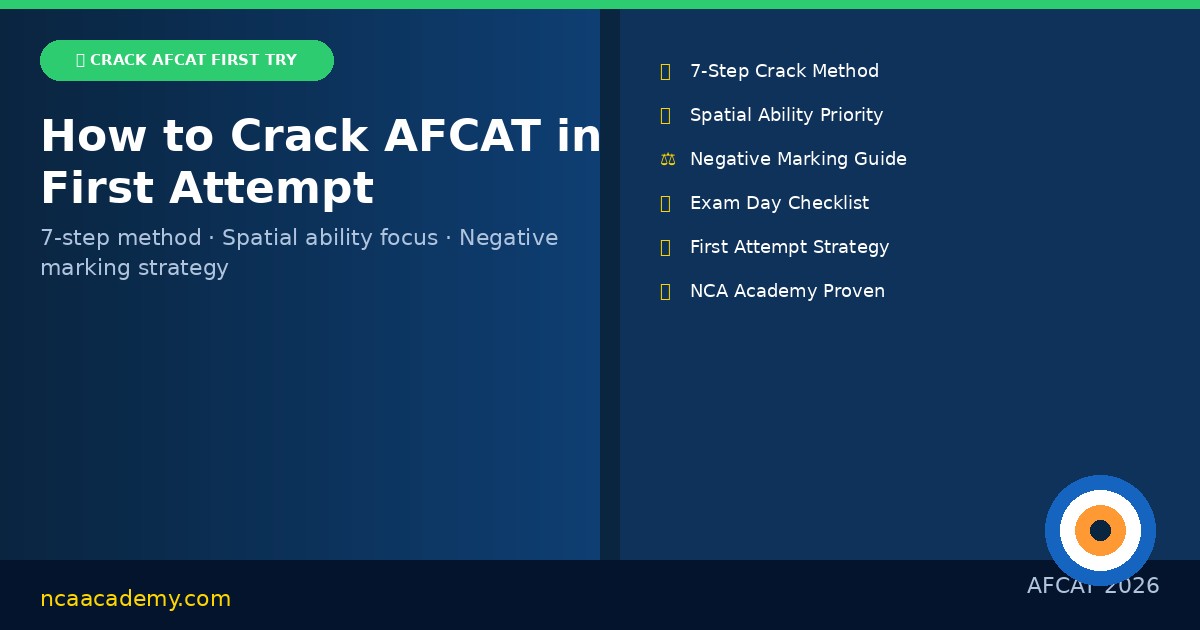
How to Crack AFCAT in First Attempt: NCA Academy’s Proven 7-Step Method
The exact approach NCA Academy students use to clear AFCAT in their very first attempt — including the section-wise strategy, exam-day execution, and the three mindset shifts that separate first-timers who pass from those who don’t.
- The Truth About First-Attempt Clearance
- Step 1: Score Diagnosis Before You Plan
- Step 2: Master the Right 3 Topics First
- Step 3: Build Spatial Ability Before Anything Else
- Step 4: Crack the Negative Marking Psychology
- Step 5: Lock In Your Attempt Order
- Step 6: The Mock Test Protocol That Works
- Step 7: Exam-Day Execution
- 5 Traps That Kill First-Attempt Results
- Frequently Asked Questions
The Truth About First-Attempt AFCAT Clearance
Approximately 8–12% of AFCAT applicants clear the written exam in any given cycle, based on IAF shortlisting data published via afcat.cdac.in. That means roughly 88–92% either don’t clear or clear but don’t score high enough to get AFSB calls. Yet every year, NCA Academy students consistently beat this rate significantly — our first-attempt clearance rate is built on one core principle: preparation that specifically addresses why candidates fail, not just what the syllabus covers.
The candidates who clear AFCAT in their first attempt aren’t necessarily the most intelligent — they’re the ones who prepared strategically, managed negative marking with discipline, and executed their exam plan without panic. This guide covers exactly how to do that, based on our deep knowledge of the AFCAT 2026 syllabus and 15+ exam cycles of coaching experience.
📊 What First-Attempt Clearers Do Differently (NCA Data)
Step 1: Score Diagnosis Before You Plan Anything
The first-attempt clearers we’ve worked with all have one thing in common: they took a baseline test on Day 1 and used that data to build a targeted plan. Attempting a full AFCAT paper blind — using a 2022 or 2023 paper from afcat.cdac.in — tells you your actual weak sections, not your assumed ones. Most candidates believe they’re weak in Numerical but are actually weaker in Spatial Ability.
| Your Weakest Section | Extra Time Required | When to Start This Section |
|---|---|---|
| Spatial Ability | +55 hours over prep window | Day 1 — no exceptions |
| Verbal (RC + Vocab) | +30 hours over prep window | Day 1 alongside Spatial |
| General Awareness | +20 hours over prep window | Week 2 — after foundation is set |
| Numerical Ability | +15 hours over prep window | Week 1 with speed formula focus |
Step 2: Master the Right 3 Topics First (Not the Whole Syllabus)
In the AFCAT PYQ analysis across 18 papers, three topic categories account for 45–50 correct answers in a typical paper. Mastering just these three first creates a scoring floor that prevents disaster even if other sections underperform:
Synonyms, Antonyms & RC
The fastest-improving topic. 50 words/day for 4 weeks + daily RC passage practice. Repeats heavily across every AFCAT cycle.
Verbal Reasoning (Series, Analogies)
Easy marks within the Reasoning section. Attempt these first in the exam before touching Spatial. Accuracy should be 85%+ by mock phase.
IAF & Defence GK
IAF aircraft (Tejas, Rafale, Su-30MKI, C-17), operations (Safed Sagar, Meghdoot, Vijay), ranks, bases. Repeats in every AFCAT cycle without fail.
These three topic clusters, if mastered, give you a near-guaranteed base score of approximately 120–135 marks — above the cutoff for GD Non-Technical and close to GD Technical cutoffs. Everything else lifts you toward Flying Branch territory.
Step 3: Build Spatial Ability Before Anything Else
Spatial Ability is the single topic that separates first-attempt passers from repeat-attempt candidates. It cannot be learned in the final 2 weeks. It requires consistent daily visual practice for 6–8 weeks to develop.
Spatial Ability sub-topics in order of frequency in AFCAT papers (from NCA’s analysis of 18 papers, 2016–2025):
| Sub-topic | Avg Questions/Paper | Difficulty | NCA Approach |
|---|---|---|---|
| 3D Figure Rotation | 4–5 | Hard | Practice axis-by-axis rotation — don’t trust gut feel |
| Mirror & Water Images | 3–4 | Medium | Left-right vs up-down — never confuse. 2-second check method. |
| Paper Folding/Cutting | 3–4 | Medium | Count folds physically on paper if needed — time allows |
| Figure Completion | 2–3 | Medium | Identify symmetry axis first, then complete |
| Embedded Figures | 2–3 | Medium | Scan for exact line segments — methodical, not visual |
💡 The NCA Spatial Ability Rule
30 Spatial Ability questions every single day — no exceptions. Students who follow this rule for 6 continuous weeks improve from 40% accuracy to 65–70% accuracy. Students who practice “when they feel like it” stagnate at 45–50% regardless of total time invested.
Step 4: Crack the Negative Marking Psychology
Negative marking in AFCAT (−1 per wrong answer, +3 per correct) creates two opposite failure modes. Understanding which one you fall into is critical:
| Failure Mode | Signs in Mock Tests | Fix |
|---|---|---|
| Type A: Over-guesser | 20+ wrong answers per mock. Attempts 90–95 questions. | Eliminate any question where you can’t rule out at least 2 options. Skip it. |
| Type B: Over-skipper | 25–35 skipped per mock. Only 60–65 attempted. | If you can eliminate 2 of 4 options, attempt it. Your odds are +1.5 marks expected value. |
The sweet spot for first-attempt clearers: attempt 80–88 questions, get 73–76 correct, leave 12–20 unanswered. This formula reliably produces 160–175 marks when your accuracy is 88–90% on attempted questions.
📌 The Expected Value Rule for AFCAT Guessing
If you can eliminate 2 wrong options from 4, you have a 50% chance of getting +3 marks vs a 50% chance of −1 mark. Expected value = 0.5×3 + 0.5×(−1) = +1 mark. Always attempt when you can eliminate 2 options — the math is in your favour.
Step 5: Lock In Your Attempt Order Before Exam Day
The attempt order you choose determines how you manage cognitive fatigue and time pressure. Experienced AFCAT candidates and NCA faculty recommend this sequence — practise it in every mock until it’s automatic:
| Sequence | Section | Time Budget | Why This Order |
|---|---|---|---|
| 1st | Verbal Ability | 18–20 min | Fresh mind handles language best. Quick confidence booster. |
| 2nd | GK — Known Only | 8–10 min | Quick read. Attempt only what you’re sure of. Skip unknowns immediately. |
| 3rd | Numerical Ability | 20–22 min | Formula-based — manageable with focus. Don’t let one hard question steal 5 minutes. |
| 4th | Verbal Reasoning (Analogies, Series, Coding) | 12–14 min | Easy Reasoning marks — do before Spatial. |
| 5th | Spatial Ability | 18–20 min | Hardest section last — you’ve already secured your base score. |
| Review | Flagged questions | 10 min | Only re-attempt if genuinely confident. Don’t guess on review. |
Step 6: The Mock Test Protocol That Works
The candidates who clear AFCAT in one attempt don’t just take more mock tests — they use a specific post-mock analysis protocol. Here’s the exact 3-step process:
The NCA Post-Mock Analysis Protocol
Step 7: Exam-Day Execution Checklist
Day Before & Exam Day Checklist
5 Traps That Kill First-Attempt AFCAT Results
| Trap | How It Kills Your Score | Prevention |
|---|---|---|
| The Syllabus Trap | Spending equal time on all topics when 3 topic clusters account for 50% of marks | Prioritise by mark density, not syllabi position |
| The Mock Overload Trap | Taking 20+ mocks without proper analysis — scores plateau and confidence drops | Max 10–12 mocks. 1 hour analysis per mock minimum. |
| The Last-Week Panic Trap | Starting new topics in the final 5 days — creates confusion, not knowledge | Lock all new learning by Week 12. Final week = revision only. |
| The GK Over-Study Trap | Spending 50%+ of prep on GK while neglecting Spatial Ability — GK is only 25 marks | Cap GK at 30% of total prep time. Spatial minimum: 35%. |
| The Section-Order Trap | Starting with Reasoning section — hardest section when fresh, leaves easy Verbal for when tired | Always: Verbal first, Spatial last. Practice this in every mock. |
Frequently Asked Questions — Cracking AFCAT in First Attempt
🏆 Clear AFCAT 2026 in Your First Attempt
NCA Academy’s AFCAT batch is built around first-attempt clearance. Personalised study plan, Spatial Ability intensive modules, 10 full-length mocks with expert analysis, and weekly performance reviews by ex-IAF faculty. Limited seats for AFCAT 2 2026 batch.
Join NCA Academy → 💬 Talk to a Counsellor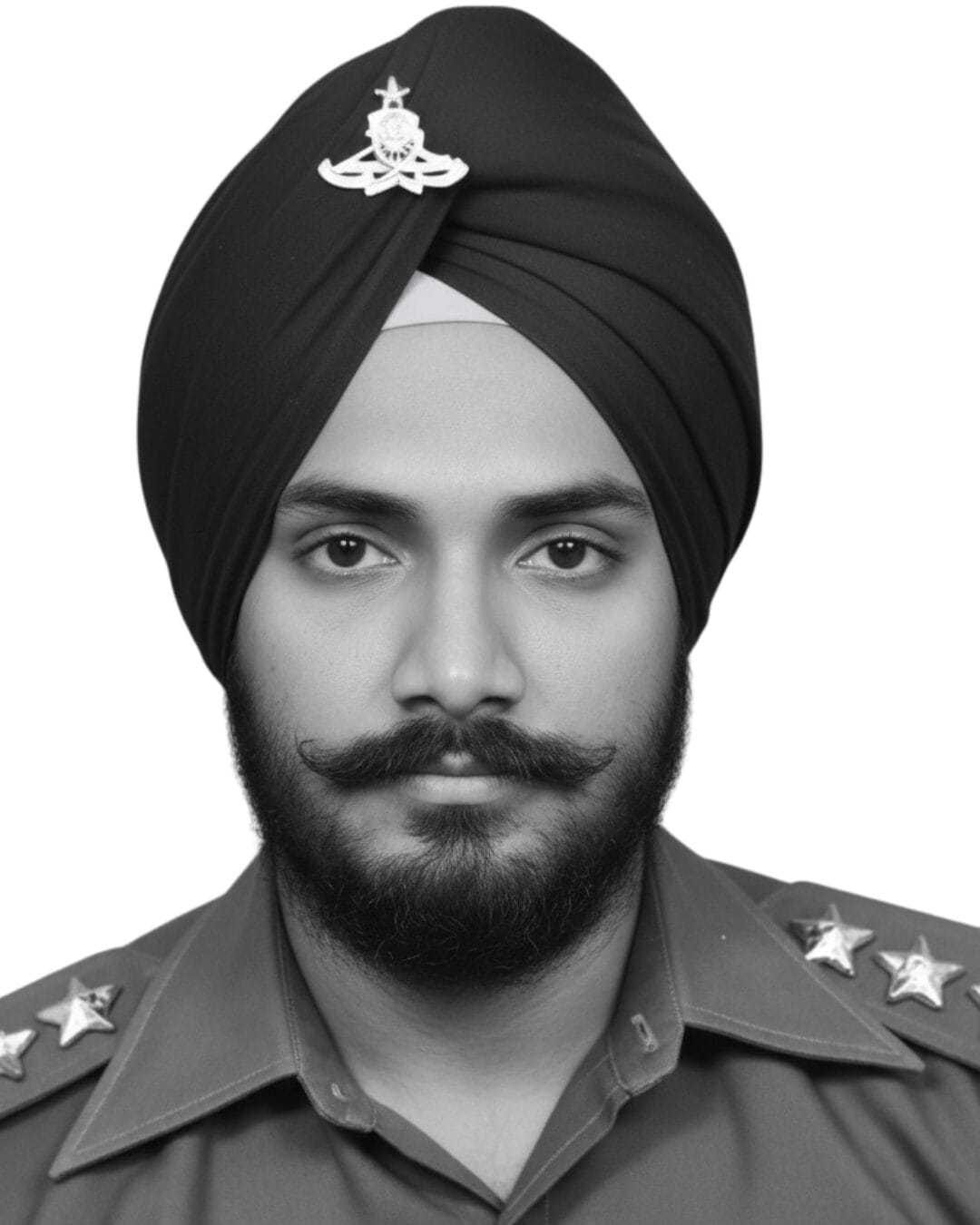
Written by
Capt. Dhaliwal · Director, New Careers Academy
Ex-Indian Army officer and SSB mentor at NCA Academy, Chandigarh (est. 1967), coaching NDA, CDS, AFCAT and SSB aspirants since the 1980s. About the author →
Reviewed by Hartaj Dhaliwal — SSB Strategist, NCA · third-generation officer · recommended by the SSB three times.