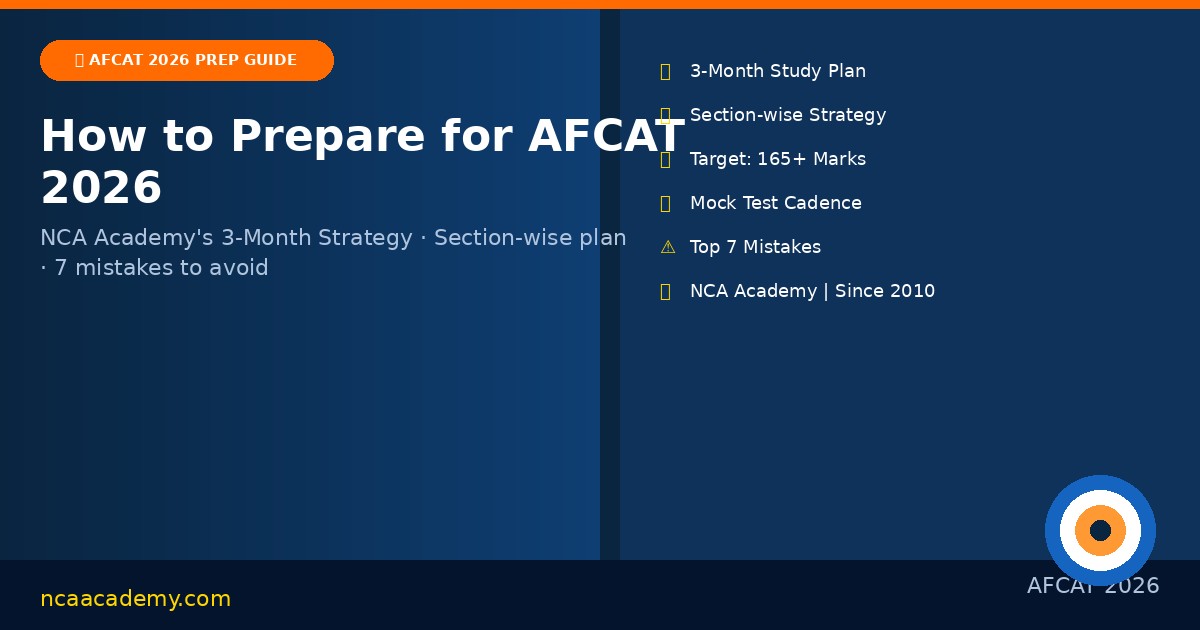
How to Prepare for AFCAT 2026: NCA Academy’s Complete 3-Month Strategy
A proven, step-by-step preparation plan used by NCA Academy students who consistently score 160+ in AFCAT — covering study schedule, section strategies, mock test cadence, and common mistakes to avoid.
- What It Actually Takes to Clear AFCAT 2026
- Step 1: Know Your Starting Point
- Phase 1 (Month 1): Foundation Building
- Phase 2 (Month 2): Depth + Speed
- Phase 3 (Month 3): Mock Tests + Final Sprint
- Ideal Daily Study Schedule
- Section-wise Preparation Strategy
- 7 Mistakes That Kill AFCAT Scores
- Mock Test Cadence That Works
- Frequently Asked Questions
What It Actually Takes to Clear AFCAT 2026
The honest answer — based on NCA Academy’s coaching data across thousands of students — is that clearing AFCAT 2026 requires 250–300 hours of focused preparation over 90 days. That’s 3–4 hours daily. Not six, not ten. Candidates who overprepare burn out; candidates who underprepare underestimate the Reasoning section.
AFCAT is a 100-question, 300-mark exam across four sections. The official AFCAT 2026 exam pattern gives Reasoning & Military Aptitude the highest weightage (32 questions, 96 marks), making it the section that most determines your rank. Most failed AFCAT attempts — in our experience coaching across cycles — trace back to two things: underestimating Spatial Ability, and negative marking anxiety causing over-skipping.
📌 AFCAT 2026 Target Score by Branch
Flying Branch: 165–175+ | GD Technical: 158–165+ | GD Non-Technical: 152–160+ | NCC Special Entry: 143–150+ | Based on historical cutoff trends — full data in our AFCAT Cut Off 2026 guide.
Step 1: Know Your Starting Point Before You Plan
The most common preparation mistake is following someone else’s plan without knowing your own baseline. Before you touch a book, attempt one full AFCAT previous year paper under exam conditions (100 questions, 120 minutes, strict negative marking). Your score will fall into one of these bands:
| Baseline Score | Current State | Time Required | Priority Focus |
|---|---|---|---|
| Below 90 | Needs foundation work | 120+ days ideal | Verbal basics + Numerical shortcuts + Reasoning patterns |
| 90–120 | Mid-level preparation | 90 days (3 months) | Spatial Ability + GK breadth + Speed accuracy |
| 120–145 | Solid base, needs refinement | 60 days (2 months) | Spatial Ability intensive + Mock test analysis |
| 145–155 | Near cutoff — need to push | 30–45 days | Error elimination + Weak section sprint |
| 155+ | On track — maintain + refine | 30 days | Mock cadence + GK current affairs |
💡 NCA Insight: The Baseline Test Rule
We give every new NCA student a blind AFCAT test on Day 1. Students who know their exact weak topics improve 35–40 marks faster than those who prepare blindly. Download a 2022 or 2023 AFCAT PYQ paper from afcat.cdac.in and attempt it today before you plan anything else.
Phase 1 (Month 1): Foundation Building
The first month is about plugging gaps — not about practicing mock tests. Students who jump to mocks without solidifying fundamentals plateau at 130–135 and stagnate. Month 1 priorities:
| Week | Verbal Focus | Numerical Focus | Reasoning Focus | GK Focus |
|---|---|---|---|---|
| Week 1 | Synonyms/Antonyms vocab list (50 words/day) | Percentages, fractions, HCF/LCM | Number series, letter series | IAF history + aircraft names |
| Week 2 | Reading Comprehension — 2 passages/day | Time-Speed-Distance, Work-Time | Analogies, coding-decoding | Indian geography + capitals |
| Week 3 | Error detection, sentence correction | Profit/Loss, SI/CI, Ratio | Verbal reasoning, directions | Indian polity, constitution basics |
| Week 4 | Idioms & phrases, para jumbles | Mensuration, algebra basics | Non-verbal reasoning, patterns | Science & defence technology |
💡 Month 1 Target
By end of Month 1, you should be able to attempt 60–65 questions correctly in a 100-question paper. This is the foundation target. Don’t rush to mock tests until you’ve hit this.
Phase 2 (Month 2): Depth + Speed
Month 2 is where preparation separates those who clear AFCAT from those who don’t. Two things happen here: (1) Spatial Ability gets its dedicated 3-week focus — more time than any other topic — and (2) you begin timed practice to build exam-day speed.
| Week | Primary Focus | Daily Practice Target | Mock Component |
|---|---|---|---|
| Week 5 | Spatial Ability: 3D rotation, folding + mirror images | 40 Reasoning Qs in 35 mins | Reasoning sectional mock × 3 |
| Week 6 | Spatial Ability: Paper cutting, figure completion | 25 Verbal Qs in 20 mins | Verbal sectional mock × 3 |
| Week 7 | Numerical shortcuts (speed-solving all topics) | 18 Numerical Qs in 22 mins | Numerical sectional mock × 3 |
| Week 8 | GK — current affairs sprint, defence tech deep-dive | 25 GK Qs in 10 mins | First 2 full-length mock exams |
⚠️ Critical: Spatial Ability Is Not Like Other Reasoning Topics
Spatial ability cannot be learned by reading — it must be practiced through repeated visual exercises. In our coaching experience, students who spend less than 20 hours on Spatial Ability in the 90-day window lose 6–10 marks in this sub-section alone, which is often the difference between clearing and not clearing. Minimum: 30 Spatial Ability questions every single day from Week 5–8.
Phase 3 (Month 3): Mock Tests + Final Sprint
Month 3 is full-exam mode. You should be attempting a complete AFCAT mock (100 questions, 120 minutes, negative marking enforced) at least twice a week, with every mock followed by a 1-hour analysis session.
| Week | Mock Count | Focus | Target Score |
|---|---|---|---|
| Week 9 | 2 full mocks | Identify patterns in wrong answers | 140+ |
| Week 10 | 2 full mocks | Negative marking discipline | 148+ |
| Week 11 | 2 full mocks | Attempt order optimization | 155+ |
| Week 12 | 2 full mocks | GK current affairs sprint | 160+ |
| Week 13 | 2 full mocks | Final error elimination | 165+ |
Ideal Daily Study Schedule (3–4 Hours)
⏰ Recommended Daily Schedule During 90-Day Preparation
Section-wise Preparation Strategy
Each section in AFCAT demands a different learning approach. Here’s what works — and what doesn’t — for each:
| Section | Questions | Core Strategy | Best Resource | Daily Time |
|---|---|---|---|---|
| Verbal Ability | 25 (75 marks) | Build vocabulary systematically. Read The Hindu editorial daily. Do not memorise idioms in lists — learn them in sentences. | Word Power Made Easy — Norman Lewis | 45 min |
| Numerical Ability | 18 (54 marks) | Master speed techniques first. Most AFCAT Numerical questions are Class 10 level — the differentiator is solving in under 50 seconds, not getting them right slowly. | Quantitative Aptitude — RS Aggarwal (selected chapters) | 30 min |
| Reasoning & Mil. Aptitude | 32 (96 marks) | Split into two sub-strategies: Verbal Reasoning (fast marks — do first) and Spatial Ability (must practice daily with visual exercises). Never attempt in paper order — do Verbal Reasoning first, Spatial last. | AFCAT Pathfinder — Arihant (Reasoning chapters) + NCA Spatial sets | 60 min |
| General Awareness | 25 (75 marks) | Prioritise IAF-specific GK (aircraft, operations, history) as it repeats every cycle. Static GK (History, Geography, Polity) is worth 15–18 questions — study systematically. Current Affairs: last 6 months only — not 12. | Manorama Yearbook + defence-focused current affairs portal | 45 min |
7 Mistakes That Kill AFCAT Scores
Based on post-exam analysis from NCA Academy students across 15+ AFCAT cycles, these are the most common patterns behind preventable failures:
“I’ll improve it later.” There is no later. Spatial Ability takes 6–8 weeks to develop. Start Week 1.
Leaving 30+ questions blank to “avoid negatives” guarantees a low score. You need 73 correct to hit 165. Math doesn’t work with 30 skips.
Taking mock tests before foundation is built gives discouraging scores that don’t improve. Wait until Week 8 minimum.
Studying world capitals and Olympic medals while ignoring Tejas, BrahMos, Operation Safed Sagar is backwards. IAF GK repeats every cycle.
Starting with Verbal → GK → Numerical → Reasoning is more efficient than the printed order. Never spend 40+ minutes on Reasoning first.
A mock test without a 60-minute analysis session is wasted. The analysis is where improvement happens — not the test itself.
GK is only 25 questions. Candidates who spend 70% of prep on GK and ignore Spatial Ability consistently fail — even with a strong GK score.
Mock Test Cadence That Works
Mock tests are tools for diagnosis, not proof of preparation. Here’s the cadence NCA Academy recommends based on where you are in the 90-day window:
| Preparation Stage | Mock Frequency | Type | Post-Mock Action |
|---|---|---|---|
| Weeks 1–4 (Foundation) | 1 sectional mock / week | Section-specific (Verbal, Numerical only) | Note exact error type per question |
| Weeks 5–8 (Depth) | 2–3 sectional mocks / week | Reasoning + Numerical focused | Track improvement in Spatial Ability score week-over-week |
| Weeks 9–13 (Sprint) | 2 full mocks / week | Full 100-question timed exam | 1-hour analysis: categorise every wrong answer |
| Final 5 days | 1 full mock, then rest | Confidence calibration — not new learning | Light revision, sleep 8 hours, no new topics |
📌 The 3-Category Error Log (NCA Method)
After every mock, tag each wrong answer: Type A = “Concept gap” (didn’t know) | Type B = “Careless error” (knew but rushed) | Type C = “Negative marking gamble” (guessed wrongly). Students who eliminate Type B and Type C errors alone typically gain 15–20 marks — without learning anything new.
Frequently Asked Questions — How to Prepare for AFCAT 2026
🎯 Let NCA Academy Build Your AFCAT 2026 Plan
We’ve taken hundreds of students from baseline 100 to 165+ in a single 90-day batch. Our AFCAT 2026 program includes personalised study plans, 500+ practice questions, 15 full-length mocks, and weekly performance reviews by ex-IAF faculty. Batch seats are limited.
Explore AFCAT Coaching → 💬 WhatsApp for Batch Details💻 Preparing from home? Explore NCA’s online AFCAT coaching in India — live classes, mock tests and AFSB interview training.
⏱️ Short on time? See How to Prepare for AFCAT 2 2026 in One Month — a week-by-week 30-day plan.
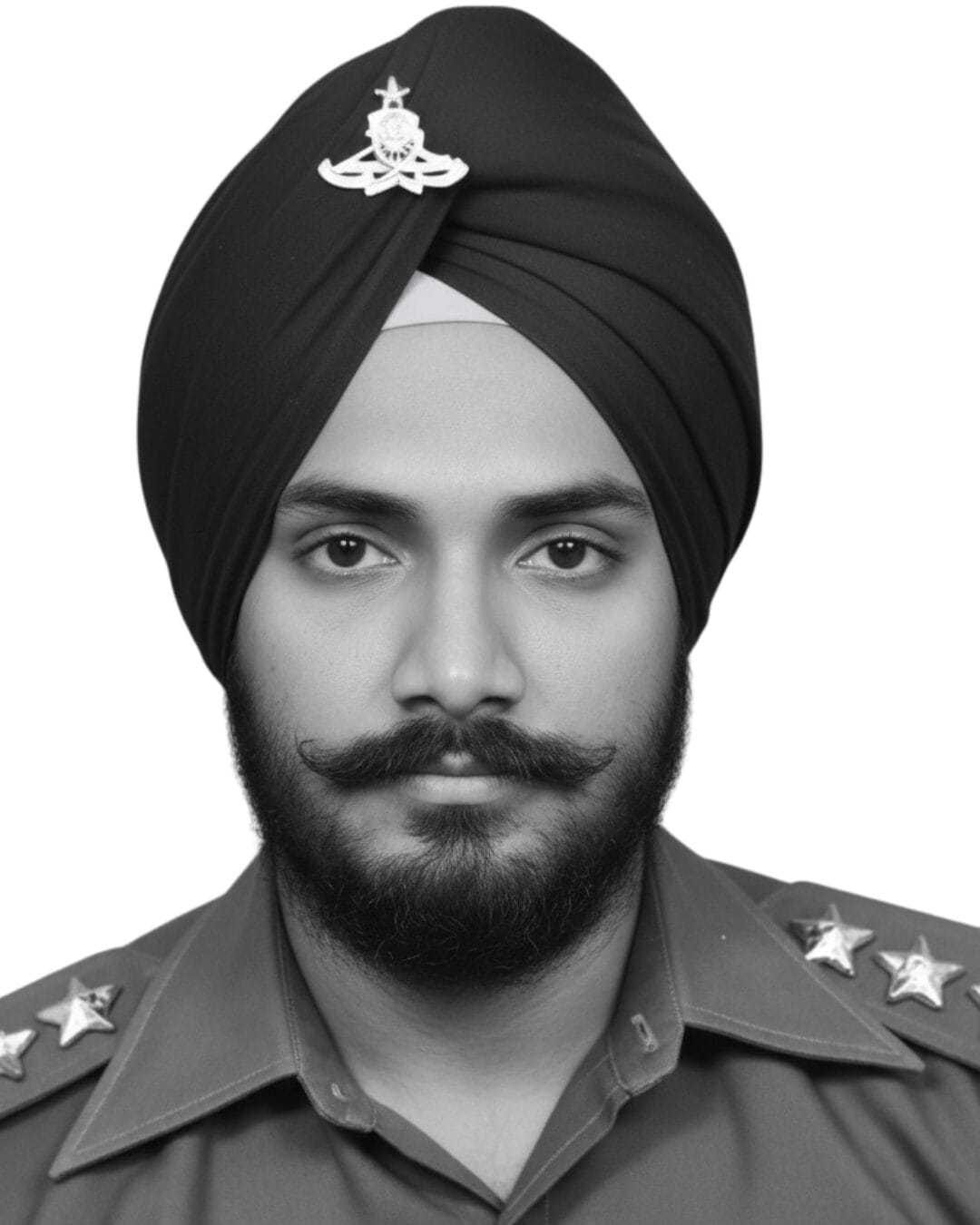
Written by
Capt. Dhaliwal · Director, New Careers Academy
Ex-Indian Army officer and SSB mentor at NCA Academy, Chandigarh (est. 1967), coaching NDA, CDS, AFCAT and SSB aspirants since the 1980s. About the author →
Reviewed by Hartaj Dhaliwal — SSB Strategist, NCA · third-generation officer · recommended by the SSB three times.