Substantive Motion and Privilege Motion: Complete 2026 Guide with Clear Differences and Examples
Substantive Motion and Privilege Motion are two important parliamentary tools used in legislative bodies like Parliament and State Assemblies. These motions often appear in news reports, competitive exams, and political discussions. However, many people confuse them or do not clearly understand their meaning.
This complete guide explains Substantive Motion and Privilege Motion in simple language, with procedures, examples, key differences, and exam-ready clarity.
Understanding the Meaning of a Motion in Parliament
A motion is a formal proposal made by a Member of Parliament (MP) asking the House to discuss and decide on a matter.
In simple words:
A motion is a request placed before the House saying, “Let the House take a decision on this issue.”
Motions are central to parliamentary democracy because they allow members to raise issues, question the government, and seek formal decisions.
Two important types are:
Substantive Motion
Privilege Motion
Although both are parliamentary tools, their purpose and procedure are different.
What is a Substantive Motion?
A Substantive Motion is an independent and self-contained proposal placed before the House for discussion and voting.
It directly asks the House to take a decision.
Simple Meaning
A Substantive Motion is like saying:
“I propose that this House decides X.”
It is:
Independent
Clear and specific
Intended for debate
Meant for voting
Examples of Substantive Motion
Common examples include:
No-confidence motion
Motion to remove a person from office
Motion expressing disapproval of government policy
Motion of thanks
These motions are political in nature because they seek a decision from the House.
Procedure for a Substantive Motion
The process follows structured parliamentary rules.
Step 1: Written Notice
A Member gives written notice to the Speaker.
Step 2: Speaker’s Decision
The Speaker checks whether the motion follows procedural rules.
If it satisfies the rules, it is admitted.
If it does not meet requirements, it is rejected.
Step 3: Listing for Discussion
If admitted, the motion is listed in the House agenda.
Step 4: Debate
Members debate the issue.
Step 5: Voting
The House votes.
If a majority supports it, the motion is passed.
What Happens If a Substantive Motion is Passed?
If passed:
It becomes the official decision of the House.
Political consequences may follow.
However, it is important to understand a key constitutional principle.
Passing a motion does not automatically override constitutional provisions.
For example:
If the House passes a motion demanding removal of someone, the removal must still follow constitutional and legal procedures.
Therefore:
Passing a motion does not mean automatic legal action.
Constitutional provisions must still be followed.
What is a Privilege Motion?
A Privilege Motion is used when a Member believes that there has been a breach of parliamentary privilege.
It is concerned with protecting:
The dignity of the House
The rights of Members
The authority of Parliament
Simple Meaning of Privilege Motion
A Privilege Motion is like saying:
“This Member has misled the House or violated parliamentary privilege. The matter should be investigated.”
Unlike a Substantive Motion, it is not about policy decisions. It is about discipline and accountability.
Procedure for a Privilege Motion
The process is different from a Substantive Motion because it involves investigation.
Step 1: Notice to the Speaker
A Member submits notice alleging breach of privilege.
Step 2: Prima Facie Examination
The Speaker examines whether there is a prima facie case. This means checking whether there is initial evidence of wrongdoing.
If the Speaker finds no case, the matter ends.
Step 3: Reference to Committee of Privileges
If a prima facie case exists, the matter is referred to the Committee of Privileges.
Step 4: Investigation
The Committee investigates the issue.
Step 5: Report Submission
The Committee submits its report to the House.
Step 6: Decision by the House
The House decides what action to take.
Possible Outcomes of a Privilege Motion
Depending on the seriousness of the breach, the House may:
Issue a warning
Demand an apology
Reprimand the Member
Suspend the Member
In rare cases, expel the Member
The purpose is to protect the dignity of Parliament.
Key Difference Between Substantive Motion and Privilege Motion
The distinction can be understood clearly in the following comparison:
| Substantive Motion | Privilege Motion |
|---|---|
| Seeks a decision of the House | Seeks investigation of misconduct |
| Directly debated and voted upon | Investigated first, then decided |
| Political in nature | Disciplinary in nature |
| Independent proposal | Complaint of breach |
In short:
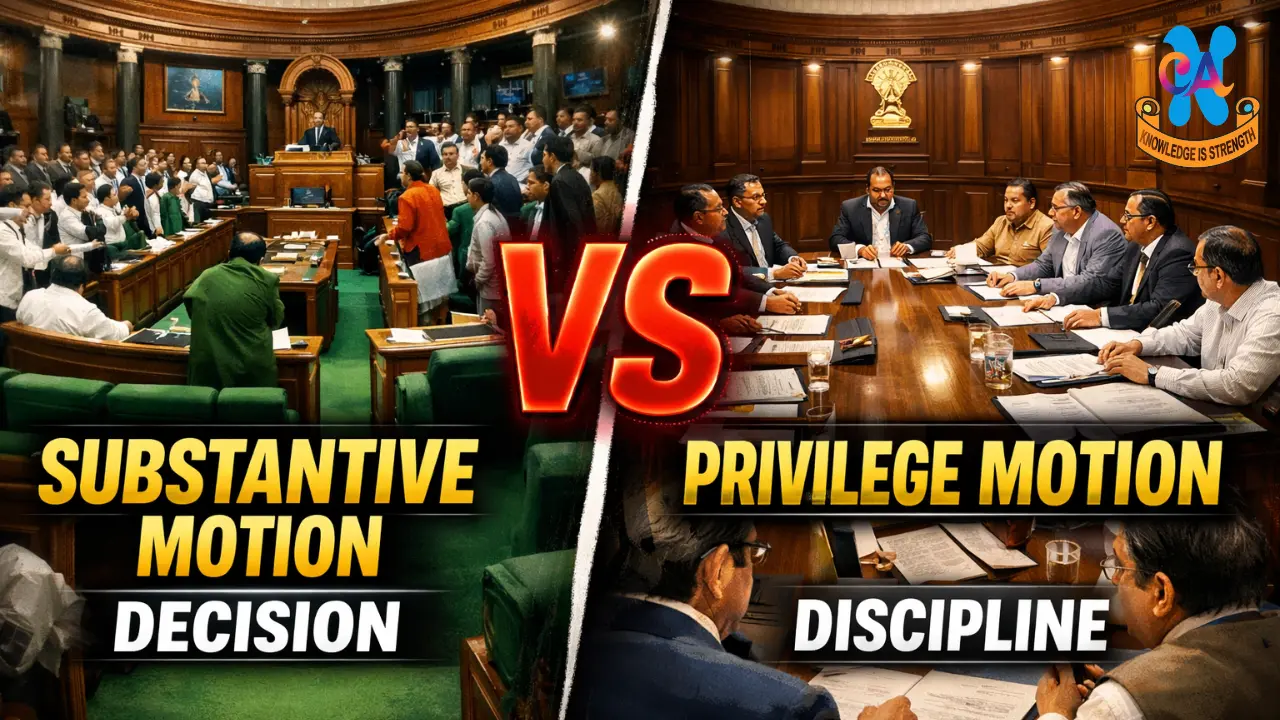
Substantive Motion = Decision
Privilege Motion = Discipline
Important Concept: Accepted vs Passed
Many students misunderstand these terms.
Accepted or Admitted means the Speaker has allowed the motion to be discussed.
Passed means the House has voted in favor of the motion.
A motion can be accepted but not passed.
This difference is crucial for exam answers.
Why Substantive Motion and Privilege Motion Are Important
Understanding Substantive Motion and Privilege Motion is important because:
They are frequently asked in competitive exams like UPSC and State PCS.
They appear in political news reports.
They show how parliamentary accountability works.
They demonstrate how democracy functions in practice.
These motions ensure that Parliament can both make decisions and maintain discipline.
Why Understanding Substantive Motion and Privilege Motion Is Important
Understanding Substantive Motion and Privilege Motion is essential for anyone preparing for competitive exams or studying parliamentary procedure. While Substantive Motion and Privilege Motion may sound similar, they serve very different purposes in Parliament. Knowing the difference between Substantive Motion and Privilege Motion helps in analyzing legislative debates, political accountability, and disciplinary action in Parliament. Students often confuse Substantive Motion and Privilege Motion, but once the distinction is clear, parliamentary procedure becomes much easier to understand.
Frequently Asked Questions (FAQs)
1. Is a No-Confidence Motion a Substantive Motion?
Yes. A No-Confidence Motion is a classic example of a Substantive Motion because it asks the House to decide whether it supports the government.
2. Can a Privilege Motion directly remove a Member?
No. It first goes through investigation by the Committee of Privileges. The House then decides the appropriate action.
3. Does passing a Substantive Motion automatically remove someone from office?
No. Constitutional and legal procedures must still be followed.
4. Who decides whether a motion is admitted?
The Speaker decides whether a motion satisfies the rules and should be admitted.
5. What does prima facie case mean in a Privilege Motion?
It means that there is initial evidence suggesting that a breach of privilege may have occurred.
6. Which motion is more serious?
They serve different purposes. A Substantive Motion affects political decisions. A Privilege Motion deals with discipline. The seriousness depends on the context.
Conclusion
Substantive Motion and Privilege Motion are essential components of parliamentary procedure. While a Substantive Motion is used to take formal decisions, a Privilege Motion is used to protect the dignity and authority of the House.
Understanding their differences is simple when you remember:
Substantive Motion deals with decisions.
Privilege Motion deals with discipline.
This clarity not only helps in exams but also strengthens your understanding of democratic governance.


Written by
Capt. Dhaliwal · Director, New Careers Academy
Ex-Indian Army officer and SSB mentor at NCA Academy, Chandigarh (est. 1967), coaching NDA, CDS, AFCAT and SSB aspirants since the 1980s. About the author →
Reviewed by Hartaj Dhaliwal — SSB Strategist, NCA · third-generation officer · recommended by the SSB three times.