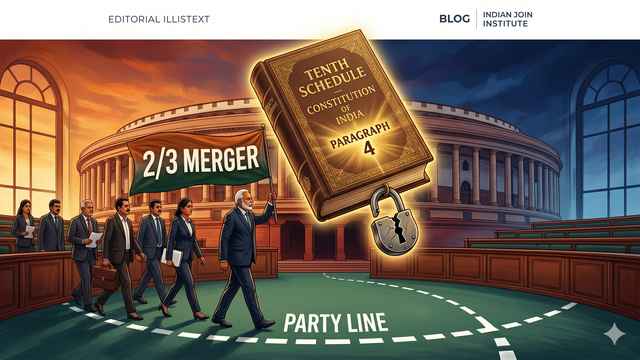
Anti-Defection Law and the Merger Loophole: What Every NDA/CDS/AFCAT Aspirant Must Know (2026)
The Anti-Defection Law — housed in the Tenth Schedule of the Indian Constitution — is one of the most consistently tested topics across UPSC, CDS, NDA, and AFCAT General Studies papers. With the merger exception back in the spotlight after the 2025 Supreme Court judgment in Padi Kaushik Reddy v. State of Telangana, this is a high-probability topic for 2026 exams.
This guide breaks down everything you need to know: what the law says, how the merger loophole works, landmark cases, recent developments, and the key points examiners test.
What Is the Anti-Defection Law?
The Anti-Defection Law was introduced by the Constitution (52nd Amendment) Act, 1985 and added as the Tenth Schedule to the Indian Constitution. It was inserted after Articles 102(2) and 191(2) to address what Parliament called the “evil of political defections” — the practice of elected legislators switching parties for personal gain after winning elections.
The law disqualifies a member of Parliament or a State Legislature if they:
- Voluntarily give up their membership of the political party that gave them the ticket
- Vote or abstain from voting in the House contrary to a direction issued by their party
- An independently elected member joins any political party after election
- A nominated member joins a political party after six months of taking their seat
The disqualification is decided by the Speaker of the House (Lok Sabha/Vidhan Sabha) or the Chairman (Rajya Sabha/Vidhan Parishad).
The Tenth Schedule: Key Paragraphs
| Paragraph | Subject | Key Provision |
|---|---|---|
| Para 1 | Definitions | Defines “legislature party”, “original political party”, “political party” |
| Para 2 | Disqualification grounds | Voluntary resignation from party; voting against party direction |
| Para 3 | Split exception (DELETED) | Originally allowed 1/3 split — deleted by 91st Amendment, 2003 |
| Para 4 | Merger exception | 2/3 of legislature party agrees to merge with another party — exempt from disqualification |
| Para 5 | Exemption for office-holders | Speaker/Chairman exempt while holding office |
| Para 6 | Decision-making authority | Speaker/Chairman of respective House decides disqualification |
| Para 7 | Bar on courts | Courts cannot interfere with proceedings of the House — though SC has carved out exceptions |
The Merger Exception (Paragraph 4): The Loophole
The most controversial provision in the Tenth Schedule is the merger exception under Paragraph 4. It states that a legislator is not disqualified if:
- Their original political party merges with another political party, AND
- At least two-thirds of the members of the legislature party agree to such a merger
The Original Intent vs. Actual Misuse
Original intent: If Party A and Party B genuinely merge at the national level, their legislators should not be penalised for following the merged political reality. The provision was designed to protect legislators’ democratic right to represent a genuine merger.
Actual misuse: A group of legislators from Party A — as few as two-thirds of the legislature party — declare a “merger” with a rival party, even though no merger has taken place at the party’s organisational level. This allows large-scale defections without disqualification. The two-thirds threshold becomes a numbers game rather than a genuine test of political realignment.
As the PRS India analysis notes, the provision has reduced the spirit of the law to a constitutional formality.
The Deleted Exception: The “Split” Provision (Paragraph 3)
Originally, Paragraph 3 allowed a “split” exemption — if at least one-third of a legislature party broke away, they were exempt from disqualification. This was the most widely abused provision in the Tenth Schedule and led to wholesale defections disguised as legitimate splits.
The 91st Constitutional Amendment Act, 2003 deleted Paragraph 3, removing the split exception entirely. The minimum threshold was raised to two-thirds, making splits harder — but the merger loophole in Paragraph 4 survived and continues to be used.
The Speaker Problem: A Structural Weakness
The Tenth Schedule gives the power to decide disqualification petitions to the Speaker of the House (or Chairman of the Upper House). This is a widely criticised design flaw.
The problem: The Speaker is typically a member of the ruling party. When legislators from the ruling party defect to a rival — or vice versa — the Speaker, whose party has a political interest in the outcome, decides their disqualification. This creates an inherent conflict of interest.
In practice, Speakers routinely delay or avoid deciding disqualification petitions, effectively allowing defectors to continue functioning as legislators for years without consequence.
Reform Proposals
- Transfer disqualification decisions to an independent tribunal or the Election Commission of India
- This recommendation has been made by the Law Commission of India, the National Commission to Review the Working of the Constitution (NCRWC), and several Supreme Court judges in their judgments
Landmark Cases: Anti-Defection Law
Kihoto Hollohan v. Zachillhu (1992)
The Supreme Court upheld the constitutional validity of the Tenth Schedule. However, it ruled that the Speaker’s decision on disqualification is subject to judicial review — the bar in Paragraph 7 does not exclude the Supreme Court’s supervisory jurisdiction. This is a critical nuance: while courts cannot interfere with proceedings of the House, they can review the Speaker’s quasi-judicial decision on disqualification.
Keisham Meghchandra Singh v. Speaker (2020)
The Supreme Court ruled that Speakers must decide disqualification cases within three months, except in extraordinary circumstances. This judgment directly addressed the chronic problem of Speakers delaying decisions indefinitely.
Nabam Rebia and Bamang Felix v. Deputy Speaker (2016)
The Supreme Court held that a Speaker facing a motion of removal cannot decide disqualification petitions. This created an important constitutional check: a Speaker under threat of removal loses authority to adjudicate defection cases.
Padi Kaushik Reddy v. State of Telangana (2025)
In this landmark recent case, the Supreme Court dealt with ten MLAs of Bharat Rashtra Samithi (BRS) who crossed over to the Congress in 2024. The Court directed the Speaker of the Telangana Legislative Assembly to decide all pending disqualification petitions within three months. Chief Justice Gavai remarked that prolonged Speaker inaction amounted to permitting a constitutional violation — a direct call for parliamentary reforms on the Speaker’s adjudicatory role.
Summary Table: Anti-Defection Law at a Glance
| Feature | Detail |
|---|---|
| Introduced by | Constitution (52nd Amendment) Act, 1985 |
| Schedule | Tenth Schedule (Articles 102(2) and 191(2)) |
| Deciding authority | Speaker (Lok Sabha/Vidhan Sabha) / Chairman (Rajya Sabha) |
| Disqualification triggers | Voluntary resignation from party; voting against party direction |
| Merger exception | 2/3 of legislature party — exempt if merging |
| Split exception | Deleted by 91st Amendment, 2003 |
| Judicial review | Allowed — SC can review Speaker’s decision (Kihoto Hollohan, 1992) |
| Time limit for Speaker | 3 months (Keisham Meghchandra Singh, 2020) |
| Key reform demand | Transfer disqualification power to independent tribunal / ECI |
High-Probability Exam Questions on Anti-Defection Law
Based on previous NDA, CDS, AFCAT, and UPSC question patterns, these are the most frequently tested angles:
- Which Constitutional Amendment introduced the Anti-Defection Law? (52nd Amendment, 1985)
- Which Schedule of the Constitution contains the Anti-Defection Law? (Tenth Schedule)
- What is the minimum fraction required for the merger exception? (Two-thirds of the legislature party)
- Which Amendment deleted the “split” provision? (91st Amendment, 2003)
- Who decides disqualification under the Tenth Schedule? (Speaker/Chairman)
- Can the Supreme Court review the Speaker’s disqualification decision? (Yes — Kihoto Hollohan, 1992)
- What time limit has the SC set for Speakers to decide? (3 months — Keisham Meghchandra Singh, 2020)
Frequently Asked Questions
What is the Anti-Defection Law in simple terms?
The Anti-Defection Law (Tenth Schedule) disqualifies elected legislators who switch parties after winning elections. If an MP or MLA voluntarily gives up their party membership, or votes against their party’s direction in the House, they can be disqualified from their seat. The law was designed to prevent opportunistic party-switching for personal gain.
What is the merger loophole in the Anti-Defection Law?
Paragraph 4 of the Tenth Schedule exempts legislators from disqualification if their party “merges” with another and at least two-thirds of the legislature party agrees. In practice, this has been misused: two-thirds of a legislature party declare a “merger” even when no genuine merger has occurred at the party’s national level, allowing mass defections without legal consequences.
Can the Supreme Court interfere in Anti-Defection cases?
Yes. While Paragraph 7 of the Tenth Schedule bars courts from interfering in House proceedings, the Supreme Court in Kihoto Hollohan v. Zachillhu (1992) ruled that the Speaker’s decision on disqualification is a quasi-judicial act and is subject to judicial review on grounds of illegality, irrationality, or procedural impropriety.
Why is the Speaker’s role in Anti-Defection cases controversial?
The Speaker belongs to the ruling party and has a political interest in disqualification outcomes. Critics argue this creates a conflict of interest. Speakers frequently delay deciding petitions — sometimes for years — allowing defectors to continue as legislators. The Supreme Court, Law Commission, and NCRWC have all recommended transferring this power to an independent tribunal or the Election Commission.
Final Word
The Anti-Defection Law is a recurring topic in defence exam General Studies papers — tested both in factual MCQ form (which Schedule? which Amendment?) and in analytical form (why is the merger loophole problematic?). The recent 2025 Supreme Court judgment in Padi Kaushik Reddy makes this topic especially relevant for upcoming exam cycles.
Understanding constitutional law topics like this is part of a broader General Ability preparation strategy for NDA and CDS. At NCA Academy, our General Studies coaching covers Polity, History, Geography, Science, and Current Affairs in a structured, exam-focused format — helping aspirants across NDA, CDS, and AFCAT build a complete GK edge.
Preparing for NDA or CDS? Explore NCA Academy’s coaching programmes today.

Written by
Capt. Dhaliwal · Director, New Careers Academy
Ex-Indian Army officer and SSB mentor at NCA Academy, Chandigarh (est. 1967), coaching NDA, CDS, AFCAT and SSB aspirants since the 1980s. About the author →
Reviewed by Hartaj Dhaliwal — SSB Strategist, NCA · third-generation officer · recommended by the SSB three times.