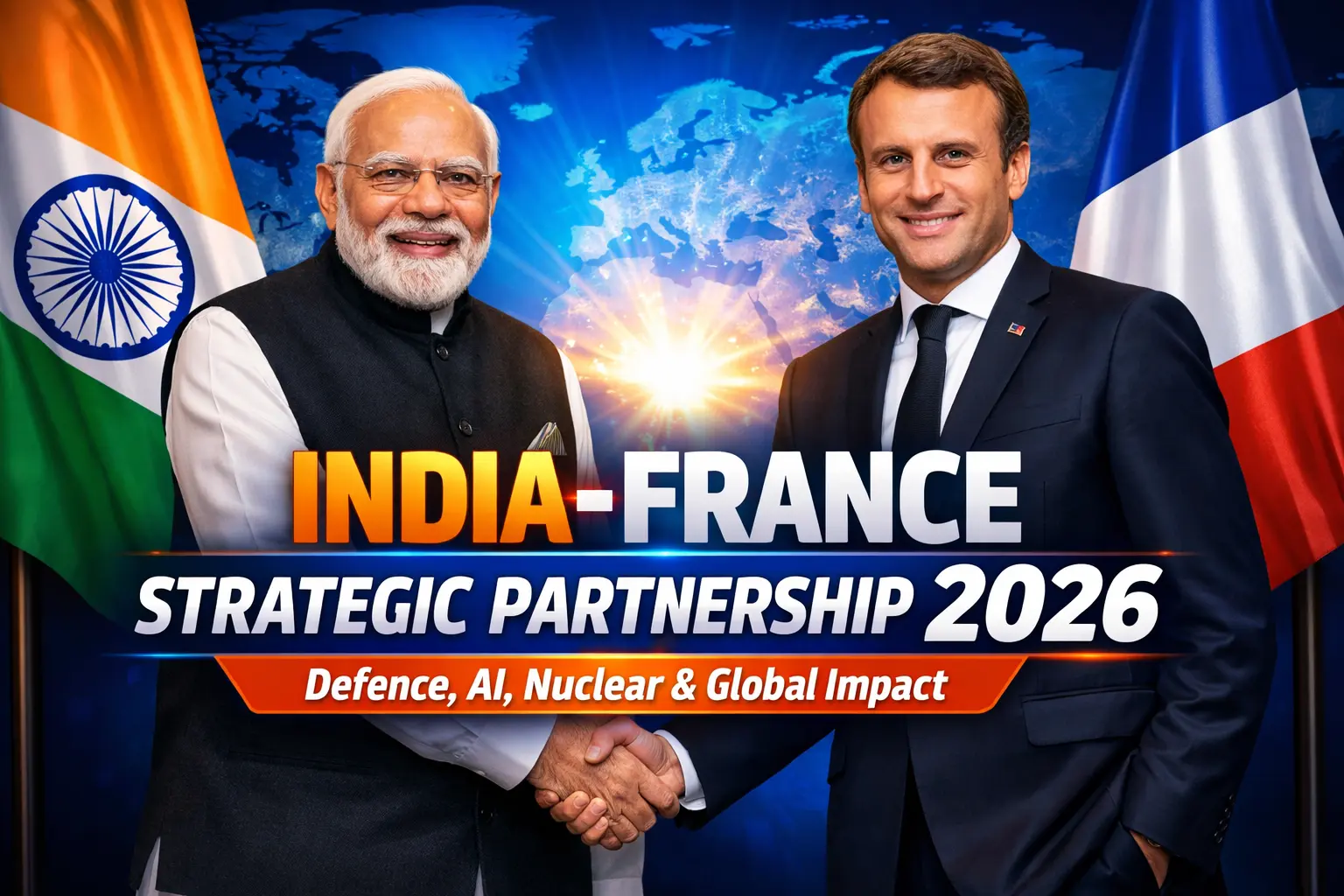
India and France Joint Statement 2026: A Transformative Strategic Milestone
The India and France Joint Statement released during French President Emmanuel Macron’s visit to India (February 17–19, 2026) marks a defining chapter in bilateral relations. Invited by Prime Minister Narendra Modi, President Macron’s visit elevated the partnership to a “Special Global Strategic Partnership”, guided by the ambitious Horizon 2047 Roadmap.The India and France Joint Statement 2026 marks a major milestone in bilateral relations…
This landmark engagement also launched the 2026 India-France Year of Innovation and saw both leaders participate in the Artificial Intelligence Impact Summit 2026. The statement reflects deep collaboration across defence, climate action, trade, education, innovation, and global governance.
Let’s break down the key highlights.
Global and Regional Cooperation
Key Highlights of the India and France Joint Statement 2026
France Invites India to G7 Summit 2026
France extended an invitation to India for the G7 Summit 2026, hosted by France. This reinforces India’s growing influence in global policymaking and economic governance.
Africa Forward Summit – Nairobi (May 2026)
India has been invited to participate in the Africa Forward Summit to support innovation-led growth in Africa, reflecting shared India-France interests in Africa’s development.
UN Security Council Reform
France reaffirmed strong support for India’s permanent membership in a reformed United Nations Security Council (UNSC). This is a significant diplomatic endorsement of India’s global leadership ambitions.
Indo-Pacific Cooperation
Both nations reaffirmed commitment to a free, open, and rules-based Indo-Pacific, strengthening coordination within the Indian Ocean Rim Association (IORA).
Global Conflict Positions
Ukraine: Called for cessation of hostilities in line with the UN Charter.
Gaza: Supported UN Resolution 2803 and reaffirmed commitment to a two-state solution.
I. Partnership for Security and Sovereignty
Defence Cooperation: Industrial Roadmap
A major highlight of the India and France Joint Statement is the emphasis on:
Co-design
Co-development
Co-production
This strengthens India’s self-reliance under “Make in India.”
Aviation Milestones
Procurement contract signed for 26 Rafale-Marine fighter jets.
Safran–HAL partnership for Indian Multi Role Helicopter (IMRH).
Inauguration of the H125 helicopter Final Assembly Line (Tata-Airbus).
Establishment of MRO facilities for LEAP and M-88 engines.
These developments significantly boost India’s defence manufacturing ecosystem.
Naval Cooperation
Delivery of the 6th Scorpène submarine (Kalvari class) in January 2025.
Continued cooperation in submarine technologies.
Missile Manufacturing
A new joint venture to produce HAMMER missiles in India, enhancing domestic defence capability.
Military Exercises
The two nations will continue key joint exercises:
Varuna (Naval)
Shakti (Army)
Garuda (Air Force)
Space and Cyber Security
Space Cooperation
Third Strategic Space Dialogue in 2026.
Focus on sovereign access to space.
Enhanced space situational awareness.
Cyber Dialogue
Commitment to secure cyberspace.
Next bilateral cyber dialogue in 2026.
Counter-Terrorism
Both leaders strongly condemned terror attacks in Pahalgam and Red Fort and pledged enhanced cooperation between NSG and GIGN.
Strategic Economy Initiatives
Critical Minerals Cooperation
Joint Declaration of Intent to collaborate on:
Exploration
Recycling
Resilient supply chains
India-Middle East-Europe Economic Corridor (IMEC)
Both reaffirmed commitment to IMEC with a ministerial meeting scheduled in 2026.
II. Partnership for the Planet
Climate & Clean Energy
International Solar Alliance & CDRI
Both countries will expand cooperation under:
International Solar Alliance (ISA)
Coalition for Disaster Resilient Infrastructure (CDRI)
Nuclear Energy Cooperation
France supports India’s ambitious target of 100 GW nuclear capacity by 2047.
Key developments:
Collaboration on Small and Advanced Modular Reactors (SMR/AMR).
Continued discussions on the Jaitapur Nuclear Power Plant.
CEA–DAE technical collaboration.
Ocean Governance
Welcomed the BBNJ Treaty (High Seas Treaty).
Acknowledged success of UN Ocean Conference in Nice.
Trade, Transport & Connectivity
Railway Modernization
Joint Declaration on:
High-speed rail
Hydrogen-powered trains
Modern station infrastructure
Digital Payments
India’s UPI is now accepted in France, including flagship stores in Paris—boosting tourism and digital trade integration.
New Aviation Route
Launch of direct route between Saint-Denis de la Réunion and Chennai, strengthening regional connectivity.
III. Partnership for the People
Innovation & Technology
Digital Research Collaboration
Launch of a binational center on digital sciences (INRIA-DST partnership).
AI in Healthcare
Research center involving AIIMS and Sorbonne University focused on artificial intelligence in healthcare.
Startup Ecosystem
Launch of the India-France Innovation Network.
VivaTech to expand to India.
Education & Mobility
Student Target
France aims to welcome 30,000 Indian students by 2030, up from 10,000 currently.
International Classes Initiative
Support system for Indian students seeking admission to French universities.
Visa-Free Transit Pilot
Indian nationals can benefit from visa-free transit through French airports (pilot period).
Migration & Mobility Partnership Agreement (MMPA)
Encouraging mobility of young professionals.
Cultural Diplomacy
Museum Cooperation
Yuge Yugeen Bharat Museum (Delhi)
National Maritime Heritage Complex (Lothal)
Namaste France 2028
Celebrating 30 years of strategic partnership.
Villa Swagatam Residencies
Reciprocal cultural exchange program.
Why the India and France Joint Statement Matters
This statement signals:
Deep strategic trust
Long-term industrial collaboration
Climate leadership partnership
Technology-driven growth
Youth-focused mobility
The shift to a Special Global Strategic Partnership reflects not just bilateral warmth, but a shared global vision for 2047 and beyond.
Frequently Asked Questions (FAQs)
1. What is the Special Global Strategic Partnership between India and France?
It is an elevated bilateral framework guiding long-term cooperation across defence, climate, innovation, and global governance under the Horizon 2047 Roadmap.
2. What defence deals were announced?
India signed a contract to procure 26 Rafale-Marine jets and initiated joint production of HAMMER missiles.
3. How does the statement address climate change?
Through cooperation in nuclear energy, International Solar Alliance initiatives, disaster-resilient infrastructure, and ocean governance.
4. What are the education benefits for Indian students?
France aims to host 30,000 Indian students by 2030 and introduced visa-free airport transit for Indian nationals (pilot phase).
5. What is IMEC?
The India-Middle East-Europe Economic Corridor aims to enhance connectivity and trade across regions.
6. How does this impact Indo-Pacific security?
Both countries reaffirmed commitment to a free, rules-based Indo-Pacific and stronger maritime cooperation.
Conclusion
The India and France Joint Statement 2026 is not merely a diplomatic communiqué—it is a comprehensive blueprint for the future. From defence manufacturing to nuclear energy, AI research to student mobility, climate leadership to Indo-Pacific security, the partnership now operates on a global scale.
As both nations look toward 2047, this relationship stands as one of the most forward-looking and resilient partnerships in international diplomacy.In conclusion, the India and France Joint Statement 2026 represents a forward-looking roadmap…

Written by
Capt. Dhaliwal · Director, New Careers Academy
Ex-Indian Army officer and SSB mentor at NCA Academy, Chandigarh (est. 1967), coaching NDA, CDS, AFCAT and SSB aspirants since the 1980s. About the author →
Reviewed by Hartaj Dhaliwal — SSB Strategist, NCA · third-generation officer · recommended by the SSB three times.