The Rajya Sabha election vote calculation is one of the most intriguing aspects of India’s parliamentary democracy. Unlike the Lok Sabha, where citizens vote directly for their representatives, Rajya Sabha members are elected by State Legislative Assembly (Vidhan Sabha) members through a unique mathematical system. Understanding how these votes are counted can help students, aspirants, and citizens appreciate the genius behind India’s federal structure.
What is the Rajya Sabha?
The Rajya Sabha (Council of States) is the upper house of India’s bicameral Parliament. It currently has 245 seats — 233 elected members representing states and union territories, and 12 members nominated by the President of India for their expertise in literature, science, art, and social service.
Unlike the Lok Sabha (House of the People), Rajya Sabha is a permanent body — it is never dissolved. One-third of its members retire every two years, and elections are held to fill those vacancies.
Who Votes in Rajya Sabha Elections?
Rajya Sabha elections are indirect elections. The elected members of each State Legislative Assembly (MLAs) vote to choose their state’s representatives to the Rajya Sabha. Members of Parliament (MPs) and ordinary citizens do not vote in these elections.
The number of Rajya Sabha seats allotted to each state depends on its population. Larger states like Uttar Pradesh have more seats (31), while smaller states like Sikkim have fewer (1).
The Voting Method: Single Transferable Vote (STV)
Rajya Sabha elections use the Single Transferable Vote (STV) system, which is a form of proportional representation. This system ensures that the seats in the Rajya Sabha roughly reflect the composition of the state assembly — meaning a party with 60% of MLAs gets approximately 60% of the Rajya Sabha seats from that state.
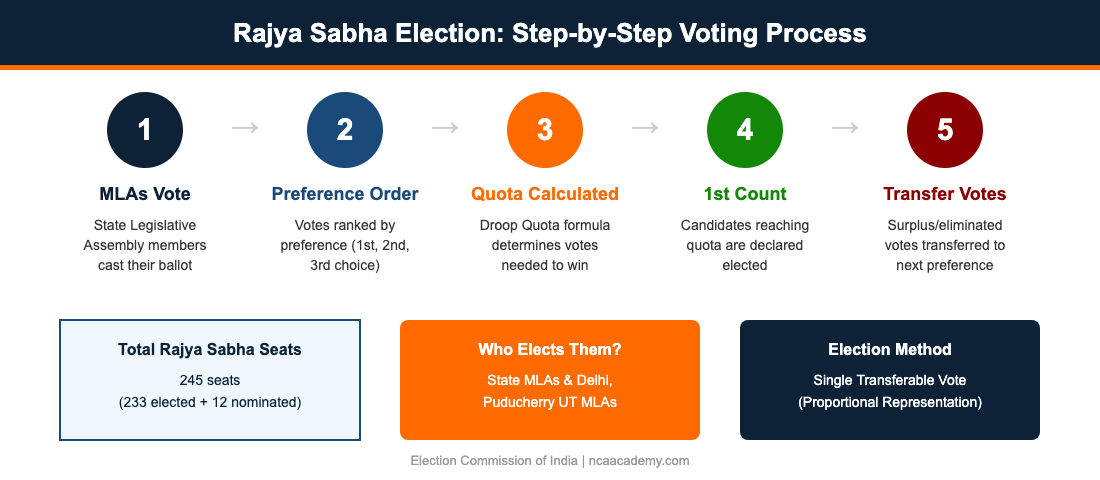
How MLAs Cast Their Vote
Each MLA receives a ballot paper listing all candidates. Instead of voting for just one candidate, the MLA ranks the candidates in order of preference — marking “1” for their first choice, “2” for their second choice, and so on. This preference-based voting is the cornerstone of the STV system.
The Droop Quota Formula — The Key to Calculation
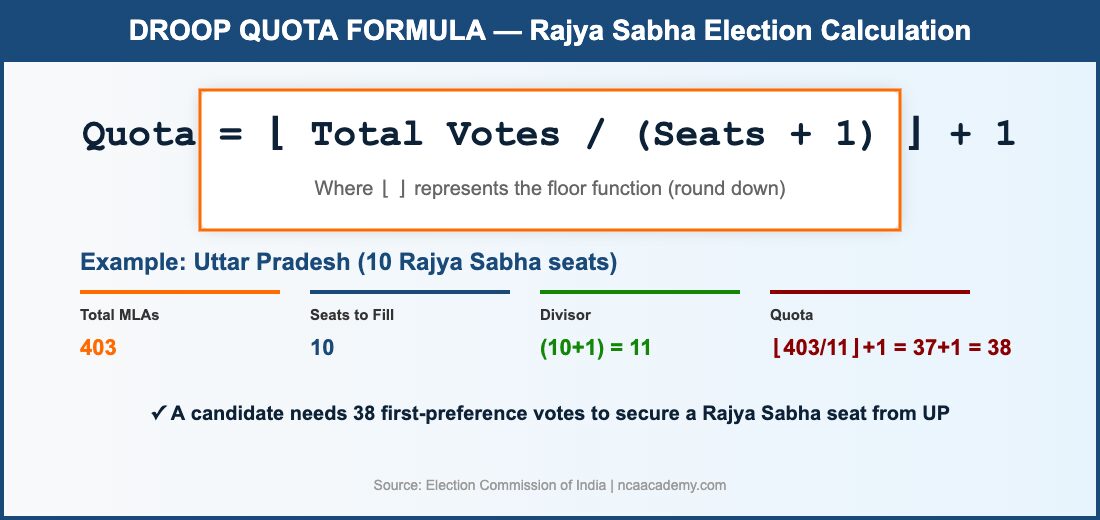
The most critical concept in Rajya Sabha vote calculation is the Droop Quota. This formula determines the minimum number of first-preference votes a candidate must secure to win a seat. It was developed by British mathematician Henry Richmond Droop in 1868 and is still used in Indian elections today.
Understanding the Formula with an Example
Let’s take the example of Uttar Pradesh, which has 403 MLAs and 10 Rajya Sabha seats to fill in a given election cycle:
- Total Votes (MLAs): 403
- Seats to be filled: 10
- Droop Quota = ⌊ 403 / (10 + 1) ⌋ + 1 = ⌊ 36.6 ⌋ + 1 = 36 + 1 = 37
This means any candidate who secures 37 first-preference votes is automatically elected to the Rajya Sabha from Uttar Pradesh.
What Happens After the First Count?
After the first count of votes, some candidates may have already reached the Droop Quota and are declared elected. But the process doesn’t end there — the STV system has a sophisticated mechanism to ensure no vote is wasted.
Transfer of Surplus Votes
If a candidate receives more votes than the Droop Quota, the surplus votes are transferred to the second-preference candidates on those ballots. This is done proportionally to ensure fairness. For example, if a candidate needed 37 votes but got 50, the extra 13 votes are redistributed.
Elimination and Redistribution
If not all seats are filled after the first count and surplus transfers, the candidate with the fewest votes is eliminated. Their votes are transferred to the next preference marked on each ballot. This process continues until all available seats are filled.
Why This System? The Logic Behind Proportional Representation
The STV system with the Droop Quota ensures that the Rajya Sabha genuinely reflects the political diversity of each state’s assembly. A party with a simple majority cannot monopolise all the Rajya Sabha seats from a state — minority parties and coalitions also get fair representation.
This was especially significant during India’s framing of the Constitution. The framers wanted the Rajya Sabha to be a body that provides stability and continuity, while also representing the interests of states and diverse political opinion.
Open Ballot System: No Secret Voting in Rajya Sabha Elections
Unlike general elections where voting is secret, Rajya Sabha elections use an open ballot system. MLAs must show their marked ballot to their party’s authorised agent before depositing it. This was introduced to prevent cross-voting and defection, and is backed by the Tenth Schedule (Anti-Defection Law) of the Constitution.
If an MLA votes against the party whip in a Rajya Sabha election, they can face disqualification from their state assembly seat.
Rajya Sabha Election: Frequently Asked Questions
Can a common citizen vote in Rajya Sabha elections?
No. Only elected members of State Legislative Assemblies (MLAs) vote in Rajya Sabha elections. It is an indirect election system.
How is the number of Rajya Sabha seats per state decided?
The number of seats is determined by population. Larger states get more seats. This is mentioned in the Fourth Schedule of the Constitution.
What is the term of a Rajya Sabha member?
Each Rajya Sabha member serves a term of 6 years. One-third of members retire every 2 years, so elections are staggered to maintain continuity.
Who oversees Rajya Sabha elections?
The Election Commission of India (ECI) conducts and supervises Rajya Sabha elections. For more information on schedules, results, and official guidelines, visit the Election Commission of India official website.
Conclusion
The Rajya Sabha election vote calculation through the Single Transferable Vote system and Droop Quota formula is a mathematically elegant solution to ensure proportional and fair representation in India’s upper house. For defence exam aspirants — whether NDA, CDS, AFCAT, or CAPF — understanding this system is crucial for the General Knowledge and Current Affairs sections. It reflects both India’s constitutional framework and its commitment to democratic pluralism.
🎯 Using this for NDA / CDS / CAPF prep? NCA Academy’s exam-focused current affairs sessions cover exactly what matters for your GK paper — India’s oldest defence coaching since 1967. Join NCA Academy →
Written by
Capt. Dhaliwal · Director, New Careers Academy
Ex-Indian Army officer and SSB mentor at NCA Academy, Chandigarh (est. 1967), coaching NDA, CDS, AFCAT and SSB aspirants since the 1980s. About the author →
Reviewed by Hartaj Dhaliwal — SSB Strategist, NCA · third-generation officer · recommended by the SSB three times.