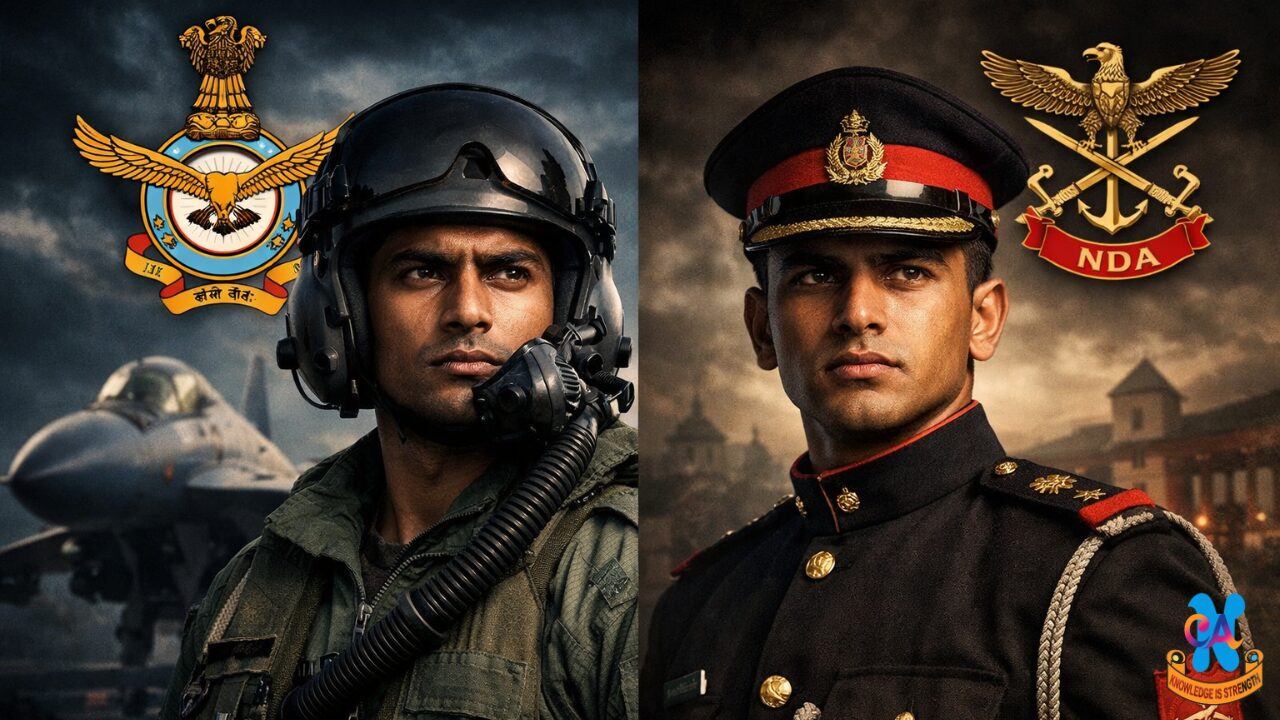
AFCAT vs NDA: Key Differences and Which is Better for You?
If you’re passionate about serving in the Indian Air Force, you have multiple pathways to achieve your goal. AFCAT (Air Force Common Admission Test) and NDA (National Defence Academy) are two primary routes to become an Air Force officer, but they differ significantly in eligibility, exam structure, training duration, and career development. Understanding AFCAT vs NDA is essential to choose the path that aligns with your qualifications, age, and career aspirations.
Many young Indians dream of wearing the blue uniform of the Indian Air Force, but confusion about whether to pursue AFCAT or NDA often delays their preparation. This comprehensive guide compares both examination pathways, helping you make an informed decision. Whether you’re a 12th pass student or a college graduate, you’ll find clarity on which route suits your profile better.
What is AFCAT and What is NDA?
The Air Force Common Admission Test (AFCAT) is a recruitment examination conducted by the Indian Air Force specifically for recruiting Short Service Commission (SSC) officers in various branches including Pilot, Flying Engineer, Ground Duty (Technical), and Ground Duty (Non-Technical). AFCAT is open to graduates from any discipline and is conducted twice yearly by the air force.
The National Defence Academy (NDA) is a tri-service recruitment examination for 12th pass candidates. It’s conducted by the Union Public Service Commission (UPSC) twice a year and leads to a three-year comprehensive military training program, after which graduates receive permanent commission in Army, Navy, or Air Force based on merit and choice.
The fundamental distinction is that AFCAT targets graduates for short-term commission in the Air Force specifically, while NDA targets 12th pass students for permanent commission in any of the three services, including the Air Force. Let’s explore the detailed differences.
AFCAT vs NDA: Eligibility Criteria
AFCAT Eligibility Requirements:
- Age: 20 to 24 years at the time of application (can be relaxed by 1 year for Armed Forces personnel)
- Educational Qualification: Bachelor’s degree from a recognized university in any discipline
- Nationality: Indian citizen
- Marital Status: Unmarried for Flying Branch, can be married for Ground Duty branches
- Physical Standards: Must meet Air Force medical and physical fitness standards
- Nationality/Domicile: No restrictions
NDA Eligibility Requirements:
- Age: 16.5 to 19.5 years at the time of application
- Educational Qualification: Must have passed 12th standard (Science stream preferred)
- Nationality: Indian citizen
- Marital Status: Must be unmarried
- Physical Standards: Must meet the prescribed physical fitness standards
The most critical difference is that AFCAT requires graduation while NDA requires only 12th pass qualification. This means if you’re currently a school student, AFCAT is not an option immediately, but NDA is. Conversely, if you’re a college graduate approaching the 24-year age limit for AFCAT, pursuing NDA is no longer possible.
Exam Pattern and Syllabus Comparison
AFCAT Exam Structure:
AFCAT is conducted in online mode with a single paper:
- Total Marks: 300 marks
- Duration: 1 hour and 45 minutes
- Question Format: 100 multiple-choice questions
- Sections: Reasoning and Military Aptitude (25 questions), Verbal Ability in English (20 questions), Spatial Reasoning (25 questions), and Situational Awareness (30 questions)
- Negative Marking: 0.25 marks deducted for each wrong answer
NDA Exam Structure (for Air Force branch):
NDA has two papers:
- Paper 1 (Mathematics): 300 marks, 2.5 hours duration
- Paper 2 (General Ability Test): 600 marks, 2.5 hours duration
- Total Written Exam: 900 marks
- SSB Interview: 900 marks
- Total Score: 1800 marks
AFCAT is comparatively easier in terms of subject difficulty and duration. NDA demands stronger mathematical knowledge and has higher total marks, increasing competition intensity. For AFCAT, AFCAT coaching in Chandigarh focuses on specific sections like military aptitude and situational awareness. For NDA, coaching emphasizes comprehensive mathematics and general knowledge preparation.
Service Type and Commission Duration
AFCAT Commission Structure:
AFCAT leads to Short Service Commission (SSC) in the Indian Air Force. The SSC duration is:
- Flying Branch (Pilot, Combat Navigator): 5 years initial SSC + 3 years extension (total 8 years service)
- Flying Engineer: 5 years initial SSC + 3 years extension (total 8 years service)
- Ground Duty (Technical and Non-Technical): 5 years initial SSC + 3 years extension (total 8 years service)
After completing SSC tenure, officers can apply for Permanent Commission (PC). However, not all SSC officers are accepted for PC, and the procedure is competitive. This means your service may end after 8 years if you don’t qualify for or aren’t selected for PC.
NDA Commission Structure:
NDA leads directly to Permanent Commission in the chosen service. The initial commission is for the entire career until retirement (25-30 years) without the uncertainty of extension or completion.
This is a major distinction: AFCAT offers temporary service with an option for permanency, while NDA provides immediate permanent commission. For officers seeking career stability and long-term service, NDA holds a significant advantage.
NDA Air Force Career Path vs AFCAT Air Force Path
NDA Air Force Officer Career:
- Training Duration: 3 years at National Defence Academy, followed by service-specific training
- Permanent Commission: Immediate upon completion of NDA, lasting entire career
- Rapid Promotion: Promotion to Squadron Leader, Wing Commander, Group Captain follows the regular Air Force seniority-based system
- Career Branches: Can join Flying (Pilot), Flying Engineer, Ground Duty (Technical), or Ground Duty (Non-Technical) based on merit and service needs
- Posting Flexibility: Greater flexibility in choosing postings and specialized roles
- Retirement Pension: Full pension benefits after 20 years of service, continuing until death with family benefits
AFCAT Air Force Officer Career:
- Training Duration: Service-specific training at Air Force Academy and specialized training centers (no separate 3-year academy)
- Short Service Commission: Initial 5 years with option for 3-year extension
- Promotion Potential: Promotions are more limited due to short tenure. Most SSC officers remain at Flight Lieutenant rank
- Career Branches: Must choose a specific branch (Pilot, Engineer, Ground Duty) at the time of joining; changing branches is not possible
- Permanent Commission Conversion: Competitive process to convert SSC to PC; not guaranteed
- Retirement Benefits: Gratuity at the end of SSC tenure; pension only if converted to PC and complete 20 years
NDA officers have more stable, long-term careers with predictable progression, while AFCAT officers face uncertainty about service continuation post-SSC tenure.
Salary and Allowances: AFCAT vs NDA
AFCAT (SSC Officer) Salary:
Upon commissioning as Flying Officer/Flight Lieutenant in the Air Force:
- Basic Pay: ₹56,100 (7th CPC)
- Dearness Allowance: Approximately ₹8,000-10,000
- House Rent Allowance: ₹4,500-8,000 based on posting location
- Flying Allowance (Pilots only): ₹15,000 per month
- Technical Allowance (if applicable): ₹5,000-8,000
- Total Monthly Salary (Pilot): Approximately ₹95,000-105,000
- Total Monthly Salary (Non-Pilot):
NDA (Permanent Commission Officer) Salary:
NDA officers enter at Second Lieutenant rank and upon Air Force posting become equivalent to Flying Officer:
- Same basic pay and allowances as AFCAT officers upon reaching equivalent rank
- However, NDA officers progress through regular ranks: Second Lieutenant → Lieutenant → Captain → Major → Lt. Colonel, reaching higher ranks faster through seniority
- Long-term salary advantage due to higher ultimate rank achieved in permanent commission
- Full pension after 20 years of service
While initial salary is similar, NDA officers have superior long-term earning potential due to permanent commission and higher rank progression. AFCAT pilots enjoy flying allowance which adds ₹15,000 monthly, but this ends if they leave the Air Force after SSC tenure.
Difficulty Level: AFCAT vs NDA
AFCAT Difficulty:
AFCAT is considered moderately difficult. The question paper tests logical reasoning, verbal ability, and military aptitude rather than deep subject knowledge. Key challenges:
- Situational Awareness questions require current affairs knowledge and logical thinking
- Military Aptitude section specifically tests officer-like qualities and decision-making
- Spatial Reasoning requires visualization skills that may be unfamiliar to non-engineering backgrounds
- Time management is crucial with 100 questions in 105 minutes
- Competition varies yearly; approximately 8-10 lakh applications for 200-300 positions is typical
NDA Difficulty:
NDA is considered more challenging, especially the Mathematics paper. Key challenges:
- Mathematics requires deep conceptual understanding and problem-solving skills (300 marks dedicated to math)
- General Ability Test covers diverse topics from English to Science to General Knowledge
- Competition is exceptionally fierce: approximately 10-12 lakh candidates annually for 400-450 positions
- Age advantage: candidates are younger with recent academic preparation
- Total marks (1800) make even small mistakes impact your ranking significantly
AFCAT is objectively easier in content difficulty, but NDA’s higher competition means achieving a merit position requires exceptional performance in both written exam and SSB. Your choice might depend on your mathematical strength—if math is your weakness, AFCAT is better; if you’re confident in math, NDA could be your path.
Which Should You Choose: AFCAT or NDA?
Choose NDA if:
- You are currently a 12th standard student or recently passed 12th
- You have strong mathematical aptitude and enjoy problem-solving
- You want permanent commission in the Air Force (or other services)
- You prefer long-term career stability without uncertainty of extension
- You want comprehensive military training alongside academics
- You’re willing to prepare for higher competition
- You value pension benefits and retirement security
- You want maximum earning potential in the long term
Choose AFCAT if:
- You have completed your bachelor’s degree
- You’re between 20-24 years of age
- You prefer relatively easier exam content and structure
- You’re open to 5-year service with potential extension (not permanent commitment)
- You want specialized Air Force training without 3-year academy
- You’re a pilot aspirant and value flying experience and flying allowance
- You can compete for Permanent Commission conversion after SSC
- You want to serve for a defined period with exit option
Many candidates strategically attempt both examinations. If you’re currently a 12th pass student, prepare for NDA but continue building your profile for future AFCAT attempt once you graduate. This dual strategy maximizes your chances of Air Force commission through whichever route succeeds first.
Career Progression: NDA vs AFCAT
NDA Career Ladder:
- Commission as Second Lieutenant → Lieutenant (3 years) → Captain (3 years) → Major (6-7 years) → Lt. Colonel (7-8 years) → Colonel (8-9 years)
- Can potentially reach Air Chief Marshal rank (rare but possible)
- Opportunity for higher staff positions and strategic roles
- Regular promotions based on seniority and service record
AFCAT Career Ladder:
- Commission as Flying Officer/Flight Lieutenant → may progress to Squadron Leader (if extended for PC)
- Majority of AFCAT officers retire as Flight Lieutenant or Squadron Leader
- Limited advancement without Permanent Commission conversion
- Career ceiling is lower compared to NDA officers
NDA officers have significantly better career progression and advancement opportunities due to permanent commission and longer service tenure.
Advantages and Disadvantages Summary
AFCAT Advantages:
- Easier exam content and structure
- Shorter preparation time compared to NDA
- Open to graduates from any discipline
- Flying allowance for pilots
- Service-specific training without long academy course
AFCAT Disadvantages:
- Short Service Commission with uncertain continuation
- No pension unless converted to PC
- Limited career progression
- Career ends at 8-13 years if not converted to PC
- Fewer opportunities for higher rank positions
NDA Advantages:
- Permanent Commission providing career stability
- Comprehensive military training and education
- Full pension after 20 years of service
- Better long-term earning potential
- Excellent career progression and advancement
- Option to join any service (Army, Navy, Air Force)
- Greater posting flexibility and specialization opportunities
NDA Disadvantages:
- Only for 12th pass candidates (age 16.5-19.5 years)
- Requires strong mathematical knowledge
- Very high competition (10-12 lakh candidates annually)
- 3-year academy commitment before commission
- Science stream preferred (though not mandatory)
Expert Opinion: NDA for Long-term Security, AFCAT for Flexibility
From a career stability perspective, NDA coaching in Chandigarh at NCA Academy emphasizes NDA’s superior long-term prospects. The permanent commission, pension benefits, and higher rank potential make NDA ideal for candidates seeking a full military career.
However, AFCAT suits candidates who want Air Force experience with flexibility to pursue other careers afterward. The 5-8 year service period allows officers to gain military experience and then transition to civilian career if desired.
NCA Academy, India’s oldest defence coaching institute since 1967 based in Chandigarh, guides students through both pathways. Many successful candidates prepare for both examinations simultaneously, as the overlapping knowledge base makes concurrent preparation efficient.
SSB Interview for Both Pathways
Both AFCAT and NDA require clearing the Services Selection Board (SSB) interview after passing the written examination. The interview process is similar:
- Officer Intelligence Rating and PPDT test
- Psychological evaluation (TAT, WAT, SRT)
- Group Testing Officer (GTO) exercises
- Personal interview with Air Force officers
For specialized preparation on SSB, candidates often seek SSB interview coaching from experienced institutes like NCA Academy. The interview evaluation is identical for both AFCAT and NDA candidates, testing leadership, decision-making, psychological stability, and military aptitude.
Final Verdict: NDA vs AFCAT
Choosing between AFCAT and NDA depends on your current education status, age, career goals, and risk tolerance:
Choose NDA if you’re a school student, want permanent commission, value long-term security, and have strong mathematical skills. NDA is the superior choice for building a complete military career with maximum benefits.
Choose AFCAT if you’re a graduate within the age limit, prefer shorter commitment, and want Air Force-specific training. AFCAT is excellent for those seeking defined service with exit options.
Ideally, prepare for both if your educational timeline permits. The knowledge overlap is substantial, and success in one makes the other more achievable. With proper guidance from experienced coaching institutes and dedicated preparation, both AFCAT and NDA are achievable goals for serious defence aspirants.
Can NDA graduates join the Air Force?
Yes, NDA graduates can join the Indian Air Force based on merit and choice. At NDA, cadets opt for their preferred service (Army, Navy, or Air Force), and allocation is done based on their academic performance and service requirements. Flying branch in Air Force is allocated to top performers.

Is AFCAT easier than NDA?
AFCAT is easier in terms of exam content and structure. It has fewer total marks (300 vs 1800), shorter duration, and simpler content. However, both are highly competitive with fierce selection processes. AFCAT’s lower difficulty doesn’t make success guaranteed.
What is the age limit for AFCAT and NDA?
AFCAT age limit is 20-24 years, while NDA age limit is 16.5-19.5 years. This is the primary factor determining which exam you’re eligible for. If you’re older than 19.5 but younger than 24, you can only pursue AFCAT.
Do AFCAT and NDA officers earn the same salary initially?
Upon commissioning at equivalent ranks, AFCAT and NDA officers earn nearly identical salary. However, NDA officers have better long-term earning potential due to permanent commission, higher rank progression, and full pension benefits.
Can AFCAT SSC officers convert to Permanent Commission?
Yes, AFCAT SSC officers can apply for Permanent Commission conversion after completing their initial 5-year tenure. However, it’s a competitive selection process and not all SSC officers are accepted. Success depends on performance, merit, and Air Force requirements.
Which exam should I prepare for if I want to be a fighter pilot?
Both NDA and AFCAT offer fighter pilot roles. NDA is better if you want permanent commission as a pilot with career stability. AFCAT is suitable if you want to be a pilot for 5-8 years with flexibility to transition afterward. Many pilots prefer NDA for long-term career.
Can I attempt both AFCAT and NDA?
Yes, you can attempt both if your age and qualification permit. If you’re currently in 12th, you should focus on NDA first (within age limit 16.5-19.5). After graduation, if your AFCAT age limit permits (before 24), you can appear for AFCAT. Some candidates successfully pursue both examinations in overlapping time periods.
Written by
Capt. Dhaliwal · Director, New Careers Academy
Ex-Indian Army officer and SSB mentor at NCA Academy, Chandigarh (est. 1967), coaching NDA, CDS, AFCAT and SSB aspirants since the 1980s. About the author →
Reviewed by Hartaj Dhaliwal — SSB Strategist, NCA · third-generation officer · recommended by the SSB three times.