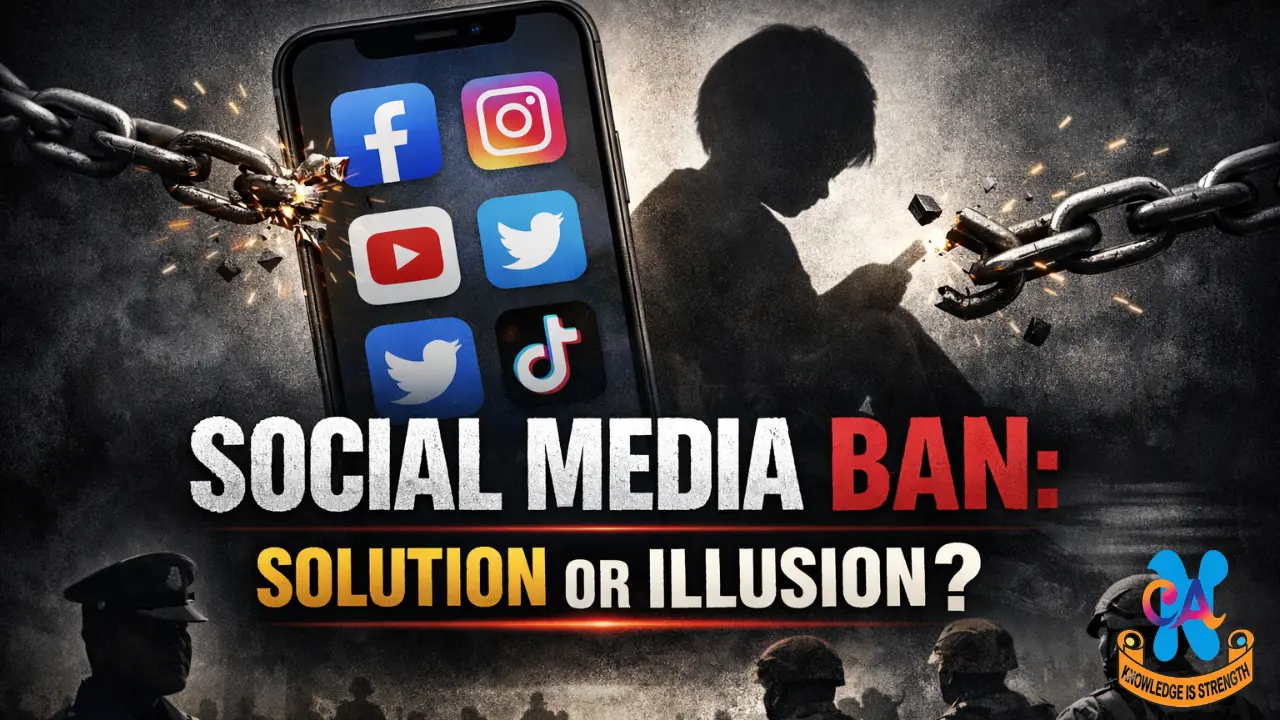
A social media ban will not save our children
Introduction: Why This Debate Matters
The demand for a social media ban often resurfaces after tragic incidents involving children and adolescents. While the emotional response is natural, policymaking driven by outrage rather than evidence risks doing more harm than good. The question India must answer is not whether children should be protected, but how they should be protected in a rapidly evolving digital ecosystem.This article argues that a social media ban will not save our children, and that sustainable solutions lie in regulation, accountability, and digital literacy.
This issue holds direct relevance for CAPF (AC) examinations, especially under:
General Studies (Paper I)
Essay Paper
Internal Security & Social Issues
The Core Argument in Brief
Social media harms exist, but blanket bans oversimplify complex realities
Enforcement of bans is technically weak and socially unequal
Children’s rights, gender equity, and democratic participation are at stake
The real need is regulation, accountability, and digital literacy, not censorship
Why Social Media Is Being Blamed
Studies across the world indicate a correlation between excessive social media use and:
Anxiety and depression
Body image dissatisfaction
Self-harm tendencies
Sleep disorders
However, correlation does not mean causation. Social media often amplifies existing vulnerabilities rather than creating them in isolation.
Key Insight for CAPF:
Social media is a risk factor, not a sole cause of adolescent mental health crises.
Why a Social Media Ban Is an Ineffective Solution
1. Technically Porous and Difficult to Enforce
Age verification can be bypassed using VPNs and fake credentials
Drives children toward unregulated and unsafe digital spaces
Risks large-scale privacy violations and surveillance
CAPF Angle: Weak enforcement undermines internal security objectives.
2. Ignores Adolescent Development
Social media also enables:
Peer support
Identity exploration
Educational access
Particularly important for:
Rural youth
LGBTQ+ adolescents
Differently-abled children
3. Deepens Gender and Social Inequality
Girls already face limited digital access
A ban may result in:
Device confiscation
Reduced educational exposure
Loss of digital mobility
Exam Value Line:
A policy that ignores gendered realities risks reinforcing structural inequality.
4. Democratic Deficit in Policymaking
Policies are made for children, not with them
Absence of youth consultation weakens legitimacy
For and Against a Social Media Ban
Arguments FOR a Social Media Ban
Immediate symbolic action after tragedies
A ban allows the state to respond swiftly after incidents involving online harm, projecting seriousness and political resolve in moments of public distress.Reduces exposure to harmful content
Restricting access limits children’s exposure to violent imagery, self-harm challenges, cyberbullying, and sexually exploitative material.Signals state concern for child welfare
Such measures communicate that child safety and mental health are prioritised over unchecked digital expansion and profit motives.Arguments AGAINST a Social Media Ban
Technically unenforceable
VPNs, proxy servers, and alternative applications make comprehensive enforcement impractical in a digitally connected society.Pushes users to unsafe platforms
Bans often divert users to poorly regulated or underground platforms that lack moderation and grievance redress mechanisms.Violates digital rights
Blanket restrictions may infringe upon freedom of expression, access to information, and the right to participate in digital spaces.Increases gender and class disparities
Marginalised groups, especially girls and rural youth, lose access to educational resources and support networks more than privileged users.Avoids accountability of Big Tech
Bans shift responsibility away from social media companies, delaying reforms related to algorithm transparency, child safety, and platform regulation.
What Should Be Done Instead?
1. Regulate Platforms, Not Children
Impose duty of care obligations
Penalize algorithmic amplification of harmful content
Independent digital regulator instead of bureaucratic control
2. Invest in Indian Context Research
Longitudinal studies across:
Gender
Caste
Region
Evidence-based policymaking
3. Promote Digital Literacy & Parental Engagement
Healthy screen habits
Mental health awareness
Media literacy in schools
4. Address the AI Blind Spot
AI chatbots increasingly used for:
Emotional support
Advice
Risks include:
Cognitive dependency
Misinformation
Unsafe interactions
Strong CAPF Line:
Selective moral outrage against social media while ignoring AI risks reflects regulatory inconsistency.
Why This Topic Is Important for CAPF Aspirants
Direct Exam Relevance
Essay topics on:
Technology and society
Youth and mental health
Internal security challenges
GS questions on:
Governance
Digital regulation
Social justice
Interview Perspective
Demonstrates:
Balanced judgment
Constitutional values
Human security approach
Conclusion: The Way Forward
A social media ban offers the illusion of control, not real protection. Children need a healthy media ecology, not exclusion from the digital world. The state must move from reactionary bans to responsible regulation, from censorship to care.
As adults and policymakers, the responsibility lies in shaping technology, not fearing it.
Why New Careers Academy Is the Best Place for CAPF Coaching in India
Preparing for the CAPF (Assistant Commandant) examination requires more than rote learning. It demands analytical clarity, balanced opinion-building, and the ability to handle sensitive socio-political issues—exactly like the debate on social media bans and child safety.
New Careers Academy stands out as one of the most reliable institutes for CAPF preparation in India because:
It trains aspirants to approach issues from multiple perspectives, a core requirement for GS Paper and Essay writing
Current affairs are taught with a policy, governance, and internal security lens, not as isolated news events
Aspirants are guided on “for and against” structuring, helping them write mature, officer-like answers
Special emphasis is given to ethical reasoning, constitutional values, and social justice, which are crucial for interviews
Regular answer-writing practice helps students convert complex debates into clear, concise, examiner-friendly responses
Most importantly, New Careers Academy focuses on shaping aspirants into thinking officers, not just exam clearers. This approach aligns perfectly with the expectations of the CAPF, where future leaders are expected to balance authority with empathy and security with rights.
Institutions like New Careers Academy prepare CAPF aspirants to critically evaluate modern challenges such as digital regulation, youth safety, and governance—skills essential for effective leadership in India’s armed forces.
In essence, a social media ban will not save our children unless it is supported by evidence-based regulation and inclusive digital policy.

Written by
Capt. Dhaliwal · Director, New Careers Academy
Ex-Indian Army officer and SSB mentor at NCA Academy, Chandigarh (est. 1967), coaching NDA, CDS, AFCAT and SSB aspirants since the 1980s. About the author →
Reviewed by Hartaj Dhaliwal — SSB Strategist, NCA · third-generation officer · recommended by the SSB three times.