Introduction: A Silent Agricultural Shift in Southern India
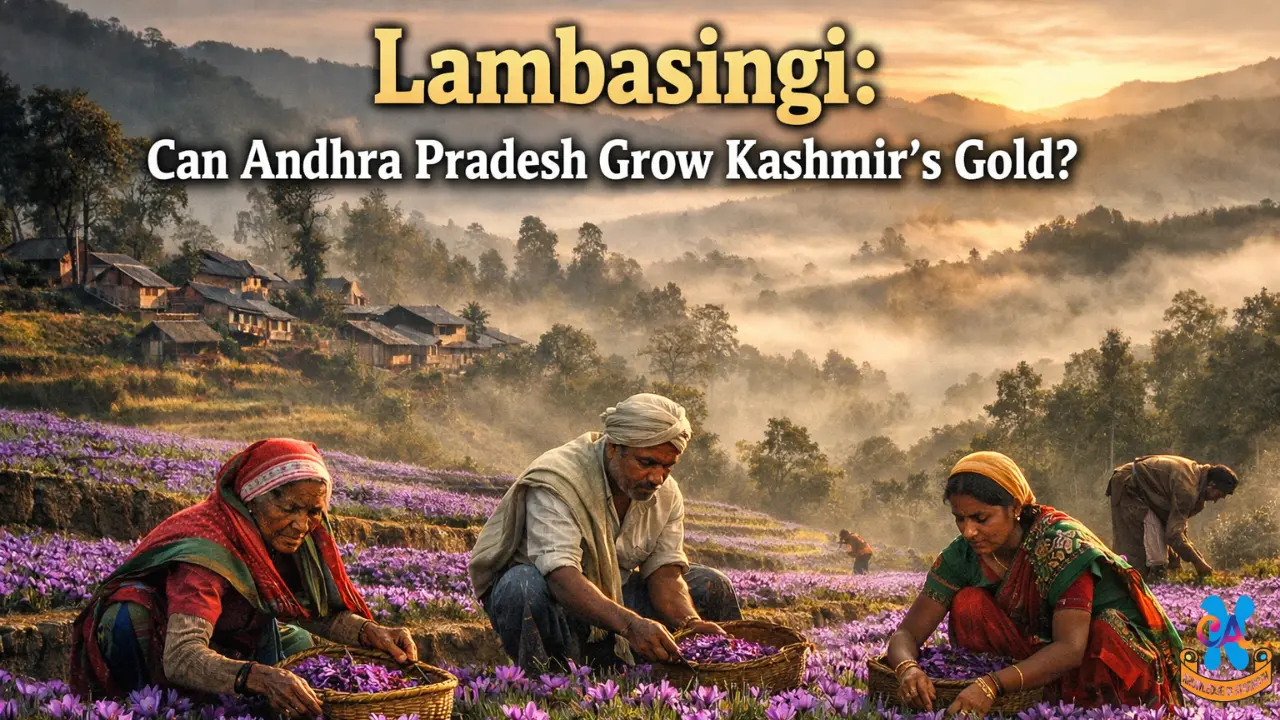
Andhra Pradesh saffron cultivation is emerging as a major agricultural experiment as the state plans to grow the world’s costliest spice in Lambasingi, often called the “Kashmir of the South.” This move signals a shift toward climate-based crop diversification, natural farming, and export-led agriculture in India.Andhra Pradesh is preparing for a quiet but strategic agricultural transformation. In Lambasingi, a hill village often called the “Kashmir of the South”, the state government has proposed large-scale saffron cultivation, a crop traditionally confined to Jammu & Kashmir.
This initiative goes far beyond experimentation. It combines natural farming, tribal participation, export orientation, and a Public–Private Partnership (PPP) model—making it highly relevant for UPSC GS-III, State PCS, NDA/CDS, and CAPF aspirants.
1. What Has Been Announced by the Andhra Pradesh Government?
Chief Minister N. Chandrababu Naidu has announced that the state will:
Invite private companies and agri-startups
Promote commercial saffron cultivation in Lambasingi
Implement the project under a PPP model
Offer land access, incentives, and infrastructure
Ensure tribal consent before land allocation
Multiple firms have already approached the government for land leases and cultivation permissions.Andhra Pradesh saffron cultivation could reduce India’s dependence on Kashmir while opening new income opportunities for tribal farmers in the Eastern Ghats.
2. Why Lambasingi Is Called the “Kashmir of the South”
Located in Chintapalli Mandal of Alluri Sitharama Raju district, Lambasingi sits at around 1,000 metres above sea level in the Eastern Ghats.
Unique climatic features:
One of the very few places in South India to experience frost
Winter temperatures occasionally near 0°C
Misty mornings and cold nights resembling temperate Himalayan zones
These conditions are exceptional in peninsular India and crucial for saffron flowering.
3. Why Saffron Matters: Economic & Strategic Importance
Saffron is not just a spice—it is a strategic agri-commodity.
World’s costliest spice (₹2–5 lakh per kg)
India’s production largely confined to Kashmir (Pampore belt)
Domestic demand often exceeds supply
Heavy dependence on a single region increases climate risk
Strong export demand in EU, Gulf, and premium food markets
Decentralising saffron production reduces regional monopoly risk.
4. Agro-Climatic Requirements for Saffron (High-Value Exam Area)
Climate
Summer: 20–30°C
Winter: –5°C to 10°C (cold dormancy essential)
Dry climate during flowering (Oct–Nov)
Low to moderate rainfall
Altitude
Ideal range: 700–1,300 m
Lambasingi (~1,000 m) fits perfectly
Soil
Well-drained loamy / sandy-loam soil
pH 6–8 (neutral to slightly alkaline)
High organic matter
No waterlogging (corms rot easily)
Water
Very low irrigation requirement
Excess water is harmful
Ideal for natural and organic farming
5. Why Andhra Pradesh Is a Strong Candidate
Cool micro-climates in Eastern Ghats
Aggressive push towards natural farming
State-backed certification and traceability
Strong port-based export logistics
Established farmer-training ecosystem
6. Tribal Participation & Fifth Schedule Alignment
A defining feature of the Lambasingi plan is tribal consent.
Government consultations ensured:
Voluntary land participation
Employment and skill development
Revenue-sharing models
Sustainable land use
This aligns with Fifth Schedule principles and inclusive development norms.
7. Role of Public–Private Partnership (PPP)
Government provides
Land access
Policy and regulatory support
Infrastructure and incentives
Private sector brings
Capital investment
Cultivation technology
Processing & branding
Export market linkages
PPP reduces farmer risk while enabling scalability.
8. Natural Farming & Export Orientation
The saffron plan aligns with Andhra Pradesh’s ambition to become India’s largest natural farming hub.
Key measures include:
Reduction of chemical fertilisers
Promotion of Zero Budget Natural Farming (ZBNF)
Training in collaboration with Subhash Palekar’s methods
EU-compliant residue-free certification
9. Is There a SAFIN / Saffron Board in India? (Exam Clarification)
India has a National Saffron Mission (launched 2010–11)
Focused mainly on Jammu & Kashmir
No statutory “SAFIN Board” exists nationally
Export and quality oversight involves the Spices Board of India and state horticulture departments.
10. Cocoa City in Eluru: A Linked Policy Signal
Alongside saffron, CM Naidu announced:
A 500-acre Cocoa City in Eluru district
Integrated approach:
Cultivation
Processing
Marketing
Intercropping with mango, coconut, cashew
This signals Andhra’s push towards high-value plantation crops.
11. Exam Relevance (UPSC / NDA / CDS / CAPF)
Prelims
Lambasingi location & frost conditions
Saffron climatic requirements
National Saffron Mission
PPP in agriculture
ZBNF
Mains (GS-III)
Crop diversification
Climate-based agriculture
Tribal participation
Export-oriented farming
Interview
Can saffron cultivation be decentralised?
Risks of mono-regional crop dependency
12. Largest Producers: Saffron & Cocoa (India & World)
Saffron
India: Jammu & Kashmir (Pampore belt)
World: Iran (~85–90%)
Cocoa
India: Kerala (~70%)
World: Côte d’Ivoire (~40%)
Conclusion
The Lambasingi saffron initiative reflects a strategic shift in Indian agriculture—from tradition-bound belts to climate-based diversification. By integrating natural farming, tribal inclusion, PPP investment, and export focus, Andhra Pradesh is attempting to replicate Kashmir’s saffron success in the Eastern Ghats.
If successful, Lambasingi may evolve from being the “Kashmir of the South” to India’s second saffron capital.

Written by
Capt. Dhaliwal · Director, New Careers Academy
Ex-Indian Army officer and SSB mentor at NCA Academy, Chandigarh (est. 1967), coaching NDA, CDS, AFCAT and SSB aspirants since the 1980s. About the author →
Reviewed by Hartaj Dhaliwal — SSB Strategist, NCA · third-generation officer · recommended by the SSB three times.