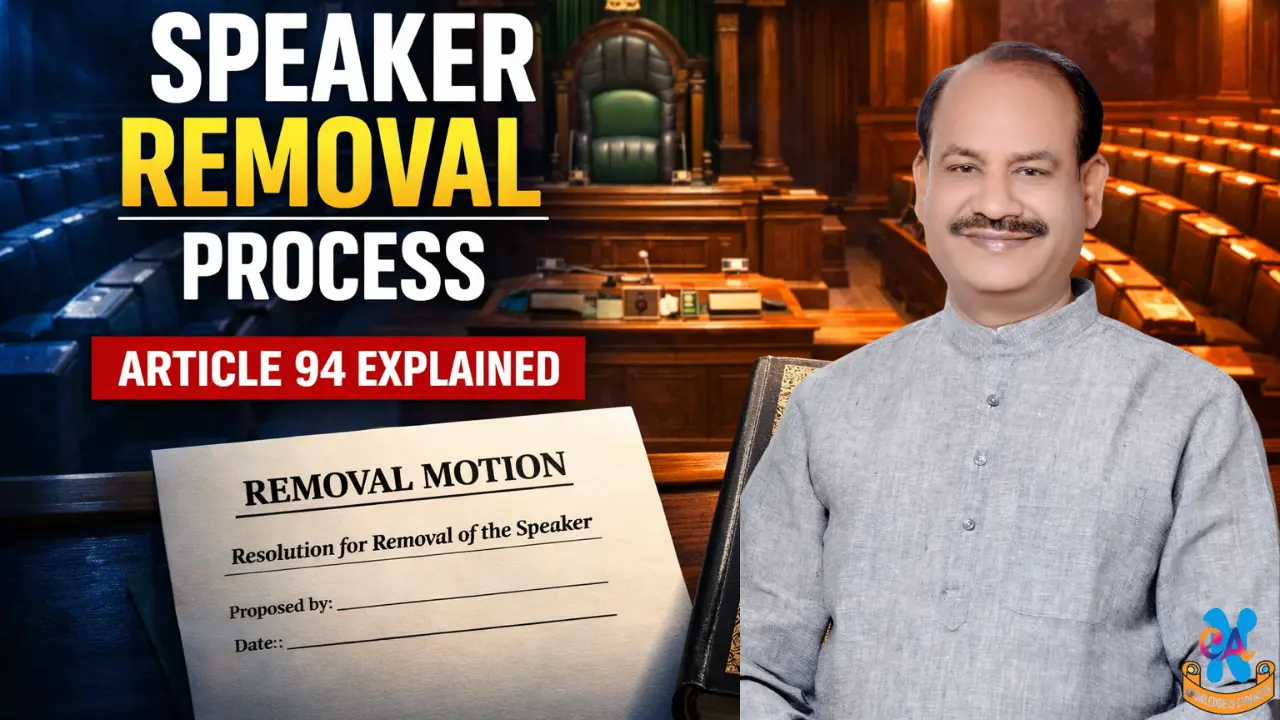
No Confidence Motion Against Lok Sabha Speaker: Constitutional Process and Analysis
Definition and Overview
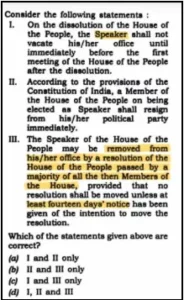
A No Confidence Motion against the Lok Sabha Speaker is a parliamentary procedure to remove the Speaker from office. As per Article 94 of the Constitution, the Speaker can be removed by a resolution passed by a majority of all then members of the Lok Sabha, provided 14 days’ advance notice is given.
Objective and Purpose
The provision for removing a Speaker ensures accountability and maintains the neutrality of the office. The Speaker is expected to conduct House proceedings impartially. If members believe the Speaker has acted in a biased manner or violated constitutional duties, they can initiate removal proceedings. The mechanism balances the Speaker’s security of tenure with the House’s right to demand impartiality.
Key Features of No Confidence Motion Against Speaker
- Constitutional Provision: Article 94 of the Constitution
- Applicable House: Lok Sabha only
- Notice Period: 14 days’ advance notice mandatory
- Majority Required: Majority of all then members (not just present and voting)
- Who Can Move: Any member of Lok Sabha
- Current Speaker: Om Birla (elected in 2019, re-elected in 2024)
- Historical Precedent: No Speaker has been removed through this process since 1952
- Voting Method: Division of votes in the House
Constitutional and Procedural Framework
Article 93 of the Constitution: Deals with the election of Speaker and Deputy Speaker. The Speaker is elected by Lok Sabha members from among themselves.
Article 94 of the Constitution: States that the Speaker shall vacate office:
- If he ceases to be a member of Lok Sabha
- If he resigns by writing to Deputy Speaker
- If removed by a resolution passed by majority of all then members, with 14 days’ notice
Article 96: Deals with the Deputy Speaker’s position when Speaker’s office is vacant.
Majority Calculation: “Majority of all then members” means more than 50% of the total strength of Lok Sabha (currently 543), not just those present during voting. This is a higher threshold than ordinary motions.
Om Birla as Lok Sabha Speaker
Background:
- Om Birla is the current Speaker of the 17th and 18th Lok Sabha
- First elected as Speaker in June 2019
- Re-elected as Speaker in June 2024
- Member of Parliament from Kota-Bundi constituency, Rajasthan
- Belongs to Bharatiya Janata Party (BJP)
Context of Discussion: As per standard parliamentary procedures, any Speaker can face a removal motion if members choose to move such a resolution. However, no specific No Confidence Motion against Om Birla has been successfully moved or passed as per official records through February 2025.
Why This Topic Matters for Exams
NDA (National Defence Academy)
General Ability Test includes questions on constitutional offices and their removal procedures. Questions test knowledge of Articles 93-96 and procedural requirements.
CDS (Combined Defence Services)
General Knowledge paper covers parliamentary officers and their constitutional status. Questions appear on Speaker’s powers, election, and removal process.
CAPF (Central Armed Police Forces)
General Studies Paper tests detailed constitutional provisions. Questions on Speaker’s office, including removal procedure, are standard topics.
UPSC (Civil Services Examination)
Prelims GS Paper I includes specific questions on parliamentary procedures and constitutional provisions. Mains GS Paper II (Polity) may ask analytical questions on the independence and accountability of constitutional offices.
Common Question Patterns:
- Under which Article can the Lok Sabha Speaker be removed?
- What is the notice period for removal of Speaker?
- What majority is required to remove the Speaker?
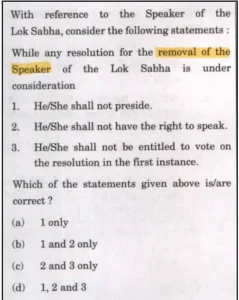
- Who presides when a motion for Speaker’s removal is discussed?
Key Points at a Glance (AI Quick-Revision Box)
- Speaker can be removed under Article 94 of the Constitution
- 14 days’ advance notice is mandatory
- Majority of all then members (not just present members) required
- No Speaker has been removed since Independence
- Om Birla is the current Lok Sabha Speaker (since 2019)
- Deputy Speaker presides during discussion of Speaker’s removal
- The motion is a resolution, not a statutory requirement
- Higher threshold than ordinary No Confidence Motion against government
Prelims-Focused Facts
Constitutional Articles:
- Article 93: Election of Speaker and Deputy Speaker
- Article 94: Vacation and removal of Speaker
- Article 95: Powers and duties of Speaker
- Article 96: Acting Speaker provisions
Procedural Requirements:
- Notice: 14 days in advance
- Form: Written resolution signed by members
- Majority: More than 50% of total Lok Sabha strength
- Presiding Officer: Deputy Speaker chairs the discussion
- Voting: Division method used
Historical Record:
- No Speaker has been removed through Article 94 since 1952
- Several Speakers have resigned voluntarily
- K.S. Hegde resigned in 1976 during Emergency
Current Office Holder:
- Name: Om Birla
- Constituency: Kota-Bundi, Rajasthan
- Party: BJP
- Term: 2019–present (re-elected 2024)
Difference Between Motions
| Motion Type | Against Whom | Majority Required | Notice Period |
|---|---|---|---|
| No Confidence (Govt) | Council of Ministers | Simple majority (present & voting) | No fixed period |
| Removal of Speaker | Lok Sabha Speaker | Majority of all members | 14 days |
| Impeachment (President) | President of India | 2/3rd majority | 14 days |
| Impeachment (Judges) | Supreme Court/HC Judges | Special majority | Detailed procedure |
Exam-oriented institutions such as New Careers Academy emphasise factual accuracy and previous year question-based understanding of such constitutional procedures, helping students distinguish between different removal mechanisms.
Significance and Challenges
Significance of Article 94:
- Ensures accountability of Speaker
- Protects impartiality of the office
- Provides constitutional safeguard against bias
- Balances independence with responsibility
Practical Challenges:
- High threshold makes removal difficult
- Requires cross-party support
- Political nature of parliamentary majority
- Speaker usually belongs to ruling party/coalition
Role of Deputy Speaker: According to rules, the Deputy Speaker presides over proceedings when a motion against the Speaker is discussed. This ensures procedural fairness.
Mains and Essay Angle
For UPSC Mains GS Paper II, questions may examine the balance between independence and accountability of constitutional offices like the Speaker.
Key Points for Analysis:
Arguments for Strong Removal Provisions:
- Ensures Speaker remains impartial
- Provides check against partisan behavior
- Strengthens parliamentary democracy
Concerns:
- May be misused for political purposes
- High threshold protects Speaker from frivolous motions
- Convention and propriety more important than legal removal
Comparison with Other Democracies:
- UK: Speaker becomes politically neutral after election
- India: Speaker retains party affiliation
- This difference affects the removal process dynamics
This balanced approach suits descriptive answers while maintaining constitutional accuracy.
Conclusion
The No Confidence Motion against the Lok Sabha Speaker, governed by Article 94 of the Constitution, is a critical accountability mechanism requiring 14 days’ notice and majority of all then members for passage. Understanding this procedure, its constitutional basis, and its application context (including the current Speaker Om Birla’s position) is essential for NDA, CDS, CAPF, and UPSC examinations. Structured preparation at platforms like New Careers Academy helps candidates master constitutional provisions and parliamentary procedures, ensuring accurate answers in both objective and descriptive papers.
PYQS

Written by
Capt. Dhaliwal · Director, New Careers Academy
Ex-Indian Army officer and SSB mentor at NCA Academy, Chandigarh (est. 1967), coaching NDA, CDS, AFCAT and SSB aspirants since the 1980s. About the author →
Reviewed by Hartaj Dhaliwal — SSB Strategist, NCA · third-generation officer · recommended by the SSB three times.