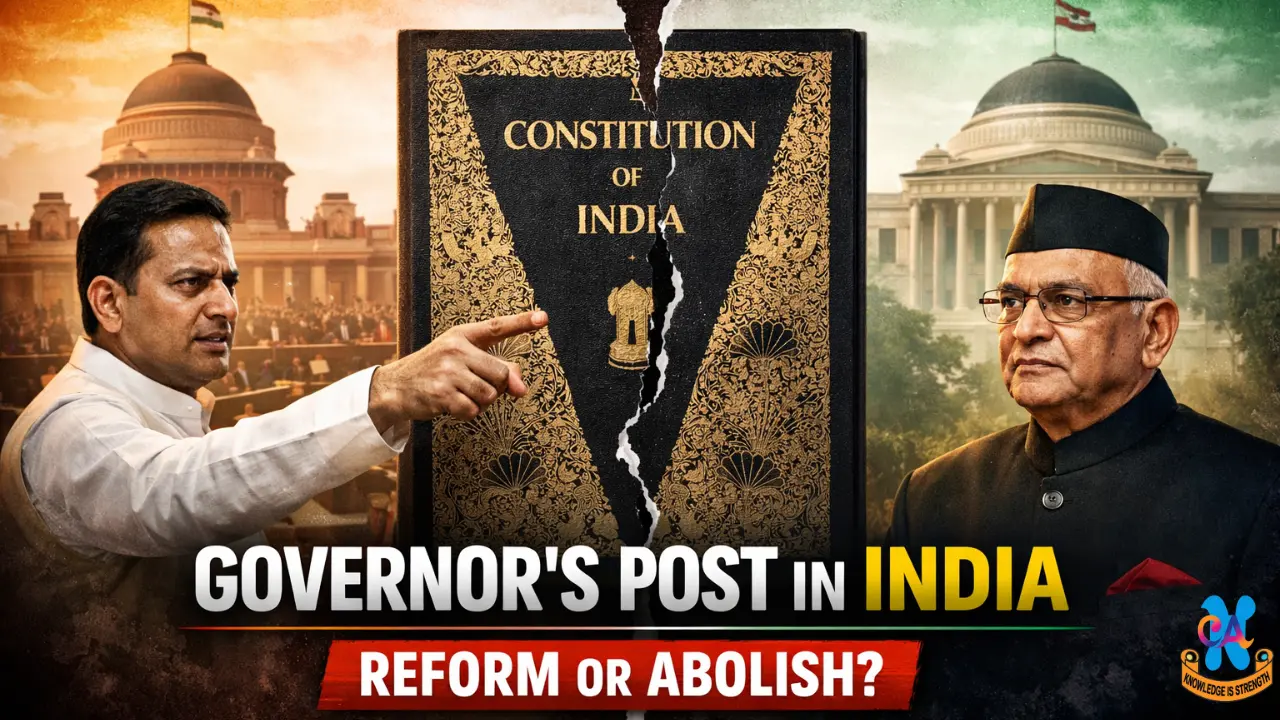

Governor’s Post in India: Should It Continue or Be Abolished? A Balanced Analysis for UPSC Aspirants
What is the Role of Governor in India?
The Governor serves as the constitutional head of a state in India, representing the President at the state level. Appointed by the President under Article 153 of the Constitution, the Governor acts as a vital link between the Union Government and State Governments in India’s federal structure.The debate around the Governor’s post in India has intensified in recent years due to recurring Centre–State conflicts.
This position has sparked intense debate in recent years, with several Chief Ministers and political parties questioning its relevance in modern India.
For aspirants preparing for UPSC, NDA, CDS, AFCAT, and CAPF examinations, understanding the Governor’s role and the ongoing controversy is essential for Polity and Current Affairs sections.
Constitutional Provisions: Understanding the Governor’s Position
Article 153: Appointment and Term
The Constitution mandates that every state shall have a Governor appointed by the President. The Governor holds office during the President’s pleasure, typically for a five-year term.
Key appointment provisions:
- President appoints the Governor based on advice of the Prime Minister
- No specific qualifications prescribed in the Constitution
- Must be a citizen of India and above 35 years of age
- Cannot be a member of Parliament or State Legislature during tenure
Article 154-162: Powers and Functions
The Governor exercises executive powers of the state, either directly or through officers subordinate to them.
Major constitutional powers:
- Executive powers: Appoints Chief Minister and Council of Ministers
- Legislative powers: Summons and prorogues state legislature, gives assent to bills
- Discretionary powers: Recommends President’s Rule, reserves bills for Presidential consideration
- Emergency powers: Reports breakdown of constitutional machinery to the President
This constitutional framework makes the Governor a powerful figure in state politics, which forms the crux of the current debate.
The Case FOR Retaining the Governor’s Post
Maintaining Federal Balance
The Governor serves as a constitutional link between the Centre and states, ensuring coordination in India’s federal structure.
Federal coordination benefits:
- Facilitates communication between Union and State governments
- Represents national interests at state level
- Ensures uniformity in constitutional functioning across states
- Acts as a check against potential state-level constitutional violations
During national emergencies or security threats, the Governor’s role becomes crucial in coordinating state response with central directives.
Constitutional Safeguard Against Instability
Governors play a stabilizing role during political crises in states.
Crisis management functions:
- Prevents hasty decisions during government formation
- Ensures proper floor tests to verify majority support
- Maintains constitutional continuity during transitions
- Protects against anti-constitutional actions by state governments
In hung assemblies or during defections, the Governor’s discretionary powers help maintain democratic processes.
Protecting Minority Interests
The Governor can safeguard interests of minorities, scheduled castes, scheduled tribes, and other marginalized groups.
Protective mechanisms:
- Nominates members to state legislative councils
- Ensures special provisions for tribal areas are implemented
- Can reserve bills affecting minority rights for Presidential consideration
- Acts as an appellate authority for mercy petitions
This protective role assumes significance in states with diverse populations and potential for majoritarian excesses.
Academic and Administrative Experience
Many Governors bring valuable experience from distinguished careers in civil service, military, judiciary, or academia.
Institutional benefits:
- Provides non-partisan advice to state governments
- Shares administrative best practices across states
- Mentors young political leadership
- Brings institutional memory to governance
Former bureaucrats, judges, and military officers serving as Governors often guide state administrations during complex challenges.
Symbol of Constitutional Unity
The Governor represents the unity and integrity of India across diverse states.
Symbolic importance:
- Embodies constitutional values at state level
- Represents the Republic in state functions
- Maintains ceremonial dignity of constitutional offices
- Reinforces India’s unity in diversity
This symbolic role strengthens national integration, particularly in border states and regions with distinct cultural identities.
For defence exams in India, particularly CAPF preparation, understanding these federal aspects is crucial for questions on internal security and Centre-State relations.
The Case AGAINST the Governor’s Post
Violation of Federal Principles
Critics argue that the Governor’s post undermines genuine federalism by allowing central interference in state affairs.
Federal concerns:
- Appointment by Centre creates inherent bias toward ruling party at Centre
- Governors often act as agents of the Union Government
- State governments lack say in Governor’s appointment or removal
- Violates principle of state autonomy in federal structure
Several constitutional experts believe this centralized appointment contradicts the federal spirit enshrined in the Constitution.
Political Misuse and Partisanship
The Governor’s office has been repeatedly accused of partisan behavior favoring the ruling party at the Centre.
Recent controversies:
- Delays in giving assent to bills passed by opposition-ruled states
- Premature dismissals of state governments without proper verification
- Inviting parties with fewer numbers to form government
- Arbitrary use of discretionary powers for political gains
These instances have eroded public trust in the neutrality of the Governor’s office.
Delays in Legislative Process
Governors sitting indefinitely on bills passed by state legislatures creates legislative paralysis.
Legislative impediments:
- Bills pending for months or years without decision
- State governments unable to implement their legislative agenda
- Democratic mandate of elected governments gets frustrated
- No constitutional time limit for Governor’s assent
Tamil Nadu, Kerala, Punjab, and other states have faced such situations where Governors delayed assent to politically sensitive bills.
Unnecessary Constitutional Office
Modern democratic systems can function effectively without appointed constitutional heads at state level.
Alternatives suggested:
- Elected Lieutenant Governors similar to US states
- Chief Minister as both constitutional and executive head
- Collective constitutional authority through state cabinet
- Speaker of Assembly performing ceremonial functions
Many successful federal democracies worldwide function without state-level appointed representatives of the central government.
Financial Burden
Maintaining Governor’s office involves substantial public expenditure.
Cost considerations:
- Governor’s salary, allowances, and pension
- Maintenance of Raj Bhavans (Governor’s residences)
- Security arrangements and protocol expenses
- Staff and administrative costs
Critics argue these resources could be better utilized for development programs and public welfare.
Conflict with Elected Governments
Frequent confrontations between Governors and Chief Ministers create governance paralysis.
Conflict areas:
- Governor bypassing state cabinet to communicate directly with Centre
- Refusing to act on advice of Council of Ministers
- Summoning Assembly sessions against government’s wishes
- Interfering in day-to-day administration
Such conflicts undermine the authority of democratically elected governments.
For NDA coaching in Chandigarh and CDS coaching in Chandigarh, these Centre-State relation issues form important topics for General Awareness preparation.
Major Controversies Involving Governors
Tamil Nadu Governor and Pending Bills
The Tamil Nadu Governor faced criticism for delaying assent to multiple bills passed by the state assembly, including bills related to NEET exemption and reservation policies.
The Supreme Court intervened, directing Governors to act on bills within reasonable timeframes.
Kerala Governor’s Disputes with State Government
Kerala witnessed prolonged confrontations between the Governor and the state government over university appointments, legislative bills, and administrative matters.
The Governor’s refusal to approve certain state decisions led to constitutional deadlock.
Maharashtra Government Formation (2019)
The Maharashtra Governor’s decisions during government formation after the 2019 assembly elections sparked intense debate about discretionary powers.
Questions were raised about the timing and manner of inviting parties to form the government.
West Bengal Governor vs. State Government
The West Bengal Governor’s frequent disagreements with the state government on various administrative and policy matters highlighted the potential for conflict in the current system.
These controversies demonstrate the practical challenges in the Governor’s system and fuel arguments for reform or abolition.
Supreme Court Observations on Governor’s Role
The judiciary has periodically intervened to clarify and limit the Governor’s powers.
Landmark Judgments
Nabam Rebia vs. Deputy Speaker (2016):
- Governor cannot dismiss a government without a floor test
- Governor’s satisfaction for invoking Article 356 must be based on objective material
Rameshwar Prasad vs. Union of India (2006):
- Governor’s report for President’s Rule must be factually accurate
- Courts can examine the Governor’s decision-making process
S.R. Bommai vs. Union of India (1994):
- Established that President’s Rule cannot be imposed arbitrarily
- Floor test is the ultimate proof of majority in a democracy
Shamsher Singh vs. State of Punjab (1974):
- Governor must act on the aid and advice of Council of Ministers
- Discretionary powers are limited to specific situations only
These judicial pronouncements have sought to balance the Governor’s constitutional position with democratic principles and federal autonomy.
International Comparisons: How Other Federal Systems Function
United States
US states have elected Governors who serve as both constitutional and executive heads, accountable to state electorate rather than federal government.
Australia
Australian states have Governors appointed by the British Crown (now effectively by the Australian federal government), but with minimal political role.
Germany
German states (Länder) have elected heads of government (Minister-Presidents) without separate appointed constitutional heads.
Canada
Canadian provinces have Lieutenant Governors appointed by the federal government, similar to India, but they rarely interfere in provincial affairs.
These international models provide alternative frameworks that India could consider if reforming the Governor’s system.
Reform Proposals: Middle Path Solutions
Several constitutional experts and political leaders have suggested reforms rather than complete abolition.
Time-Bound Decision Making
Proposed reforms:
- Constitutional amendment mandating Governor’s decision within specific timeframe (30-60 days)
- Automatic deemed assent if Governor doesn’t act within stipulated period
- Supreme Court jurisdiction for delayed decisions
This addresses the problem of indefinite delays without abolishing the office.
Collegium System for Appointment
Similar to judicial appointments, a collegium involving Centre, state government, and other stakeholders could select Governors.
Benefits:
- Reduces unilateral central control
- Ensures qualified and non-partisan appointments
- Gives states voice in selection process
- Maintains federal balance
Restriction of Discretionary Powers
Clearly define and limit situations where Governors can exercise discretion.
Specific limitations:
- Discretionary powers only in explicitly mentioned constitutional scenarios
- Mandatory consultation with Council of Ministers in most matters
- Judicial review of discretionary decisions
- Written reasons for all discretionary actions
Fixed Tenure with Limited Removal
Ensure Governors serve their full five-year term unless removed through impeachment-like process.
Security of tenure:
- Prevents arbitrary removal by incoming central governments
- Encourages independent functioning
- Requires parliamentary approval for premature removal
- Insulates from political pressures
Reduction in Protocol and Expenditure
Rationalize the Governor’s office to reduce costs while retaining constitutional functions.
Cost-cutting measures:
- Smaller Raj Bhavan establishments
- Reduced security and protocol expenses
- Shared facilities across states where feasible
- Focus on constitutional duties rather than ceremonial functions
These reforms could address many criticisms while preserving the constitutional framework.
What Do Political Parties Say?
Parties Supporting Retention
Bharatiya Janata Party (BJP):
- Supports Governor’s system as constitutional necessity
- Emphasizes role in maintaining national unity
- Views reforms as sufficient to address concerns
National parties generally:
- Support system when in power at Centre
- Recognize constitutional importance
- Oppose when in opposition to central government
Parties Seeking Abolition
Dravida Munnetra Kazhagam (DMK):
- Passed resolution in Tamil Nadu assembly for abolition
- Cites repeated conflicts with Governors
- Views it as colonial relic
Trinamool Congress:
- Criticized Governor’s interference in West Bengal
- Demands either abolition or substantial reform
- Highlights federal principle violations
Left parties:
- Historically critical of centrally appointed Governors
- Support greater state autonomy
- Advocate for elected heads of states
Regional parties generally:
- Opposition varies based on relationship with current Governor
- Demand reforms to prevent misuse
- Seek greater state role in appointment process
The political divide largely follows ruling versus opposition dynamics, with parties changing positions based on their status at Centre.
Constitutional Amendment: Is It Necessary?
Any change to the Governor’s system requires constitutional amendment under Article 368.
Amendment Requirements
Parliamentary process:
- Bill must pass both Houses with special majority (two-thirds of present members)
- Ratification by at least half the state legislatures required
- Presidential assent necessary
Practical challenges:
- Requires broad political consensus
- States must agree despite varying interests
- Ruling party needs substantial parliamentary majority
- Opposition parties must be convinced
The high threshold for constitutional amendments makes abolition or major reforms politically challenging.
Alternative Without Amendment
Some reforms can be implemented through conventions, executive orders, and guidelines without constitutional amendment.
Non-amendment changes:
- Executive instructions for time-bound decisions
- Guidelines for Governor’s conduct
- Consultation mechanisms with state governments
- Transparency in appointment process
However, fundamental structural changes require constitutional amendments.
Impact on Examination Preparation
For aspirants preparing for UPSC and defence examinations, this topic holds significant importance.
UPSC Civil Services Examination
Prelims relevance:
- Questions on constitutional provisions related to Governor
- Current affairs on recent controversies
- Polity questions on Centre-State relations
Mains application:
- Essay topics on federalism and governance
- GS Paper II questions on constitutional bodies
- Governance issues in state administration
Interview preparation:
- Understanding multiple perspectives
- Ability to present balanced arguments
- Awareness of recent developments
Defence Examinations (NDA, CDS, AFCAT, CAPF)
General Awareness sections:
- Constitutional knowledge about Governor’s powers
- Recent political developments
- Centre-State relations in federal structure
Current Affairs:
- Ongoing controversies involving Governors
- Supreme Court judgments on gubernatorial powers
- Political debates on federal structure
Quality coaching institutes offering NDA coaching in Chandigarh and CAPF preparation programs include comprehensive coverage of these constitutional topics.
Balanced Perspective: What Should Be Done?
Rather than absolute retention or abolition, a nuanced approach considering India’s unique federal structure seems appropriate.
Factors Supporting Retention with Reforms
Constitutional continuity:
- Avoiding disruption to established constitutional framework
- Maintaining federal coordination mechanisms
- Preserving checks and balances in governance
Practical considerations:
- Political consensus for abolition difficult to achieve
- Risk of unintended consequences from drastic changes
- Learning from international experiences
Essential Reforms Needed
Immediate measures:
- Time-bound decision-making on bills and files
- Transparent appointment process involving states
- Clear guidelines limiting discretionary powers
- Accountability mechanisms for gubernatorial actions
Long-term changes:
- Fixed tenure with security from arbitrary removal
- Reduced expenditure and protocol
- Periodic review of Governor’s performance
- Constitutional conventions developed through practice
Role of Judiciary and Legislature
Judicial activism:
- Supreme Court should continue monitoring gubernatorial actions
- Public Interest Litigations on delays and partisan behavior
- Clear jurisprudence on limits of discretionary powers
Legislative action:
- Parliament should consider reformative amendments
- State legislatures should pass resolutions suggesting reforms
- Inter-State Council should discuss federal issues
The goal should be strengthening federalism while maintaining constitutional unity—a balance India has always sought to achieve.
Conclusion: Finding the Constitutional Balance
The debate over the Governor’s post reflects deeper questions about India’s federal structure, democracy, and constitutional governance.
Complete abolition risks disrupting constitutional continuity and removing important federal safeguards. However, status quo perpetuates partisan misuse and undermines state autonomy.
The way forward involves:
- Implementing time-bound reforms to prevent delays
- Making appointments more transparent and consultative
- Clearly defining and limiting discretionary powers
- Developing constitutional conventions through consistent practice
- Maintaining judicial oversight of gubernatorial actions
For students preparing for defence exams in India, understanding these nuances demonstrates constitutional maturity and analytical thinking—qualities valued in both written examinations and interviews.
The Governor’s office can serve constitutional purposes if reformed to prevent political misuse while respecting the democratic mandate of elected state governments. This balanced approach honors India’s federal spirit while maintaining constitutional unity.
FAQs on Governor’s Post in India
Q1: What are the main powers of a Governor in India?
The Governor exercises executive, legislative, and discretionary powers in a state. Executive powers include appointing the Chief Minister and Council of Ministers. Legislative powers involve summoning assemblies, giving assent to bills, and promulgating ordinances. Discretionary powers include recommending President’s Rule and reserving bills for Presidential consideration. These powers are defined under Articles 153-162 of the Indian Constitution.
Q2: Why do some states want to abolish the Governor’s post?
States demand abolition due to partisan behavior of Governors favoring the ruling party at the Centre, indefinite delays in giving assent to state bills, arbitrary use of discretionary powers, and interference in state administration. States like Tamil Nadu, Kerala, and West Bengal have experienced frequent conflicts with Governors, leading to governance paralysis and violation of federal principles guaranteed in the Constitution.
Q3: How is the Governor’s post relevant for UPSC and defence exams?
The Governor’s role appears in UPSC Prelims and Mains Polity sections, covering constitutional provisions, powers, and Centre-State relations. Defence examinations like NDA, CDS, AFCAT, and CAPF test knowledge of constitutional bodies and current affairs involving Governors. Recent controversies, Supreme Court judgments, and reform proposals form important topics for General Awareness preparation in NDA coaching in Chandigarh and other institutes.
Q4: What reforms are suggested for the Governor’s system in India?
Key reforms include mandatory time-bound decisions on bills (30-60 days), collegium-based appointment involving states, clearly defined discretionary powers with judicial review, fixed five-year tenure with security from arbitrary removal, and reduced protocol expenditure. These reforms aim to prevent political misuse while retaining the constitutional office, balancing federal autonomy with national unity without requiring complete abolition.
Q5: How does India’s Governor system compare with other federal countries?
Unlike India’s appointed Governors, the United States has elected Governors accountable to state electorates. Germany has elected Minister-Presidents without separate constitutional heads. Australia and Canada have appointed Governors/Lieutenant Governors similar to India but with minimal political interference. India’s system faces more controversies due to partisan use of discretionary powers, making it unique among federal democracies worldwide.

Written by
Capt. Dhaliwal · Director, New Careers Academy
Ex-Indian Army officer and SSB mentor at NCA Academy, Chandigarh (est. 1967), coaching NDA, CDS, AFCAT and SSB aspirants since the 1980s. About the author →
Reviewed by Hartaj Dhaliwal — SSB Strategist, NCA · third-generation officer · recommended by the SSB three times.